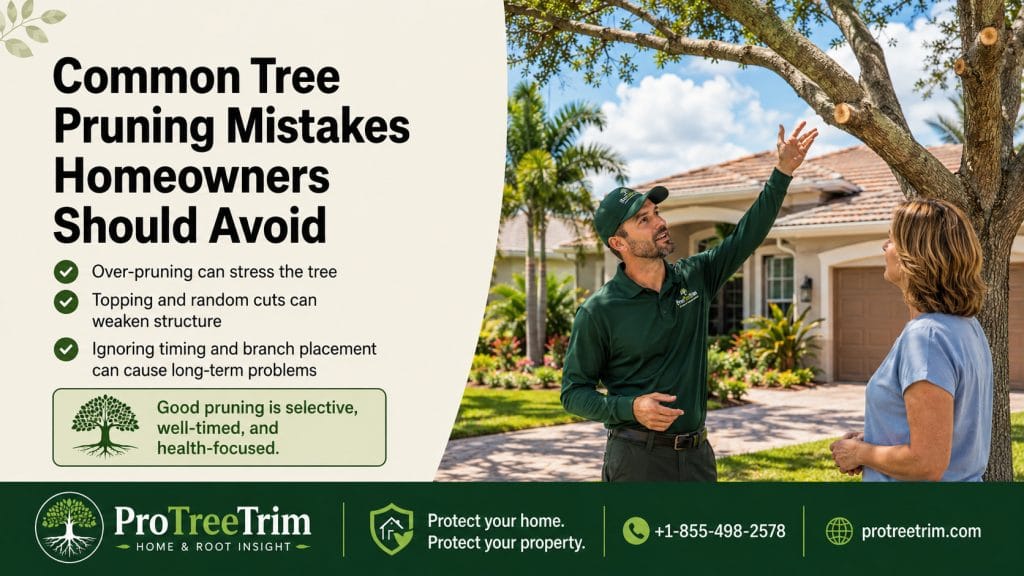
Tree pruning can improve safety, structure, clearance, and appearance when it is done carefully. Bad pruning can do the opposite. It can weaken branches, create large wounds, remove too much live canopy, stress palms, expose bark, damage trunks, and make future tree problems more expensive.
The biggest pruning mistake is simple: cutting before knowing why the cut is being made.
Mistake 1: Topping the Tree
Topping is one of the most damaging pruning mistakes. It means cutting the top or major limbs back to stubs to make the tree shorter. Homeowners sometimes request this because a tree feels too tall, too messy, or too close to the house.
Topping may create quick regrowth, but that regrowth is often weak, crowded, and poorly attached.
Topping can lead to:
- large wounds
- weak sprouts
- decay points
- ugly regrowth
- long-term structural problems
- more frequent future pruning
- reduced tree value
- higher future removal risk
A tree that is too large for its location may need selective reduction, clearance pruning, or in some cases removal and replacement. It should not be topped.
Mistake 2: Removing Too Much Live Canopy
A tree’s leaves are its energy system. Removing too much live canopy can stress the tree, especially during heat, drought, flooding, pest pressure, root damage, or recovery after storms.
Over-pruning often happens when homeowners ask for the tree to be “thinned out a lot” or “cut way back.”
| Over-pruning sign | Why it matters |
|---|---|
| Canopy looks thin and see-through | Too much leaf area may be gone |
| Large bare limbs remain | Natural structure may be weakened |
| Tree looks shocked after pruning | Cuts may have been excessive |
| Many sprouts appear later | Tree may be reacting to stress |
| Shade disappears suddenly | Bark and roots may face more heat |
| Tree needs cutting again quickly | Weak regrowth cycle may begin |
Good pruning usually looks natural. The tree should not look stripped.
Mistake 3: Lion-Tailing Branches
Lion-tailing happens when too many interior branches are removed, leaving foliage only at the ends of long limbs. This is often done under the mistaken idea that wind will pass through the tree more safely.
In reality, lion-tailing can leave branches long, bare, and end-heavy.
Lion-tailing may:
- remove useful interior structure
- increase weight at branch ends
- expose limbs to sun
- encourage weak regrowth
- make the tree look unnatural
- reduce the tree’s natural canopy balance
Crown thinning should be selective and limited. It should not empty out the inside of the tree.
Mistake 4: Making Flush Cuts
A flush cut removes a branch too close to the trunk or parent limb. It cuts into the branch collar, which is the area the tree uses to close over the wound.
Flush cuts can make wounds larger and slower to close.
A proper cut should not leave a long stub, but it also should not cut into the trunk. The cut should respect the natural branch collar.
Bad flush cuts are especially risky on:
- mature shade trees
- large oaks
- maples
- trees already stressed
- branches near the main trunk
- trees with decay or canker issues
A clean cut in the wrong place is still a bad cut.
Mistake 5: Leaving Long Stubs
The opposite mistake is leaving a long stub. A stub usually dies back and may decay before the tree can close the wound properly. It can also create weak shoots and an unattractive shape.
Long stubs often happen when someone is afraid to cut close enough or does not understand where the branch collar is.
A good pruning cut should remove the branch without leaving unnecessary dead wood behind.
Mistake 6: Cutting Large Healthy Limbs Without a Clear Reason
Large cuts create large wounds. Removing a major healthy limb should not be casual. Sometimes it is necessary, especially when a limb is cracked, dead, storm-damaged, or damaging a structure. But cutting large healthy limbs just for appearance can create long-term problems.
Before removing a large limb, ask:
- Is it dead or broken?
- Is it cracked or weak?
- Is it touching a roof or structure?
- Is there a smaller cut that solves the problem?
- Will removing it unbalance the tree?
- Is the tree already stressed?
- Is this cut worth the wound it creates?
Large limb removal should always have a clear purpose.
Mistake 7: Pruning Only Because the Tree Looks Big
A big tree is not automatically a problem. Many mature trees are supposed to be large. Cutting a tree just because it looks tall or wide can damage its structure and health.
The better question is whether the tree is creating a real conflict:
- dead limbs over a driveway
- branches touching rooflines
- limbs blocking walkways
- storm-damaged branches
- weak branch unions
- trunk cracks
- root or stability concerns
- branches near utility lines
If the tree is healthy, structurally sound, and has enough space, size alone is not a pruning problem.
Mistake 8: Pruning at the Wrong Time for the Goal
Trees can be pruned in different seasons for different reasons, but timing still matters. Dead, broken, or hazardous branches may need removal whenever they create risk. Cosmetic or heavy pruning may be better timed more carefully.
Poor timing can matter when:
| Timing issue | Why it matters |
|---|---|
| Heavy summer pruning | Can stress trees during heat |
| Pruning flowering trees before bloom | May remove flowers |
| Cutting stressed trees too soon | May reduce recovery ability |
| Pruning during storm cleanup panic | Can lead to excessive cutting |
| Trimming palms before understanding health | May remove needed fronds |
| Cutting after root damage | Tree may already be under stress |
The right season depends on the tree, the cut, and the reason.
Mistake 9: Pruning a Stressed Tree Too Hard
A stressed tree may already have fewer resources. If it is dealing with drought, poor drainage, transplant shock, root damage, pests, disease, or construction injury, heavy pruning can make recovery harder.
Be careful when a tree has:
- brown leaf edges
- early leaf drop
- thinning canopy
- recent trenching nearby
- damaged roots
- standing water
- trunk wounds
- pest activity
- storm damage
- recent transplanting
A stressed tree may need deadwood removed, but it usually does not need aggressive live-branch removal.
Mistake 10: Removing Green Palm Fronds Too Aggressively
Palm pruning is one of the most common places homeowners see bad cuts. A palm should not be stripped of healthy green fronds just to look tidy or “storm ready.”
Healthy green fronds help the palm produce energy. Removing too many can stress the palm and leave it with a thin, unnatural crown.
Good palm trimming removes:
- fully dead fronds
- broken fronds
- hazardous hanging fronds
- seed pods when they create mess or risk
- fronds touching roofs or pool cages
Bad palm trimming removes healthy green fronds until only a small tuft remains.
Mistake 11: Hurricane-Cutting Palms
A hurricane cut removes too many palm fronds, often leaving the palm looking like a narrow spike or feather duster. It is usually done with the idea that fewer fronds means less storm resistance.
That logic can backfire. A palm needs a healthy crown. Stripping it before storm season is not good preparation.
Better storm preparation for palms means:
- remove dead fronds
- remove broken fronds
- remove heavy seed pods where needed
- clear fronds from roofs and pool cages
- check leaning or trunk concerns
- preserve healthy green fronds
A palm should be cleaned, not scalped.
Mistake 12: Sealing Every Pruning Cut
Most pruning cuts do not need wound paint, tar, caulk, glue, or sealer. Trees seal wounds naturally when cuts are made properly.
Sealing can trap moisture, hide decay, and create false confidence. It is usually better to focus on making the cut correctly in the first place.
Do not routinely seal:
- normal branch pruning cuts
- palm trimming cuts
- trunk cracks
- cankers
- storm tears
- cavities
- large wounds without evaluation
If a cut looks concerning, the issue is usually the cut quality, wound size, or tree condition—not the lack of paint.
Mistake 13: Cutting Branches Near Power Lines
Tree work near power lines is not normal pruning. It is a serious safety issue. Homeowners should not use ladders, pole saws, ropes, or hand tools near energized lines.
Do not:
- cut branches touching wires
- pull limbs off wires
- climb trees near lines
- use metal tools near service lines
- stand under storm-damaged branches near wires
- assume insulated-looking lines are safe
If utility lines are involved, contact the proper utility or qualified help.
Mistake 14: Using Dull or Wrong Tools
Bad tools create bad cuts. Dull saws, weak pruners, and improper tools can crush branches, tear bark, and leave ragged wounds.
Tool mistakes include:
- tearing bark under a branch
- crushing small limbs
- using hedge shears on tree branches
- using chainsaws for small precision cuts
- cutting branches too heavy to control
- making one cut on a large limb without a relief cut
- using unsafe ladders
Clean, controlled cuts matter.
Mistake 15: Cutting Too Close to the Trunk With Lawn Equipment Damage Already Present
Some trees already have trunk wounds from mowers, string trimmers, deer rubbing, or old pruning damage. Pruning without noticing those wounds may add stress to an already weakened tree.
Before pruning, check the trunk base.
Look for:
- bark missing near the ground
- mower scrapes
- string-trimmer cuts
- mulch against the trunk
- root flare buried
- mushrooms near the base
- cracks or cankers
- oozing or soft wood
Tree care should include the trunk and root zone, not just the canopy.
Mistake 16: Ignoring the Root Problem
A canopy problem may start underground. If leaves are browning, branches are dying back, or the tree looks thin, pruning may not solve the real issue.
Root-related stress can come from:
- construction
- trenching
- paver installation
- driveway work
- compacted soil
- standing water
- buried root flare
- too much mulch
- root cutting
- poor drainage
Cutting branches will not fix damaged roots. Sometimes the tree needs site correction, monitoring, or risk evaluation instead of more pruning.
Mistake 17: Pruning to Fix a Tree That Should Be Removed
Some trees are too damaged, too decayed, too unstable, or too poorly placed to be fixed by pruning. Repeated trimming may delay the real decision while risk increases.
Removal may need discussion when a tree has:
- severe trunk split
- major decay
- large dead canopy
- root failure
- new lean
- repeated large limb drop
- major storm damage
- dead top
- severe structural defects
- serious conflict with structures or utilities
Pruning can reduce some risks. It cannot make every unsafe tree safe.
Mistake 18: Hiring Based Only on the Lowest Price
Tree work is skilled work. A low price can become expensive if the tree is topped, over-thinned, damaged, or left with poor structure.
Before hiring, ask:
| Question | Why it matters |
|---|---|
| What exactly will be removed? | Prevents vague over-cutting |
| Will the tree be topped? | Topping should be avoided |
| How much live canopy will be removed? | Helps avoid over-pruning |
| Are dead limbs included? | Clarifies risk work |
| Will roof clearance be selective? | Protects tree shape |
| Will debris be hauled away? | Avoids unfinished cleanup |
| Are utility lines involved? | Safety concern |
| Is removal a better option? | Avoids wasting money on the wrong work |
A good scope should sound specific.
Mistake 19: Not Taking Before Photos
Before major pruning, take photos. Photos help document tree condition, storm damage, roof contact, dead branches, and finished work.
This is useful for:
- insurance documentation
- rental properties
- home sale preparation
- storm cleanup records
- comparing canopy before and after
- confirming what was agreed
- tracking whether a tree declines later
Photos protect both the homeowner and the decision-making process.
Mistake 20: Expecting Pruning to Stop All Leaves, Acorns, Fruit, or Debris
Trees naturally drop leaves, seeds, flowers, fruit, twigs, cones, bark, and fronds. Pruning may reduce some specific conflicts, but it will not eliminate normal tree debris.
Do not over-prune just to reduce:
- leaf drop
- acorns
- seed pods
- pine needles
- palm debris
- flowers
- small twigs
- seasonal cleanup
If the debris is unacceptable for the location, the real issue may be tree placement, not pruning frequency.
What Good Pruning Should Accomplish
Good pruning should be specific, restrained, and purposeful.
It may:
- remove deadwood
- clear roof contact
- improve driveway or walkway clearance
- reduce rubbing branches
- remove broken storm limbs
- guide young tree structure
- improve branch spacing
- reduce selected risk points
- preserve natural shape
It should not leave the tree topped, gutted, scalped, or unbalanced.
Final Homeowner Takeaway
Most pruning mistakes happen when branches are cut without a clear reason. Topping, over-thinning, flush cuts, long stubs, unnecessary large limb removal, palm hurricane cuts, wound sealing, and unsafe utility pruning can all create bigger problems later.
Good pruning starts with a question: What problem are we solving?
If the answer is deadwood, clearance, storm damage, structure, or safety, pruning may help. If the answer is only “make it smaller” or “cut it way back,” slow down.
If you are unsure whether your tree needs pruning, trimming, crown work, palm cleanup, or removal instead, ProTreeTrim can help connect homeowners with local tree service support. Call +1-855-498-2578 or visit protreetrim.com.
FAQs
What is the worst tree pruning mistake?
Topping is one of the worst mistakes because it creates large wounds, weak regrowth, and long-term structural problems.
Can pruning too much hurt a tree?
Yes. Removing too much live canopy can stress the tree, reduce energy production, and create weak regrowth.
Should pruning cuts be sealed?
Usually no. Proper cuts are normally left uncovered so the tree can seal the wound naturally.
Is it bad to remove green palm fronds?
Removing too many healthy green palm fronds can stress the palm. Palm trimming should focus on dead, broken, hazardous, or messy material.
ProTreeTrim™ can help you take the next step.
If you are dealing with a damaged tree, fallen branch, stump, root issue, palm concern, or storm cleanup question in Florida, call ProTreeTrim for tree service support.