
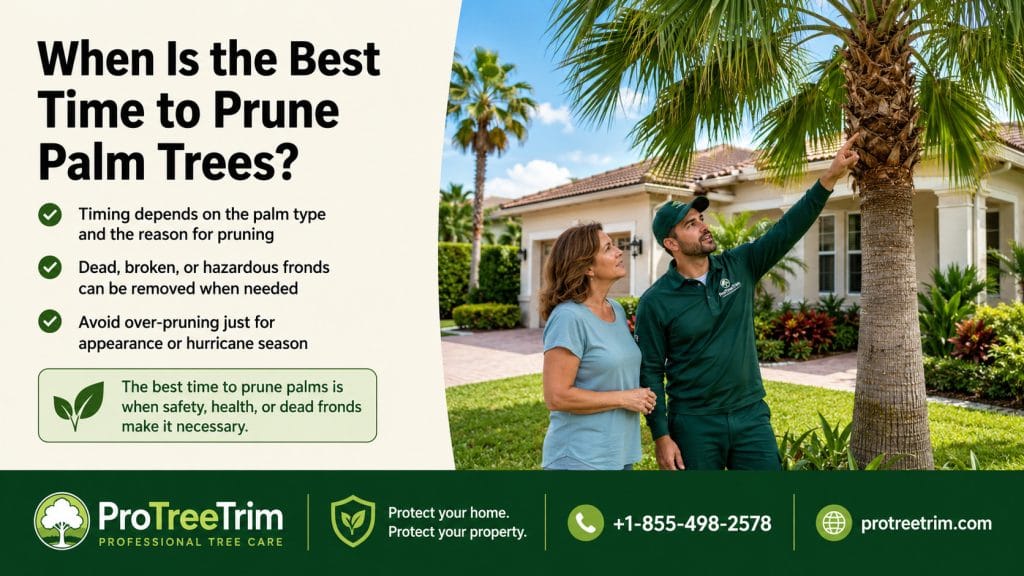
The best time to prune palm trees is when there is a clear reason to prune: dead fronds, broken fronds, seed pods, roofline contact, pool cage contact, driveway hazards, or storm-damaged material. Palm pruning should not be done simply because the crown looks full or because storm season is approaching. A healthy palm needs its green fronds.
Palm Pruning Is Different From Shade Tree Pruning
Palm trees do not branch like oaks, maples, pines, or other shade trees. A palm’s growing point is in the crown. That means careless trimming can affect the palm’s future growth and appearance.
With palms, pruning is usually about removing:
- fully dead fronds
- broken or hanging fronds
- fronds touching structures
- seed pods or fruit clusters causing mess
- storm-damaged material
- fronds blocking walkways, driveways, or pool areas
It is not about thinning the crown heavily or shaping the palm like a hedge.
Do Not Wait Too Long on Dangerous Fronds
If a dead or broken palm frond is hanging over a driveway, walkway, patio, pool cage, roof, or front entry, timing becomes practical. You do not need to wait for a “perfect season” when the frond could fall where people walk, park, or gather.
| Situation | Better timing |
|---|---|
| Dead frond over open lawn | Less urgent |
| Dead frond over walkway | Handle sooner |
| Frond resting on pool cage | Handle before screen damage worsens |
| Seed pod over driveway | Remove before fruit or seeds drop |
| Frond touching roofline | Clear before debris builds up |
| Broken storm frond | Remove when safe |
| Green healthy fronds | Usually leave them alone |
Palm pruning should be based on condition and location, not only the calendar.
Before Storm Season Is a Good Time to Inspect, Not Over-Cut
Many homeowners think palms should be cut hard before hurricane season. That can backfire. A severe “hurricane cut” removes too many green fronds and leaves the palm with a thin, unnatural crown.
Before storm season, the smart move is inspection and selective cleanup.
A good pre-storm palm check may include:
- removing dead fronds
- removing broken hanging fronds
- removing heavy seed pods over high-use areas
- clearing fronds touching roofs or pool cages
- checking for leaning or trunk concerns
- avoiding removal of healthy green fronds
- checking whether the crown looks full and firm
The goal is not to strip the palm. The goal is to remove obvious loose or dead material.
Fully Dead Fronds Can Usually Be Removed Anytime
A fully brown, dry, dead frond is no longer helping the palm much. If it is hanging, unattractive, or in a bad location, it can usually be removed as routine maintenance.
This is different from cutting a partly green frond. Partly green fronds may still be contributing energy to the palm, especially if the palm is stressed, newly planted, or recovering from over-pruning.
A safer trimming mindset:
- remove fully dead fronds
- remove broken fronds
- remove hazardous hanging fronds
- preserve green fronds
- avoid cutting into the crown
- avoid shaving the trunk aggressively
- avoid damaging palm boots if they are tight
A palm should look clean, but still natural.
Seed Pods Can Set the Maintenance Schedule
For many homeowners, seed pods and fruit clusters are the real reason to schedule palm trimming. They can drop seeds, fruit, sticky debris, or staining material onto driveways, pool decks, patios, roofs, and walkways.
If a palm produces messy pods every year, pruning before they drop can reduce cleanup.
This is especially useful when pods hang over:
- pool water
- pool cages
- pavers
- driveways
- front entries
- outdoor furniture
- walkways
- gutters
- neighbor-facing areas
Seed pod removal can often be combined with dead frond removal in the same visit.
Palms Near Pool Cages Need Practical Timing
A palm near a pool enclosure may need more regular attention than one in open lawn. Fronds can rest on screen panels, seed pods can collect on the cage, and falling material can damage or stain the pool area.
The best time to prune these palms is usually before debris becomes a problem, not after screens are already loaded with fronds and pods.
Look for:
| Pool-area clue | Why trimming may be needed |
|---|---|
| Fronds touching screen panels | Can tear or stress screens |
| Seed pods over cage | Debris may collect on top |
| Dead fronds above pool deck | Falling material concern |
| Palm debris in skimmer | Cleanup schedule may need adjusting |
| Fronds rubbing frame | Clearance may be needed |
| Palm too close to enclosure | Long-term placement issue may exist |
Pool-area palms should be maintained cleanly, not aggressively.
Avoid Trimming Too Often
Frequent palm trimming can become a problem if each visit removes green fronds. A palm that is pruned too often may never keep a full crown. It may look thin, stressed, or scalped.
More frequent visits are reasonable only if the work is light and focused on dead material, seed pods, or structure contact. Frequent removal of healthy fronds is not good maintenance.
A palm does not need to look freshly trimmed all the time. It needs enough healthy canopy to function.
Newly Planted Palms Need Caution
A newly planted palm may already be under stress from transplanting, root disturbance, watering changes, wind exposure, or planting depth issues. Heavy pruning soon after planting can add stress.
If a new palm has a few older fronds declining, do not rush to strip it. Remove only fully dead, broken, or hazardous fronds. Watch the center growth and the overall crown.
For a newly planted palm, focus first on:
- correct planting depth
- stable watering
- good drainage
- trunk base visibility
- proper staking if needed
- avoiding mower or trimmer damage
- avoiding over-pruning
- monitoring new growth
A new palm needs establishment more than cosmetic trimming.
Do Not Prune Green Fronds Just Because They Point Down
Some palm fronds naturally arch downward. That does not automatically mean they should be cut. Removing every downward frond can lead to over-pruning.
A green frond should usually stay unless it is broken, severely damaged, creating a safety issue, or directly interfering with a structure.
Be cautious if a palm crew recommends removing most fronds below a certain angle without explaining why. The result may be a thin crown and a palm that looks “hurricane cut.”
Weather Damage May Change the Timing
After storms, wind, cold, or heavy rain, palms may show broken fronds, browning, or hanging material. Fully broken or hazardous fronds can be removed once it is safe.
But if the palm is weather-stressed and many fronds are partly damaged, avoid removing too much too quickly. Some damaged-looking fronds may still be contributing energy while the palm recovers.
After weather damage, check:
- whether the center spear is healthy
- whether the crown is firm
- whether fronds are broken or only discolored
- whether the palm is leaning
- whether roots are exposed
- whether trunk wounds appeared
- whether fronds are over rooflines or walkways
Storm cleanup should be safe, selective, and careful.
When Pruning Should Wait
Pruning may be better delayed when the palm is already stressed and the fronds are not hazardous.
Wait or be conservative when:
- the palm was recently over-pruned
- the palm is newly planted
- fronds are only partly yellow or brown
- the cause of decline is unclear
- the center crown is being evaluated
- the palm has too few green fronds left
- drought, flooding, or root damage recently happened
- trimming would leave the crown thin
If the palm has enough green fronds and no safety issue, patience may be better than another cut.
When Pruning Should Not Wait
Pruning should be handled sooner when dead or broken material threatens property or safety.
Do not ignore:
- dead fronds over a walkway
- broken fronds over a driveway
- fronds resting on a roof
- palm material touching a pool cage
- seed pods dropping on pavers
- fronds near service lines
- storm-damaged hanging material
- dead fronds over outdoor seating
A dead frond can be normal and still worth removing because of where it may fall.
Tall Palms Are Not DIY Work
Tall palm pruning can be dangerous. Heavy fronds fall unpredictably. Ladders can shift. Pole saws can be hard to control. Work near roofs, pool cages, driveways, and utility lines adds risk.
Homeowners should avoid DIY palm pruning when:
- the palm is tall
- fronds are heavy
- work requires a ladder
- fronds are over a roof or pool cage
- utility lines are nearby
- seed pods are large and high
- the palm is leaning
- the crown looks damaged
Small reachable cleanup is one thing. Tall palm work is different.
What a Good Palm Pruning Scope Sounds Like
A good palm pruning plan should be specific.
Better scope:
- remove fully dead fronds
- remove broken fronds over driveway
- remove seed pods over pool deck
- clear fronds touching pool cage
- preserve healthy green crown
- haul debris away
Poor scope:
- cut it way back
- remove all lower green fronds
- shave the trunk aggressively
- hurricane-cut the palm
- clean it until only a small top remains
A good crew should explain what they are removing and why.
Final Homeowner Takeaway
The best time to prune palm trees is when pruning has a clear purpose: dead fronds, broken fronds, seed pods, roof contact, pool cage contact, storm damage, or safety concerns. Fully dead fronds can usually be removed as needed. Healthy green fronds should be preserved.
Before storm season, inspect and clean up selectively. Do not hurricane-cut palms just because storms may come. A healthy palm should look maintained, not stripped.
If you are unsure whether your palm needs pruning now, should wait, or is showing signs beyond routine frond aging, ProTreeTrim can help connect homeowners with local tree service support. Call +1-855-498-2578 or visit protreetrim.com.
FAQs
When is the best time to prune palm trees?
The best time is when there are fully dead fronds, broken fronds, seed pods, structure contact, or safety concerns. Routine palm pruning should be selective.
Should palms be pruned before hurricane season?
They can be inspected and cleaned up before storm season, but they should not be hurricane-cut or stripped of healthy green fronds.
Can you prune palm trees too often?
Yes. Frequent trimming that removes green fronds can stress the palm and leave the crown too thin.
Is it okay to remove palm seed pods while pruning?
Yes, especially when pods hang over pools, driveways, patios, walkways, rooflines, or areas where dropped fruit and seeds create cleanup problems.
ProTreeTrim™ can help you take the next step.
If you are dealing with a damaged tree, fallen branch, stump, root issue, palm concern, or storm cleanup question in Florida, call ProTreeTrim for tree service support.