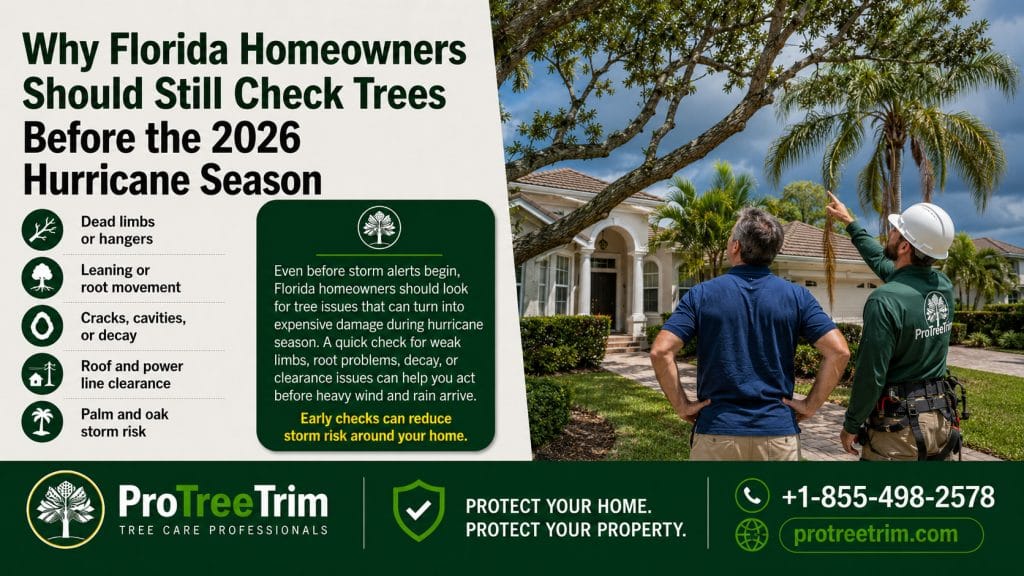
The 2026 Atlantic hurricane season is not currently forecast to be a record-breaking season, but Florida homeowners should not treat that as permission to ignore yard trees. NOAA’s outlook points to below-normal activity, yet forecasts do not say where storms will go. One local storm, heavy rain band, or wind event can still expose a weak tree.
A “Quieter” Forecast Does Not Protect One Yard
NOAA’s 2026 Atlantic outlook calls for a 55% chance of a below-normal season, with 8 to 14 named storms, 3 to 6 hurricanes, and 1 to 3 major hurricanes forecast. The Atlantic hurricane season runs from June 1 through November 30.
Colorado State University’s April 2026 forecast also expects somewhat below-normal Atlantic activity, partly because El Niño conditions may increase vertical wind shear over the tropical Atlantic. But CSU still reminds coastal residents that it only takes one hurricane making landfall to make it an active season for them.
For Florida homeowners, that is the practical point. A seasonal forecast is not a yard inspection. It does not know whether your live oak has a cracked limb over the driveway, whether a palm is leaning toward the roof, or whether sandy soil has softened around roots after repeated rain.
| What the forecast can tell you | What it cannot tell you |
|---|---|
| Expected basin-wide storm activity | Whether your tree is stable |
| Possible named storm count | Whether a limb over your roof is safe |
| General climate patterns | Whether your soil or roots are shifting |
| Seasonal preparedness timing | Whether your pool cage, fence, or driveway is exposed |
| Overall hurricane probability | Whether one local storm could damage your yard |
What to Check Before Storm Talk Turns Into a Warning
Start with trees closest to the house, driveway, pool cage, fence, septic area, and neighbor’s property. Look for large limbs hanging over structures, trunk cracks, mushrooms near the base, exposed roots, lifted soil, or a new lean after rain.
Palms need their own look. Dead fronds, heavy seed pods, a crown leaning over a roofline, or repeated debris landing on a pool enclosure can become more than a cleanup issue once wind arrives.
Also check access. If a tree falls, can a crew reach it without crossing fragile pavers, irrigation, soft lawn, or a narrow side gate? A tree problem is harder to solve after the yard is already wet, blocked, or damaged.
Do not use scary hurricane headlines as the only reason to remove a tree. Use the season as a reminder to inspect what is already showing signs of risk. Take photos now, before storms are named, and keep them with any tree service records, HOA notes, or insurance documentation.
If you are unsure whether a tree, palm, stump, or root issue should be checked before the 2026 hurricane season, ProTreeTrim can help connect Florida homeowners with local tree service support. Call +1-855-498-2578 or visit protreetrim.com.
FAQs
Does a below-normal hurricane forecast mean my trees are safe?
No. A seasonal forecast does not evaluate individual trees, roots, limbs, soil, or structures on your property.
Should I remove trees just because hurricane season is coming?
Not automatically. Focus on visible risks: new lean, lifted roots, split trunks, large hanging limbs, decay, or trees too close to structures.
When should I check trees before hurricane season?
Before storms are active. It is easier to inspect, document, schedule work, and clear access before heavy rain and wind are already in the forecast.
ProTreeTrim™ can help you take the next step.
If you are dealing with a damaged tree, fallen branch, stump, root issue, palm concern, or storm cleanup question in Florida, call ProTreeTrim for tree service support.