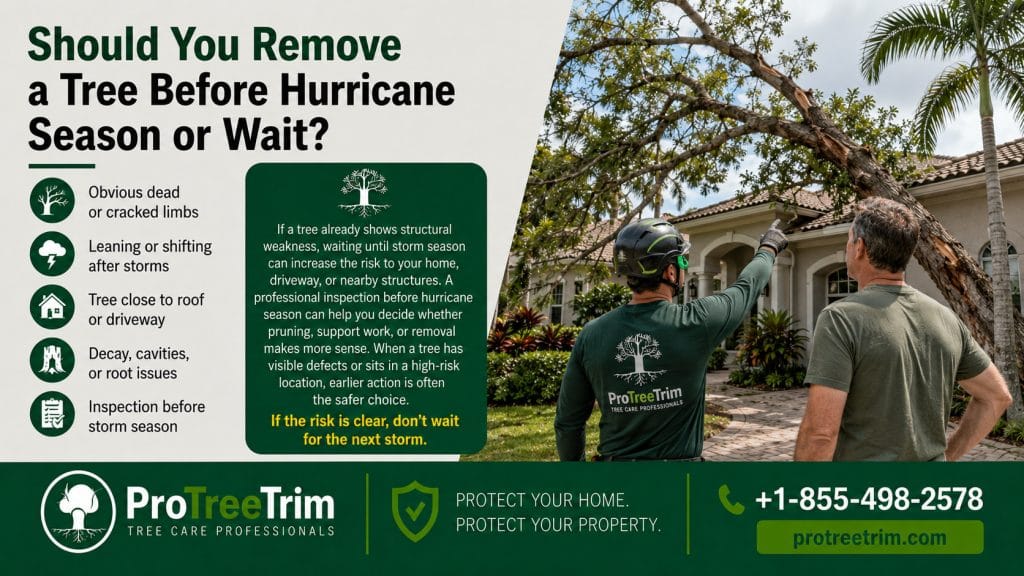
Not every tree should be removed before hurricane season, but waiting can be risky if the tree already shows structural problems. Florida homeowners should look at the tree’s lean, roots, trunk, limbs, location, and recent changes before deciding. The right question is not “Is the tree big?” It is “What could fail, and what would it hit?”
When Waiting May Be Reasonable
The Atlantic hurricane season officially runs from June 1 through November 30, according to the National Hurricane Center. That gives Florida homeowners a clear window to review trees before storms become a practical concern.
Waiting may be reasonable if the tree appears stable, has no large dead or hanging limbs, shows no new lean, and is not positioned over a roof, driveway, pool cage, fence, septic area, or neighbor’s property. A mature shade tree in the open part of the yard may need pruning, monitoring, or a professional opinion rather than immediate removal.
The same is true for some palms. A palm that is upright, maintained, and not dropping heavy fronds near the roofline may not need removal just because storm season is approaching. Routine trimming and cleanup may be enough, depending on the tree and site.
| What you see | Removal before hurricane season? | Better next step |
|---|---|---|
| Stable tree in open yard | Not automatically | Monitor and maintain |
| Small dead branches | Usually no | Schedule pruning or cleanup |
| Large limb over roof or pool cage | Possibly | Get it assessed soon |
| New lean after rain or wind | More concerning | Do not wait too long |
| Split trunk or lifted roots | Often urgent | Seek professional help |
| Tree touching power lines | Do not handle yourself | Contact utility or qualified help |
When Waiting Can Become the Expensive Choice
A tree deserves faster attention if it has a split trunk, fresh root movement, exposed or torn roots, a new lean, large hanging limbs, or decay near the base. Green leaves do not cancel out those concerns. A tree can look alive and still have structural issues.
Location matters just as much as condition. A questionable tree over an empty back corner is different from one over a bedroom, screened pool enclosure, driveway, parked vehicle area, or main entrance. In tighter Florida yards, a falling limb may damage several things at once: pavers, fences, gutters, irrigation, landscaping, and outdoor furniture.
Before deciding, take clear photos from the ground. Include the full tree, the trunk base, root area, canopy, and nearby structures. NOAA’s preparedness guidance encourages people to prepare before hurricane season, including documenting property and reviewing insurance needs. Tree photos can fit naturally into that preparation.
If you are unsure whether a tree, palm, stump, or root issue should be handled before hurricane season, ProTreeTrim can help connect Florida homeowners with local tree service support. Call +1-855-498-2578 or visit protreetrim.com.
FAQs
Should I remove every large tree before hurricane season?
No. Size alone is not enough. Structure, roots, lean, location, and condition matter more.
Is pruning enough before storm season?
Sometimes. Pruning may reduce certain limb risks, but it will not fix root failure, trunk splits, severe lean, or decay.
When should I not wait?
Do not delay if the tree has lifted roots, a new lean, a split trunk, large hanging limbs, or is threatening a structure or access point.
ProTreeTrim™ can help you take the next step.
If you are dealing with a damaged tree, fallen branch, stump, root issue, palm concern, or storm cleanup question in Florida, call ProTreeTrim for tree service support.