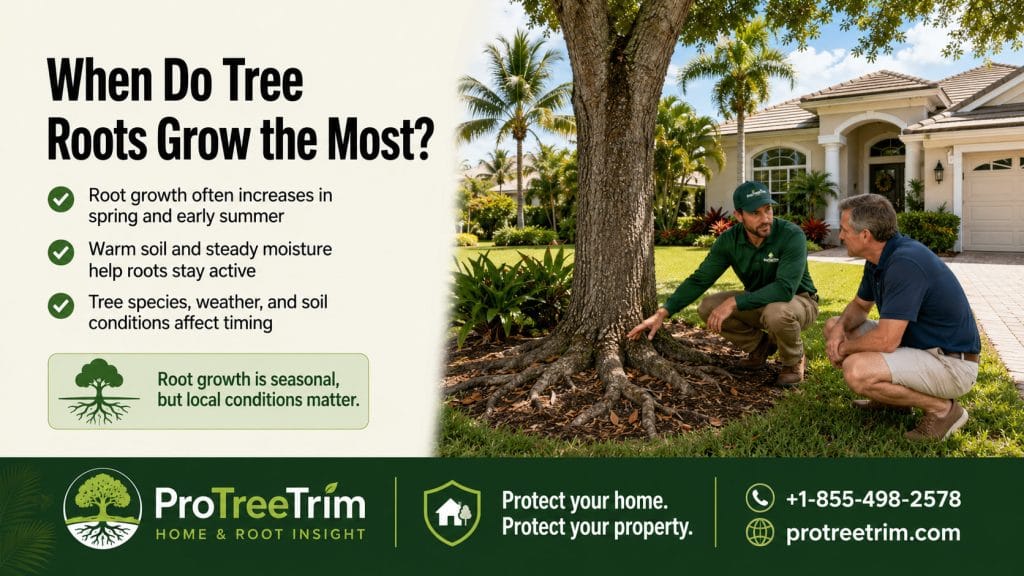
Tree roots usually grow most when soil conditions are favorable: not too dry, not too wet, not too cold, and not too compacted. In many regions, roots can grow actively in spring and fall when soil moisture and temperature are moderate. In warmer climates, roots may continue growing during much of the year if soil conditions support them.
The important point for homeowners is this: root growth does not always match what you see above ground. A tree may look quiet above the soil while roots are still active below it.
Roots Do Not Follow the Same Calendar as Leaves
Leaves, flowers, and fruit are easy to see. Roots are hidden, so homeowners often assume root growth stops when the canopy slows down. That is not always true.
A tree may have active roots when:
- leaves have already dropped
- top growth has slowed
- the tree is not flowering
- the yard looks dormant
- weather is mild
- soil remains moist and oxygenated
- roots are recovering from stress
Root activity depends more on soil conditions than on the calendar alone.
Soil Temperature Matters
Roots need suitable soil temperature to grow. If soil is too cold, root activity slows. If soil is too hot and dry, roots may also struggle. Moderate soil temperature is often better for root development.
Root growth is more likely when:
| Soil condition | Root response |
|---|---|
| Mild soil temperature | Roots may grow actively |
| Very cold soil | Root growth slows |
| Hot, dry soil | Roots may become stressed |
| Warm, moist soil with oxygen | Root activity may continue |
| Saturated soil | Roots may struggle from low oxygen |
| Compacted soil | Roots may have limited growth |
The best root environment is balanced, not extreme.
Moisture Matters, but Too Much Water Can Hurt
Roots need moisture, but they also need oxygen. This is why overwatering can be just as harmful as drought. A root system sitting in saturated soil may not function well, even if the tree looks thirsty above ground.
Good root growth is more likely when soil is:
- evenly moist
- well drained
- not constantly soggy
- not bone dry
- not compacted
- protected by proper mulch
- not buried under heavy fill
A tree root zone should be moist enough to support roots, but open enough to breathe.
Spring Root Growth
Spring is a common period for root activity because soil begins warming and moisture may be available. Trees may be producing leaves, flowers, or new shoots above ground, but roots are also working below ground to support that growth.
Spring is also when homeowners often notice:
- new leaf growth
- transplant stress
- root flare issues
- mulch problems
- exposed roots after winter or rain
- drainage problems
- early signs of tree stress
Spring is a good time to inspect root-zone conditions before summer heat increases stress.
Fall Root Growth
Fall can also be an important root-growth period, especially when air temperatures cool but soil remains mild enough for root activity. In many yards, fall conditions may be easier on roots than summer heat.
Fall can be useful for:
- root recovery after summer stress
- planting or transplant planning in some climates
- mulch correction
- soil moisture management
- checking exposed roots
- preparing trees before colder or drier periods
- reducing mower damage around root zones
A tree may be slowing visible top growth while still supporting root development below ground.
Do Tree Roots Grow in Winter?
Tree roots can grow in winter if the soil is not frozen and conditions are mild enough. In colder climates, root growth may slow significantly when soil temperatures drop. In warmer regions, roots may remain more active through the winter.
For homeowners, the practical lesson is this: do not assume winter means roots are irrelevant.
Winter root concerns may include:
- soil compaction from foot or equipment traffic
- poor drainage after rain
- roots exposed by erosion
- mulch piled too high
- root damage during construction
- planting depth problems
- roots under sidewalks, driveways, and pavers
Even when the canopy looks quiet, the root zone still matters.
Do Tree Roots Grow in Summer?
Roots can grow in summer when soil moisture and temperature are suitable. But summer can also be stressful. Heat, drought, reflected heat from pavement, and compacted soil can limit root function.
Summer root stress is more likely near:
- driveways
- sidewalks
- patios
- pool decks
- streets
- walls
- compacted lawns
- narrow planting beds
- dry slopes
This is why trees near hardscape may show leaf scorch, browning, early leaf drop, or canopy thinning during hot weather.
Roots Often Grow Where Conditions Are Best
Tree roots do not simply grow straight down. Many important roots grow outward and relatively close to the surface because that is where oxygen and moisture are available.
Roots often grow toward:
- moist soil
- oxygenated soil
- loose soil
- mulch beds
- irrigation zones
- drainage paths
- cracks and gaps near hardscape
- areas with less compaction
This helps explain why roots may appear near sidewalks, driveways, patios, pavers, septic areas, irrigation leaks, or downspouts.
Why Roots Grow Near the Surface
Many homeowners are surprised when roots appear above ground. Surface roots do not always mean the tree is unhealthy. Many roots naturally live in the upper soil layers.
Surface roots are more common when:
| Condition | Why roots may appear |
|---|---|
| Mature tree | Roots thicken over time |
| Compacted soil | Roots stay where oxygen is available |
| Shallow soil | Roots have limited depth |
| Erosion | Soil washes away from roots |
| Heavy shade | Grass thins and roots become visible |
| Frequent mowing | Soil and bark get disturbed |
| Poor drainage | Roots may avoid low-oxygen deeper soil |
Visible roots are not automatically bad, but they should be protected.
Root Growth and Hardscape Problems
Roots may continue growing under or near hardscape if the tree is alive and conditions support growth. That is why sidewalk, driveway, and paver repairs can fail again if the root conflict is not addressed.
Root-related hardscape problems include:
- sidewalk lifting
- driveway cracking
- patio paver movement
- pool deck lifting
- walkway unevenness
- fence-post conflict
- irrigation line damage
- drainage changes
Cutting roots may seem like the obvious fix, but it can harm tree health and stability. The better decision depends on root size, tree location, and repair options.
Root Growth After Cutting
If roots are cut, small roots may regrow or be replaced if the tree remains healthy. Large roots may not quickly regain their original function. A cut structural root can be a long-term concern.
Root regrowth depends on:
- tree species
- root size
- distance from trunk
- tree health
- soil moisture
- oxygen availability
- season
- how much root was removed
- whether the tree was already stressed
Do not cut roots just because they might grow back. Some root cuts matter for years.
Root Growth After Stump Grinding
After stump grinding, many underground roots remain. In most cases, roots from the removed tree gradually decay because they no longer have a living canopy feeding them. But some species may send up sprouts from remaining root or stump tissue.
After stump grinding, homeowners may notice:
- soil settling
- mushrooms as wood decays
- small root or stump sprouts
- soft areas where roots break down
- old roots under grass or pavers
- uneven planting conditions
Stump grinding removes the visible stump, but it does not instantly erase the entire root system.
Root Growth and Mulch
Proper mulch can support better root-zone conditions by moderating soil temperature, reducing mower damage, and helping soil moisture stay more stable.
Good mulch helps when it is:
- wide
- shallow
- kept away from the trunk
- not piled like a volcano
- not covering the root flare
- not stacked deeper every year
- not installed over landscape fabric that traps roots
Bad mulch can harm roots and trunk tissue if it is too deep or piled against the bark.
Root Growth and the Root Flare
The root flare is where the trunk widens into the main roots. It should be visible. If the trunk goes straight into the ground like a pole, the tree may be planted too deep or buried under soil or mulch.
A buried root flare can create long-term stress because:
- trunk tissue stays too wet
- roots may get less oxygen
- girdling roots may develop
- decay may be hidden
- tree stability issues may be harder to see
- root problems may go unnoticed
Root growth is healthier when the tree is planted at the correct depth and the root flare remains visible.
Root Growth and Construction
Construction can damage roots at any time of year. Trenching, driveway repair, paver installation, grading, fence work, irrigation lines, and heavy equipment can all injure the root system.
Root damage may happen when:
- roots are cut
- soil is compacted
- grade is changed
- roots are exposed and dry out
- heavy equipment crosses the root zone
- soil is added over roots
- drainage changes after construction
- utility trenches cut through major roots
A tree may look fine right after construction and decline later.
Signs Root Growth or Root Health May Be Poor
Because roots are hidden, canopy symptoms often give the first warning.
Watch for:
| Above-ground sign | Possible root-related meaning |
|---|---|
| Early leaf drop | Root stress may be involved |
| Brown leaf edges | Heat, drought, or root stress possible |
| Thinning canopy | Root function may be reduced |
| Dead branch tips | Tree may not be moving enough water |
| Small leaves | Stress or poor root support possible |
| Leaning tree | Root or soil stability concern |
| Soil lifting | Root movement or instability possible |
| Mushrooms near base | Decay or moisture concern |
Not every symptom is a root problem, but root conditions should be checked.
How Homeowners Can Support Root Growth
Homeowners cannot force roots to grow perfectly, but they can improve root-zone conditions.
Helpful steps include:
- keep mulch shallow and away from trunk
- avoid mowing over exposed roots
- avoid cutting roots casually
- reduce soil compaction
- correct drainage problems
- avoid piling soil over roots
- protect roots during construction
- keep the root flare visible
- water young trees consistently but not excessively
- avoid heavy pruning during root stress
Good root care is often quiet and simple.
What Hurts Root Growth
Root growth can be limited or damaged by common yard habits.
Avoid:
- deep mulch against the trunk
- soil piled over the root flare
- repeated mower damage
- cutting roots for convenience
- compacting soil with vehicles
- trenching close to the trunk
- installing pavers over major roots
- overwatering poorly drained soil
- leaving young trees dry after planting
- building raised beds against the trunk
Many root problems begin with well-intended landscaping.
When Root Growth Becomes a Property Conflict
Healthy roots can still create property problems when the tree is in the wrong location. A tree can be vigorous and still lift a sidewalk, crack a driveway, disturb pavers, or crowd a foundation-side walkway.
Root conflict is more likely when a tree is planted too close to:
- sidewalks
- driveways
- patios
- pool decks
- pavers
- fences
- septic areas
- retaining walls
- narrow planting strips
- house-side walkways
Sometimes the tree should be protected. Sometimes the hardscape should be adjusted. Sometimes removal and replacement may be the long-term answer.
What Homeowners Should Photograph
Photos help track root-zone changes.
Take photos of:
- full tree from several angles
- trunk base and root flare
- exposed roots
- mulch depth
- sidewalk or driveway lifting
- paver movement
- drainage after rain
- canopy thinning or deadwood
- construction near the tree
- any lean or soil lifting
Photos are useful before repairs, root cutting, stump grinding, or removal decisions.
What to Do First
A practical root-growth checklist:
- Check whether the root flare is visible.
- Look for exposed roots and mower damage.
- Notice drainage and soil moisture.
- Avoid cutting large roots.
- Avoid deep soil over roots.
- Use shallow mulch correctly.
- Protect roots during construction.
- Watch for canopy symptoms.
- Get help before repairing hardscape around major roots.
Root care starts before there is a visible crisis.
Final Homeowner Takeaway
Tree roots grow most when soil conditions are favorable: mild enough, moist enough, oxygenated, and not overly compacted. In many areas, spring and fall can support strong root growth, but roots may also grow during mild winter periods or summer periods if moisture and soil conditions are right.
For homeowners, root growth matters because roots affect tree health, stability, sidewalks, driveways, patios, pavers, stump regrowth, and future planting decisions. Do not cut roots casually. Protect the root flare, manage mulch correctly, and treat hardscape conflicts as tree-health decisions—not just surface repairs.
If you are unsure whether roots are growing normally, damaging hardscape, recovering after cutting, or creating a future tree-risk issue, ProTreeTrim can help connect homeowners with local tree service support. Call +1-855-498-2578 or visit protreetrim.com.
FAQs
When do tree roots grow the most?
Tree roots usually grow most when soil temperature, moisture, and oxygen are favorable. Spring and fall are often important root-growth periods in many regions.
Do tree roots grow in winter?
They can if the soil is not frozen and conditions are mild enough. In colder climates, root growth slows when soil gets too cold.
Do tree roots grow in summer?
They can, but heat and drought may limit root growth. Summer root stress is more common near pavement, compacted soil, and dry yards.
Do roots keep growing after a tree is cut down?
Most roots decline after tree removal, but some tree species can send up sprouts from remaining roots or stump tissue.
ProTreeTrim™ can help you take the next step.
If you are dealing with a damaged tree, fallen branch, stump, root issue, palm concern, or storm cleanup question in Florida, call ProTreeTrim for tree service support.