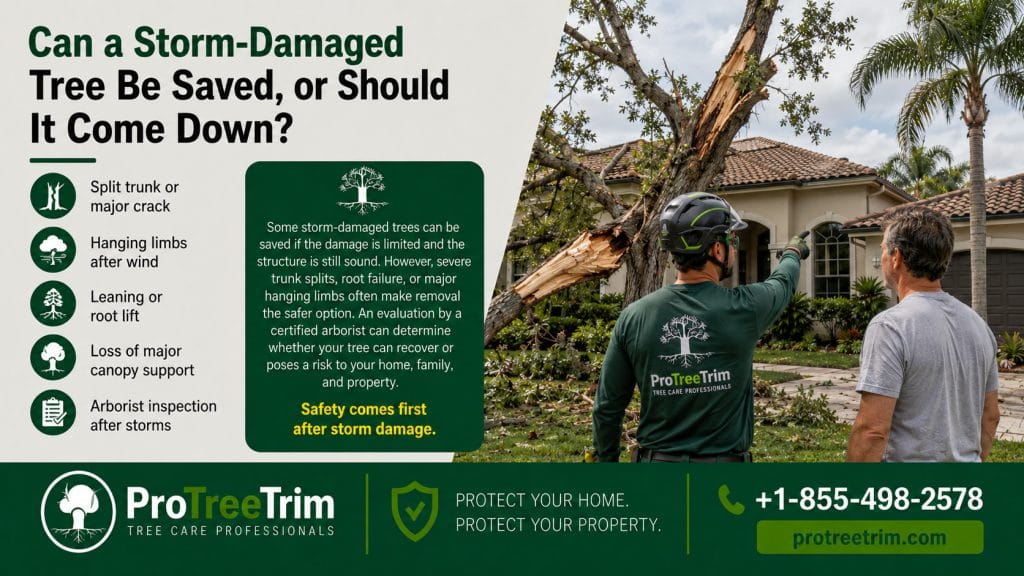
A storm-damaged tree does not always have to be removed. Some Florida trees recover after losing smaller limbs, while others become unsafe because of a split trunk, lifted roots, major canopy loss, or a new lean. The decision depends on the tree’s structure, location, damage severity, and what it could hit if it fails later.
Damage That May Be Manageable
Not every broken branch is a removal sign. If the trunk is intact, the roots are stable, and most of the canopy remains healthy, the tree may only need careful pruning and monitoring. This is especially true when the damage is limited to small or medium limbs away from the main structure of the tree.
A mature oak that lost a few outer branches may still have a strong framework. A palm that dropped fronds during wind may simply need cleanup. A tree in an open part of the yard may have more room for safe recovery than one leaning over a roof, pool cage, driveway, or neighbor’s fence.
Still, do not judge only by green leaves. A tree can look alive while holding cracks, hidden decay, or weakened branch connections.
| What you notice | What it may mean |
|---|---|
| Small broken outer limbs | May be manageable with pruning |
| Trunk is intact and upright | Better recovery potential |
| No root lifting or soil cracking | Stability may be less concerning |
| Large split through trunk | Serious structural concern |
| Roots lifted after storm | Possible stability issue |
| New lean toward house or driveway | Should be checked quickly |
| Major canopy loss on one side | Tree may be unbalanced |
When Removal Becomes the Safer Question
Removal becomes more likely when the damage affects the tree’s main support system. A split trunk, torn root plate, large hanging limb, or fresh lean after heavy rain can change the situation quickly. In Florida’s sandy soil, saturated ground may reveal root movement that was not obvious before the storm.
Location also matters. A damaged tree over an open lawn is different from one over a bedroom, pool enclosure, parked vehicle area, septic field, or main walkway. If the tree falls later, the damage may involve more than the tree itself.
Take photos before cleanup begins. Include the full tree, trunk base, broken limbs, root area, and nearby structures. Avoid cutting heavy limbs yourself, especially if they are overhead, under pressure, or resting on a roof or fence.
If you are unsure whether a storm-damaged tree, palm, stump, or root issue can be saved or needs removal, ProTreeTrim can help connect Florida homeowners with local tree service support. Call +1-855-498-2578 or visit protreetrim.com.
FAQs
Does storm damage always mean a tree should be removed?
No. Some trees recover with proper pruning and monitoring, depending on the amount and location of the damage.
What storm damage is most concerning?
A split trunk, lifted roots, new lean, large hanging limbs, or major damage near the main stem should be taken seriously.
Should I wait to see if the tree recovers?
Sometimes, but not if the tree threatens a structure, driveway, pool cage, fence, utility line, or high-use area.
ProTreeTrim™ can help you take the next step.
If you are dealing with a damaged tree, fallen branch, stump, root issue, palm concern, or storm cleanup question in Florida, call ProTreeTrim for tree service support.