
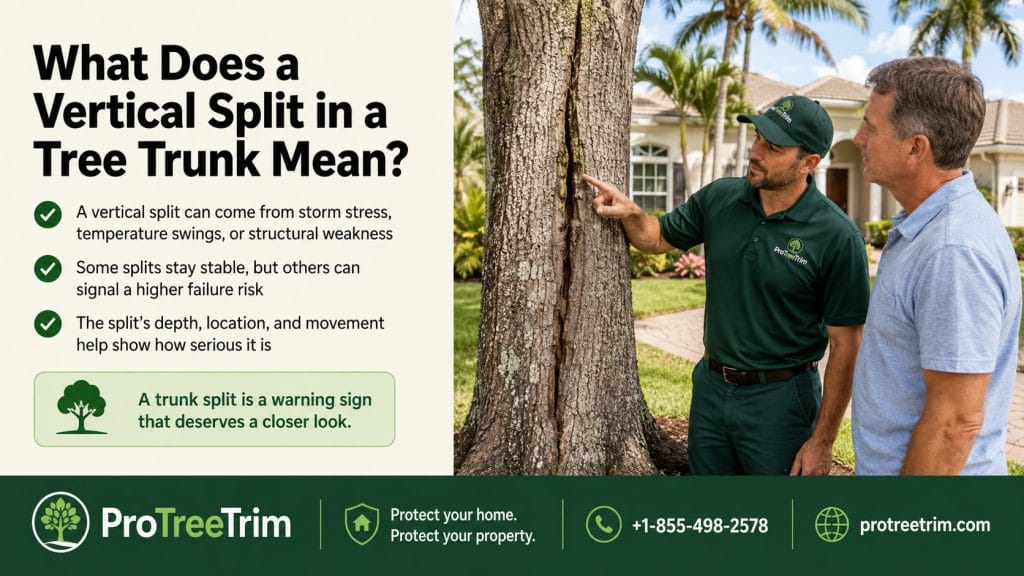
A vertical split in a tree trunk is a warning sign that should be taken seriously. Sometimes a split is a surface crack caused by weather, rapid temperature changes, old injury, or bark expansion. Other times, it may reveal deeper structural weakness, internal decay, storm damage, included bark, or trunk failure risk.
The most important question is not only “Why did the trunk split?”
It is “How deep is the split, is the tree stable, and what could it hit if it fails?”
Start With the Size and Depth of the Split
Not every trunk split means the tree is about to fall. But a vertical crack is different from ordinary bark texture. The deeper, longer, wider, or more open the split is, the more attention it deserves.
| What you see | What it may suggest |
|---|---|
| Thin surface bark crack | May be weather or growth related |
| Long vertical split down trunk | Structural concern may be possible |
| Open crack showing inner wood | More serious than bark-only cracking |
| Split with dark, soft, or wet wood | Decay or internal damage may be involved |
| Split after storm or wind | Recent structural stress may have occurred |
| Split between two stems | Weak union or included bark may be present |
| Split plus leaning | Stability concern increases |
| Split plus dead canopy | Tree health may be declining |
A small bark crack can be monitored. A deep trunk split on a tree near a house, driveway, or walkway should not be ignored.
Surface Bark Cracks vs. Structural Splits
A surface bark crack affects mostly the outer bark. A structural split goes deeper into the wood and may affect how the trunk carries weight.
Homeowners can often see the difference by looking for depth and movement.
A surface issue may look like:
- narrow crack in outer bark
- no visible gap into the trunk
- no movement in wind
- no soft or dark inner wood
- healthy canopy above
- no new lean
- no large dead limbs
A structural split may look like:
- open gap in the trunk
- visible inner wood
- crack continuing into a branch union
- tree moving around the split in wind
- oozing, decay, or dark staining
- canopy decline above the split
- lean developing after the crack appears
If the split looks structural, the tree needs closer evaluation.
Weather Can Cause Trunk Cracking
Trees can develop vertical cracks from weather stress. Rapid temperature changes, sunscald, frost cracks in colder climates, drought followed by rain, or internal stress can all contribute to splitting.
Weather-related cracks may appear suddenly, especially on thin-barked or exposed trees.
Weather stress is more likely when:
- the split appears on the sun-exposed side
- the tree recently experienced extreme heat or cold
- the trunk had old injury or thin bark
- the soil went from very dry to very wet
- the tree is young or newly planted
- the tree is exposed near pavement or open lawn
Even if weather triggered the crack, the tree still needs to be checked for depth and stability.
Storm Damage Can Create or Worsen Splits
Wind and storms can twist trunks, pull heavy limbs, and stress weak branch unions. A tree may split during a storm or show a crack afterward.
A post-storm trunk split is more concerning if the tree also has:
- broken limbs
- hanging branches
- new lean
- soil lifting near roots
- exposed roots
- canopy suddenly shifted to one side
- branch union splitting open
- trunk crack widening
- large limb over roof, driveway, or patio
Storm-related splits should be treated as structural warnings until proven otherwise.
Splits Between Two Stems Can Be Serious
Some trees grow with two main stems that press closely together. If the connection between those stems is weak, a vertical split may form where they meet. This is especially concerning when the stems have included bark, meaning bark is trapped between the stems instead of strong wood forming a solid union.
A split between stems may lead to one side failing, especially under wind, rain, or limb weight.
Look for:
| Sign | Why it matters |
|---|---|
| Two large stems forming a tight V | Weak attachment may be possible |
| Crack running down between stems | Union may be splitting |
| Bark trapped in the union | Included bark concern |
| One stem leaning away | Failure risk may increase |
| Large limbs on both stems | Weight may pull the union apart |
| Split widening after wind | Structural weakness may be active |
This is not a cosmetic bark problem. It can be a major tree-structure issue.
Decay Can Hide Behind a Split
A vertical split can expose inner wood. If that wood is dark, soft, crumbly, wet, hollow, or fungal-looking, decay may already be present. A split may be the first visible clue that the trunk is compromised inside.
Decay concerns increase when you see:
- mushrooms near the base
- soft wood inside the crack
- ants or insects entering the split
- hollow sound when tapped lightly
- bark peeling around the crack
- dark staining or oozing
- sawdust-like material
- cavities or old wounds nearby
A tree can have green leaves and still have internal decay.
A Healthy Canopy Does Not Always Mean the Split Is Safe
Many homeowners assume that if the tree has green leaves, the trunk must be fine. That is not always true. Trees can keep leaves while structural defects develop inside the trunk.
A vertical split is especially important when the tree has heavy branches, leans toward a structure, or stands where people walk or park.
Do not dismiss a trunk split just because the canopy still looks green.
Instead, ask:
- Is the crack deep?
- Is the crack widening?
- Is the tree leaning?
- Are large limbs above the split?
- Is the crack near a branch union?
- Is there decay inside the split?
- Is the tree near something valuable?
- Did the crack appear after a storm?
The trunk structure matters as much as leaf color.
Do Not Fill, Seal, or Paint the Split
It may be tempting to fill the split with foam, cement, tar, paint, caulk, or wound sealer. That is usually not helpful. It can trap moisture, hide decay, and make it harder to monitor the crack.
Trees do not heal like skin. They seal off damaged tissue internally and grow new wood around wounds over time.
Avoid:
- filling the crack
- painting the wound
- wrapping the trunk tightly
- drilling into the split
- cutting bark away aggressively
- pressure washing inside the crack
- applying random chemicals
The safest first step is inspection, documentation, and preventing additional stress.
Do Not Strap or Bolt the Tree Yourself
Some trunk splits may be candidates for cabling, bracing, or other structural support, but this is not a DIY project. Improper hardware can damage the tree further, create false confidence, or fail under load.
Do not try to:
- ratchet-strap the trunk together
- screw plates across the crack
- wrap chain around the trunk
- install random bolts
- tie the tree to another tree
- pull stems together with rope
Support systems require correct assessment, hardware, placement, and follow-up. In some cases, support is not appropriate and removal may be safer.
When Pruning May Help
Pruning may help when the split is related to excessive limb weight, broken branches, storm damage, or a weak branch union. But pruning must be careful. Removing too much canopy can stress the tree, and removing the wrong limb can change weight distribution in a dangerous way.
Pruning may be considered when there are:
- dead limbs
- broken hanging branches
- cracked limbs
- heavy limbs pulling on the split
- branches over a roof or driveway
- rubbing or crossing branches
- storm-damaged sections
Do not prune heavily just to “lighten” the tree without understanding the structure. A split trunk can behave unpredictably.
When Removal May Be the Safer Option
Removal may be necessary when the split is deep, widening, connected to decay, affecting the main trunk, or located on a tree near important targets.
Removal becomes more likely when:
- the split runs far down the trunk
- the crack is open and deep
- the tree has a new lean
- decay is visible inside
- mushrooms are near the base
- large limbs are dead or cracked
- the split is between co-dominant stems
- the tree is near a house, driveway, or walkway
- support would not realistically reduce risk
A tree with a serious trunk split may not be a good candidate for saving.
Young Trees With Trunk Splits
Young trees can sometimes recover from limited bark cracking, especially if the crack is shallow and the tree is otherwise healthy. But young trees with deep trunk splits may develop long-term structural problems.
Young trees should be checked for:
- planting depth
- root flare visibility
- trunk guards rubbing bark
- deer rub damage
- mower or trimmer wounds
- sunscald
- staking ties too tight
- water stress
- split extending into the main stem
A young tree may be easier to replace than a mature tree if the trunk defect is severe.
Mature Trees With Trunk Splits
A mature tree with a vertical trunk split deserves careful attention because the size and weight of the canopy are much greater. The tree may have large limbs, internal decay, and significant targets below.
A mature split tree near a home should be treated differently from a young ornamental in open lawn.
Be especially cautious with mature trees near:
- rooflines
- bedrooms
- driveways
- parked vehicles
- sidewalks
- patios
- pool cages
- fences
- utility lines
- neighbor property
The bigger the tree and the closer the target, the less room there is for guessing.
What If the Split Is Old?
An old split may have callus growth around the edges. That means the tree has been trying to grow around the wound. If the split is stable, dry, and not spreading, it may be less urgent.
But old splits can still hide decay.
Check whether the old split has:
- new widening
- soft or dark wood
- insects entering
- mushrooms nearby
- dead limbs above it
- oozing or wet areas
- bark cracking around the edge
- new lean
An old wound is not automatically safe. It is simply not new.
What Homeowners Should Photograph
Photos help track whether the split is changing.
Take photos of:
- full tree from several angles
- close-up of the split
- the split with a size reference
- base of trunk and root flare
- canopy above the split
- any dead limbs
- any mushrooms, oozing, or dark wood
- the tree’s lean, if visible
- nearby house, driveway, walkway, or fence
- storm damage around the tree
Repeat photos after storms or heavy rain if the tree is being monitored.
What to Do First
A practical first response:
- Keep people and vehicles away if the split looks severe.
- Photograph the trunk and full tree.
- Check whether the split is shallow or deep.
- Look for decay, soft wood, mushrooms, or oozing.
- Check whether the tree is leaning.
- Look for dead or broken limbs above.
- Do not fill, paint, strap, or bolt the split yourself.
- Get help if the tree is near structures or the split appears structural.
A trunk split is not the place for guesswork.
Final Homeowner Takeaway
A vertical split in a tree trunk can be minor, but it can also signal serious structural weakness. The depth, length, location, decay signs, lean, canopy condition, and nearby targets all matter.
Do not fill or seal the split. Do not try to strap the tree together yourself. Monitor small stable cracks, but take deep, widening, storm-related, decayed, or trunk-level splits seriously—especially near homes, driveways, walkways, fences, patios, pool cages, or utility areas.
If you are unsure whether a vertical trunk split is cosmetic, repairable, or a removal-level risk, ProTreeTrim can help connect homeowners with local tree service support. Call +1-855-498-2578 or visit protreetrim.com.
FAQs
Can a tree survive a vertical split in the trunk?
Sometimes, if the split is shallow, stable, and the tree is otherwise healthy. Deep or widening splits are more concerning.
Should I seal or fill a split tree trunk?
Usually no. Filling or sealing can trap moisture and hide decay. The tree should be evaluated rather than covered up.
Can a split tree trunk be repaired?
Some structural issues may be managed with pruning or professional support systems, but not every split is repairable. Severe trunk splits may require removal.
When is a vertical split dangerous?
It is more dangerous when the split is deep, widening, connected to decay, paired with leaning, or located on a tree near a house, driveway, walkway, or other target.
ProTreeTrim™ can help you take the next step.
If you are dealing with a damaged tree, fallen branch, stump, root issue, palm concern, or storm cleanup question in Florida, call ProTreeTrim for tree service support.