
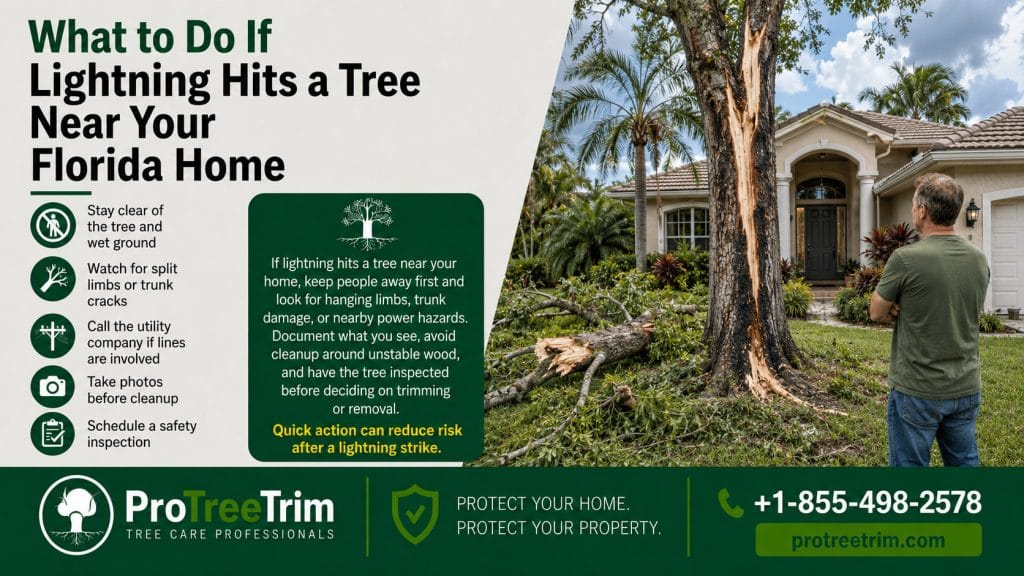
If lightning hits a tree near your Florida home, do not assume the danger is over once the storm passes. Some trees show obvious damage right away, while others decline slowly over days, weeks, or months. Start by checking safety from a distance, documenting visible damage, and watching for cracks, bark loss, hanging limbs, or changes in the canopy.
Look for Damage From the Ground
A lightning-struck tree may have a long strip of missing bark, a split trunk, cracked limbs, scorched areas, or broken branches below the canopy. Sometimes the damage is dramatic. Other times, it is subtle: leaves wilt on one side, bark loosens, or a limb begins to die back later.
Do not touch the tree during or immediately after the storm, especially if power lines, service wires, metal fencing, wet ground, or nearby electrical equipment are involved. Wait until conditions are safe and inspect only from the ground.
| What you notice | Why it matters |
|---|---|
| Long bark strip missing | Lightning may have traveled down the trunk |
| Fresh trunk crack | Could affect structural strength |
| Hanging limbs | May fall after the storm |
| One-sided leaf wilt | Can signal internal or vascular damage |
| Bark loosening days later | Tree may be declining after the strike |
| Tree near roof or driveway | Property risk is higher if it weakens |
Watch for Delayed Problems
Lightning damage does not always make a tree fail immediately. A tree may stay standing and green for a while, then begin dropping limbs, thinning at the top, or showing decay around the wound. That delayed response is one reason Florida homeowners should keep photos and monitor changes.
Location matters. A lightning-struck tree in an open back corner may be watched differently from one beside a bedroom, driveway, pool cage, fence, or neighbor’s property. If the tree has a fresh crack, a large wound, heavy limbs over the roof, or root movement after the storm, it deserves faster attention.
Avoid sealing the wound, peeling bark, or cutting large limbs yourself. Also avoid aggressive trimming just to “clean it up.” Poor cuts can create more stress and make future structure harder to judge.
Take clear photos of the whole tree, the wound, the canopy, the base of the trunk, and the nearby property. If branches fell, photograph where they landed before cleanup.
If you are unsure whether a lightning-struck tree, palm, stump, or root issue needs professional attention, ProTreeTrim can help connect Florida homeowners with local tree service support. Call +1-855-498-2578 or visit protreetrim.com.
FAQs
Can a tree survive a lightning strike?
Yes, some trees survive, but others decline later. The amount of trunk, limb, and root damage matters.
Should I remove a lightning-struck tree right away?
Not automatically. But fresh cracks, hanging limbs, major bark loss, or nearby structures make the situation more urgent.
What should I photograph after lightning damage?
Photograph the full tree, bark damage, trunk cracks, fallen limbs, canopy changes, and anything the tree could hit if it weakens.
ProTreeTrim™ can help you take the next step.
If you are dealing with a damaged tree, fallen branch, stump, root issue, palm concern, or storm cleanup question in Florida, call ProTreeTrim for tree service support.