
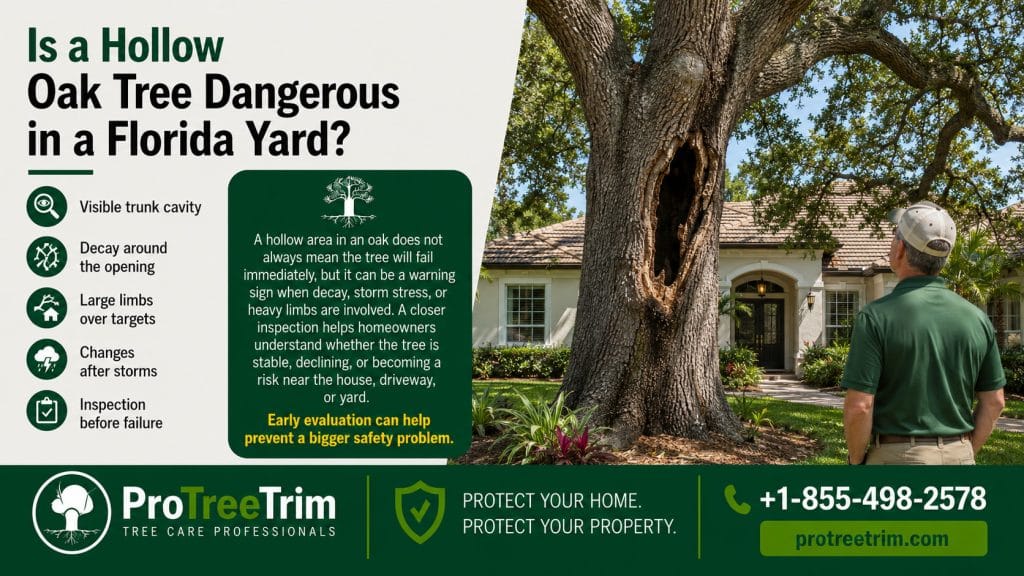
A hollow oak tree is not always dangerous, but it should be taken seriously. Some older oaks can live for years with cavities, while others may have decay, cracks, weak limbs, or root problems that make them risky. In Florida yards, the concern depends on how much structure is affected and what the tree could hit if it fails.
A Cavity Is a Warning Sign, Not a Final Answer
Many Florida homeowners first notice a hollow area at the base of an oak, an old pruning wound, or a dark opening where a limb once broke. It may look dramatic, especially if you can see into the trunk.
The important point is that a cavity alone does not tell the whole story. A tree can seal off old wounds and continue growing. But if the hollow area is expanding, soft, wet, full of insects, surrounded by mushrooms, or connected to cracks in the trunk, it becomes more concerning.
Do not poke deeply into the cavity, cut around it, or fill it with concrete, foam, or sealant. Those quick fixes can trap moisture or hide the real issue. Take photos instead and watch for changes over time.
| What you notice | Why it matters |
|---|---|
| Small old cavity with firm surrounding wood | May be stable, but should be monitored |
| Soft or crumbling wood inside | Can suggest active decay |
| Mushrooms near the trunk base | May point to moisture or decay nearby |
| Crack running from the cavity | More serious structural concern |
| Hollow area at a major branch union | Could affect limb strength |
| Tree leans toward roof or driveway | Raises urgency because of what it could hit |
Location Makes the Risk More Practical
A hollow oak in an open back corner is different from one beside a bedroom, driveway, pool cage, fence, or neighbor’s property. Risk is not only about the tree. It is also about the target.
Look up as well as at the trunk. Are large limbs growing over the roof? Are branches dropping after storms? Is one side of the canopy much heavier than the other? A hollow trunk paired with heavy overhanging limbs deserves more attention than a cavity on a smaller, well-balanced tree away from structures.
Also check the base. Florida’s sandy soil, heavy rain, irrigation, mulch buildup, and drainage problems can all hide changes around roots. If the tree has a cavity, a new lean, lifted soil, exposed roots, or soft ground near the trunk, do not wait until storm season is active to ask questions.
Before any removal or major pruning decision, document the tree. Photograph the full oak, the cavity, trunk base, limbs over structures, and any nearby damage to pavers, fencing, gutters, or irrigation.
If you are unsure whether a hollow oak, large limb, stump, or root issue needs professional attention, ProTreeTrim can help connect Florida homeowners with local tree service support. Call +1-855-498-2578 or visit protreetrim.com.
FAQs
Does a hollow trunk mean an oak tree must be removed?
Not always. Some oaks remain standing with old cavities, but soft wood, cracks, decay, leaning, or nearby structures can make the situation more serious.
Should I fill a tree cavity myself?
No. Filling a cavity can trap moisture or hide decay. It is better to understand the tree’s condition before trying to cover the opening.
When is a hollow oak more urgent?
It is more urgent if the cavity is near the base, the trunk is cracked, the tree is leaning, mushrooms are present, or large limbs hang over a roof, driveway, pool cage, or walkway.
ProTreeTrim™ can help you take the next step.
If you are dealing with a damaged tree, fallen branch, stump, root issue, palm concern, or storm cleanup question in Florida, call ProTreeTrim for tree service support.