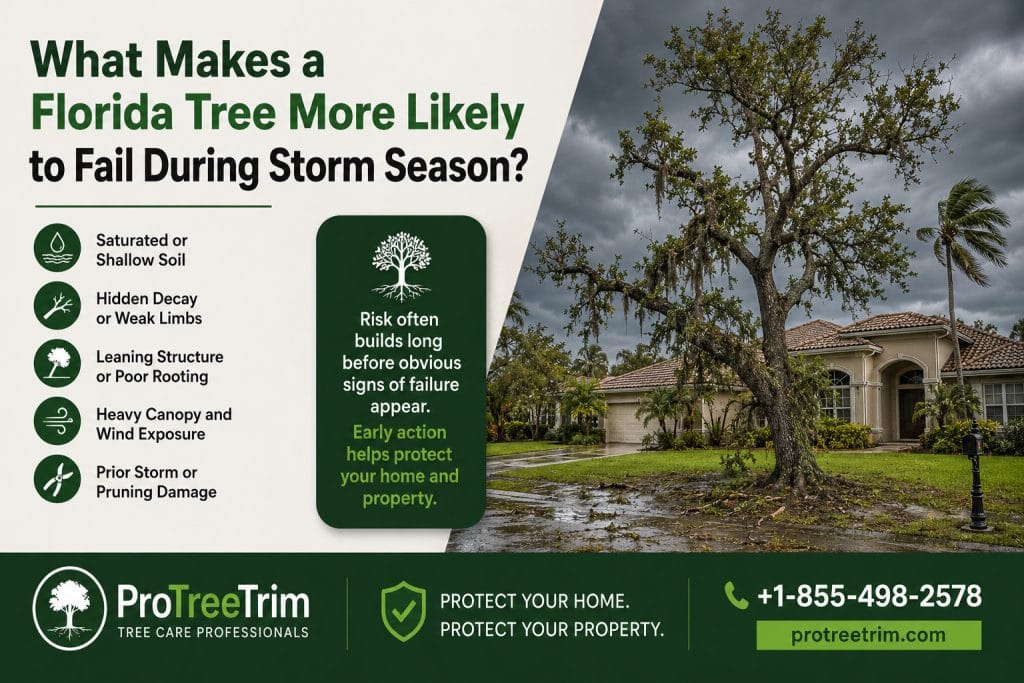
A Florida tree is more likely to fail during storm season when structural problems, root stress, heavy canopy weight, saturated soil, or poor placement all stack up. A tree does not have to look dead to become a concern. Homeowners should look for recent changes, weak points, and what the tree could hit if wind or rain exposes the problem.
The Warning Signs Are Often Below the Canopy
Many homeowners judge a tree by its leaves. If the canopy is green, the tree feels safe. But storm failure often starts lower: at the trunk, roots, branch unions, or soil line.
Look for cracks in the trunk, old wounds, hollow areas, mushrooms near the base, peeling bark, or large limbs with visible splits. A tree with two main stems growing tightly together can sometimes hold a weaker connection than it appears from the ground. You do not need to diagnose it yourself, but you should notice anything that looks new, widening, or different after rain and wind.
Roots matter just as much. Freshly lifted soil, exposed roots, a new lean, or ground that feels soft around the base can all point to movement. In Florida’s sandy soil, heavy rain may make root problems more visible. Around driveways, pavers, pool decks, fences, and irrigation lines, root stress can show up as cracking, lifting, or uneven settling.
Canopy balance is another clue. A tree with most of its weight leaning over the roof, driveway, pool cage, or neighbor’s yard may deserve attention before the next storm system arrives.
Yard Conditions Can Increase the Risk
A tree’s location can turn a small defect into a real property concern. A weak limb over an open lawn is one thing. The same limb over a screened lanai, parked vehicle, septic area, front walkway, or roof edge is different.
Recent yard work also matters. Trenching, fence installation, driveway repairs, paver work, irrigation changes, or soil added over roots can stress a tree without creating an immediate visual problem. A tree may react slowly, then show thinning leaves, dead branches, or instability later.
Before storm season gets busy, take photos of trees that worry you. Include the full tree, trunk base, root area, large limbs, and anything nearby that could be damaged.
If you are unsure whether a tree, palm, stump, or root issue needs professional attention before storm season, ProTreeTrim can help connect Florida homeowners with local tree service support. Call +1-855-498-2578 or visit protreetrim.com.
FAQs
Can a green tree still fail in a storm?
Yes. Green leaves do not confirm that the roots, trunk, or major limbs are structurally sound.
What tree problems should not wait until after a storm?
A split trunk, new lean, lifted roots, hanging limbs, or branches over the roof, driveway, or pool cage should be taken seriously.
Does sandy soil make storm failure more likely?
Not by itself, but sandy soil can shift, wash out, or soften after heavy rain, making existing root problems easier to see.
ProTreeTrim™ can help you take the next step.
If you are dealing with a damaged tree, fallen branch, stump, root issue, palm concern, or storm cleanup question in Florida, call ProTreeTrim for tree service support.