
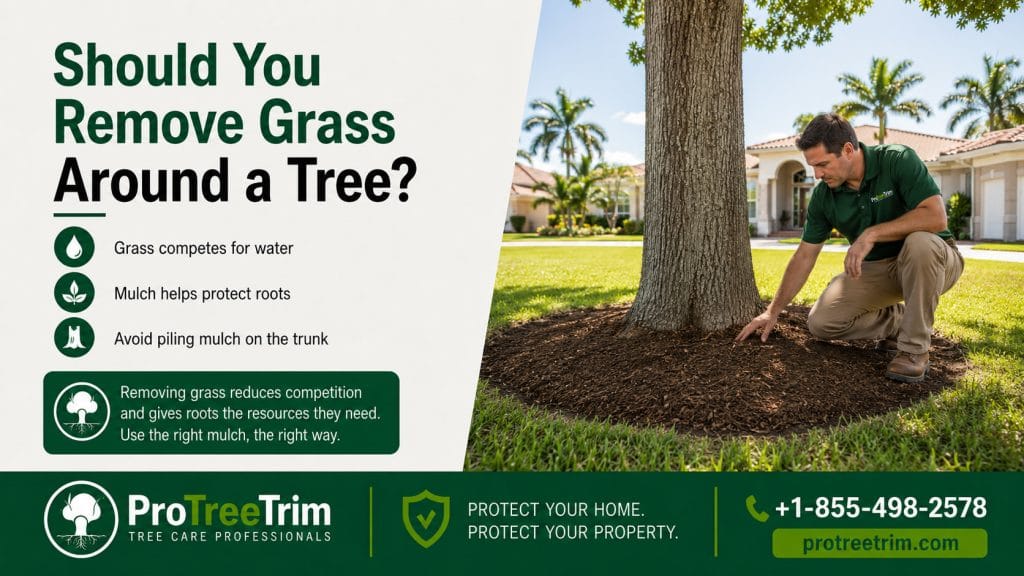
Removing grass around a tree is often a smart move, especially for young trees, stressed trees, or trees with mower damage at the trunk. Turf and tree roots compete for water, nutrients, and space. A proper mulch ring can reduce that competition, protect bark, and make the tree easier to maintain.
Grass and Trees Are Not Always Good Neighbors
A green lawn right up to the trunk may look tidy, but it is not always good for the tree. Turfgrass roots can form a dense mat in the same upper soil area where many tree roots need water and oxygen. University of Minnesota Extension notes that when trees and shrubs grow in turf, competition for nutrients, water, and space happens below ground, and turf can limit woody plants’ water-absorbing roots in the top few inches of soil.
Shade adds another problem. As a tree matures, grass below the canopy often thins because turf has limited tolerance for shade and root competition. University of Maryland Extension notes that lawns around trees may gradually thin and decline as the tree grows larger.
That thin, struggling grass often leads to more mowing, edging, reseeding, fertilizing, and irrigation. In other words, the homeowner keeps working harder around the tree while the tree is quietly dealing with competition and repeated disturbance.
| What you notice | What it may mean |
|---|---|
| Grass thinning under the canopy | Shade and root competition may be too strong |
| Mower marks near the trunk | The grass area is too tight to maintain safely |
| Exposed surface roots | Mowing and soil movement may be stressing the area |
| Soil stays dry under the tree | Turf and tree roots may be competing for moisture |
| Grass needs constant reseeding | The site may be better as mulch or groundcover |
| Mulch piled against the trunk | The fix needs adjusting, not more grass |
A Mulch Ring Is Usually Better Than a Tight Lawn Edge
The goal is not to bury the tree in mulch. The goal is to create a clean, protected root-zone buffer.
University of Maryland Extension says mulching as far out as the branches reach can maximize tree growth compared with grass growing up to the trunk, because it reduces root competition for moisture and nutrients and helps protect the trunk from mechanical damage. University of Minnesota Extension also recommends eliminating turf and weeds from the base of newly planted trees and applying organic mulch while leaving the root flare bare and keeping mulch off the trunk.
For a homeowner, the practical version is simple: make the ring wider, not deeper. The mulch should look like a shallow donut, not a volcano.
Keep the root flare visible. Keep mulch away from the bark. Penn State Extension recommends keeping mulch off the trunk and leaving the root flare exposed; it describes proper mulch as only a few inches deep, not mounded around the tree.
When Removing Grass Matters Most
Removing grass around a tree is especially helpful when the tree is young, recently planted, drought-stressed, or already showing mower damage. It also matters around trees with visible roots, compacted soil, or struggling turf that keeps inviting more lawn work.
This can be useful near driveways, sidewalks, pool cages, and front entries too. A clean mulch ring can reduce the temptation to run a mower or string trimmer right against the trunk. It also makes it easier to spot mushrooms, bark wounds, insects, soil washout, or root movement before they are hidden by turf.
Do not remove grass by cutting deeply into the soil or chopping roots. Avoid using herbicide right against the trunk or exposed roots unless you know the product and application are safe for that situation. A careful hand removal or gradual bed expansion is usually better than aggressive digging.
If the tree already has dead limbs, trunk wounds, leaning, exposed roots, or canopy thinning, the grass may not be the whole problem. But improving the root-zone environment can still be part of better tree care.
If you are unsure whether grass competition, mower damage, exposed roots, or a stressed tree needs professional attention, ProTreeTrim can help connect homeowners with local tree service support. Call +1-855-498-2578 or visit protreetrim.com.
FAQs
How wide should a mulch ring be around a tree?
Wider is usually better than deeper. Extension sources often recommend spreading mulch out toward the dripline when possible, while keeping it shallow and away from the trunk.
Should mulch touch the trunk?
No. Mulch should be pulled back from the trunk so the root flare remains visible. Mulch against bark can trap moisture and hide problems.
Can I just keep grass if the tree looks healthy?
Sometimes, yes. But if grass is thin, roots are exposed, mower damage is visible, or the tree is stressed, a mulch ring is often a better long-term setup.
Is landscape fabric needed under the mulch?
Usually not for a tree bed with organic mulch. A simple shallow mulch ring is easier to adjust, inspect, and maintain.
ProTreeTrim™ can help you take the next step.
If you are dealing with a damaged tree, fallen branch, stump, root issue, palm concern, or storm cleanup question in Florida, call ProTreeTrim for tree service support.