
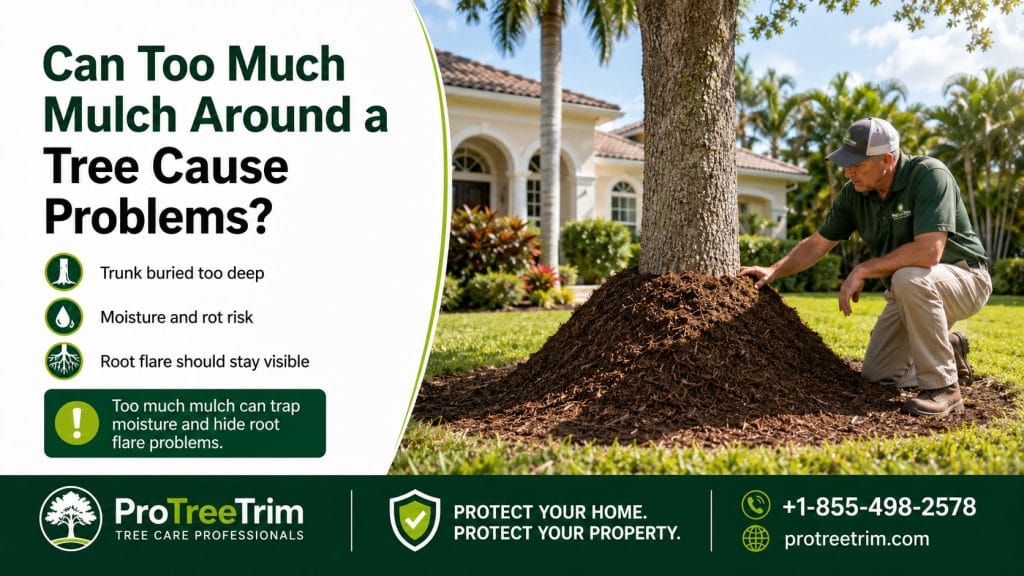
Yes, too much mulch around a tree can cause problems, especially when it is piled against the trunk. Mulch should protect the root zone, not bury the tree’s base. A deep “mulch volcano” can trap moisture, hide decay, reduce air movement, encourage root problems, and make warning signs harder to see.
Mulch Should Look Like a Donut, Not a Volcano
Good mulch is useful. It can help moderate soil temperature, reduce weed competition, protect roots from mower damage, and hold moisture during dry periods. The problem starts when mulch is stacked high against the trunk or added year after year without removing the old layer.
Penn State Extension recommends spreading excess mulch out evenly, about 2–4 inches deep, while pulling it back from the trunk so the root flare is visible. Rutgers Extension gives similar guidance: remove excess soil or mulch until the root flare and trunk collar are exposed, taking care not to damage tender bark.
| What you see | Why it matters |
|---|---|
| Mulch piled against trunk | Traps moisture against bark |
| Tree looks like a pole entering mulch | Root flare may be buried |
| Thick layers added every season | Roots may get less air and water movement |
| Mushrooms near trunk | Moisture and decaying organic matter may be present |
| Soft bark at soil line | Trunk tissue may be staying too wet |
| Surface roots circling in mulch | Root pattern may be changing |
| Insects near buried base | Mulch may be hiding a larger issue |
Why Over-Mulching Can Hurt a Tree Slowly
A tree’s trunk and roots do different jobs. The trunk bark above the soil line is not meant to stay buried in damp mulch. When mulch is piled high, that bark may stay wet longer than it should. The root flare also disappears, making it harder to see cracks, decay, insects, girdling roots, mushrooms, or soil movement.
UF/IFAS Duval County describes this as “mulch volcano” damage and warns that too much mulch piled against the trunk can keep water and oxygen from reaching the root ball, stressing the tree.
This is why mulch problems can be easy to miss. The landscape bed may look neat. The tree may stay green for a while. But over time, homeowners may notice smaller leaves, thinning canopy, dead branch tips, bark problems, insects, or mushrooms around the base.
Mulch is not always the only cause. Poor drainage, irrigation overspray, buried planting depth, compacted soil, construction damage, or old root stress may also be involved. But deep mulch can hide those issues and make them harder to catch early.
What Homeowners Should Do Before Adding More Mulch
Before refreshing a tree bed, pull back a small area near the trunk and look for the flare. The base of the tree should widen naturally where the trunk transitions into roots. If it looks like a straight post disappearing into mulch, there may be too much material around the base.
Do not dig aggressively or cut roots. Start gently:
- Pull mulch back a few inches from the trunk.
- Check whether the root flare is visible.
- Remove old, compacted mulch if the layer is too deep.
- Spread mulch wider instead of higher.
- Keep mulch off bark and away from the trunk.
- Watch whether water collects around the base after rain or irrigation.
A shallow, wide mulch ring is usually better than a tall mound. University of Maryland Extension recommends keeping a mulch-free buffer around the root flare and using a wide, shallow “donut” shape rather than a heaped mound.
When Mulch Becomes a Tree-Risk Clue
Too much mulch by itself is usually a maintenance issue. It becomes more important when the tree also shows decline or structural warning signs.
Pay closer attention if you see:
- mushrooms near the trunk
- bark peeling or soft bark at the base
- sawdust-like material
- ants or other insect activity
- small leaves or thinning canopy
- dead branch tips
- root flare completely buried
- trunk cracks
- a new lean after rain or wind
If the tree stands near a roof, driveway, pool cage, fence, walkway, parked vehicle area, or utility line, these signs deserve more caution. A hidden trunk-base problem matters more when the tree has something important to hit.
If you are unsure whether heavy mulch, buried root flare, root stress, or tree decline needs professional attention, ProTreeTrim can help connect homeowners with local tree service support. Call +1-855-498-2578 or visit protreetrim.com.
FAQs
How deep should mulch be around a tree?
A common recommendation is about 2–4 inches, spread wide and kept away from the trunk so the root flare remains visible.
Should mulch touch the tree trunk?
No. Mulch should be pulled back from the bark. Trapping moisture against the trunk can create long-term problems.
Can too much mulch kill a tree?
It can contribute to decline over time by burying the root flare, holding moisture against bark, reducing air movement, and hiding root or trunk problems.
Should I remove all mulch from around my tree?
No. Mulch can be helpful when used properly. The goal is not bare soil everywhere; it is a shallow, wide mulch layer that does not touch the trunk.
ProTreeTrim™ can help you take the next step.
If you are dealing with a damaged tree, fallen branch, stump, root issue, palm concern, or storm cleanup question in Florida, call ProTreeTrim for tree service support.