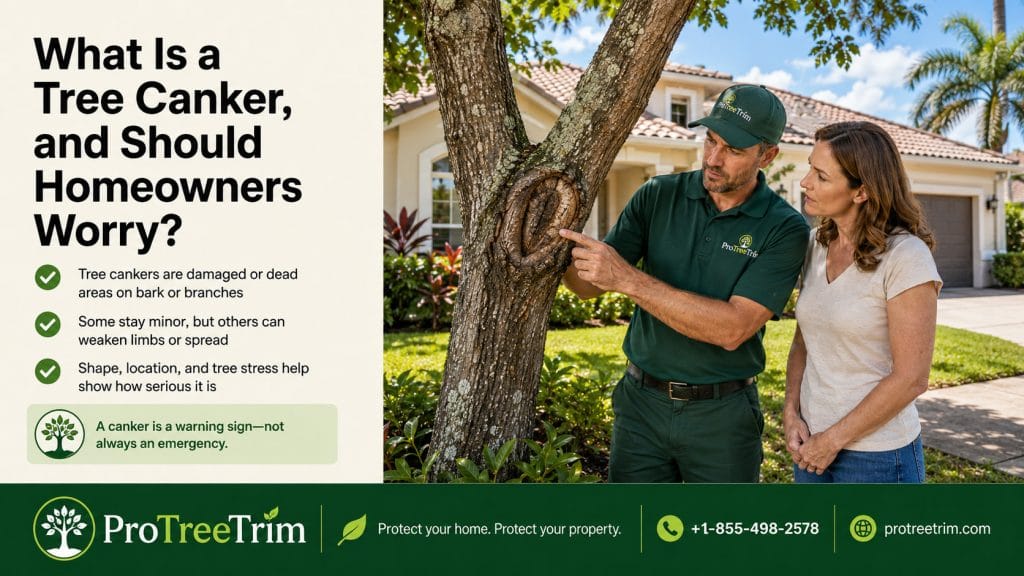
A tree canker is an area of dead, damaged, or diseased bark and underlying tissue on a trunk, branch, or stem. To homeowners, it may look like a sunken patch, cracked bark, an oozing wound, a dark stain, peeling bark, or a dead-looking section on one side of the tree.
Some cankers stay small, and the tree grows around them. Others expand, weaken branches, or signal a larger tree-health problem. The key is to look at where the canker is, how large it is, whether it is spreading, and whether the tree has other warning signs.
What a Tree Canker Can Look Like
Cankers do not all look the same. Some are obvious wounds. Others are subtle bark changes that homeowners only notice after leaves begin browning or a branch starts dying back.
| What you see | What it may suggest |
|---|---|
| Sunken bark patch | Dead or damaged tissue may be present |
| Bark cracking around one area | Tree may be sealing off an injury |
| Dark stain or oozing | Wound response or disease activity may be involved |
| Peeling bark in one spot | Localized tissue death may be possible |
| Dead branch beyond a wound | Canker may be affecting branch health |
| Swollen callus around a wound | Tree may be trying to close the area |
| Multiple cankers on branches | Broader stress or disease pressure may exist |
A canker is not always an emergency, but it should not be ignored if it is growing, oozing heavily, or tied to branch decline.
Cankers Often Start With Stress or Injury
Cankers may develop after bark injury, pruning wounds, mower damage, storm damage, sunscald, drought stress, root damage, insects, disease organisms, or poor site conditions. A healthy tree may be better able to limit the damage. A stressed tree may struggle.
Common contributing factors include:
- broken branches
- poor pruning cuts
- mower or string-trimmer wounds
- drought stress
- standing water or poor drainage
- root damage from construction
- soil compaction
- bark cracks after weather stress
- pest activity
- old storm damage
A canker is often the visible result of a tree that has already been under pressure.
Location Matters
A small canker on a minor branch is different from a large canker on the main trunk. A canker on a branch over open lawn is different from one on a limb over a driveway, roof, patio, or pool cage.
Pay closer attention when the canker is on:
| Location | Why it matters |
|---|---|
| Main trunk | Can affect structural strength if large or spreading |
| Branch union | May weaken attachment area |
| Large limb over roof | Consequences are higher if the limb fails |
| Limb over driveway | Vehicles and people may be exposed |
| Tree near walkway | Falling branch risk matters more |
| Young tree trunk | Small trunk has less tissue to lose |
| Multiple branches | Broader tree stress may be involved |
The same wound can be low-risk or serious depending on where it sits.
Do Not Confuse Normal Bark Shedding With a Canker
Some trees naturally shed bark. Sycamores and crape myrtles, for example, may have peeling or mottled bark as part of normal growth. That is different from a localized dead, sunken, cracked, or oozing wound.
Normal bark shedding is more likely when:
- the canopy looks healthy
- bark underneath is firm
- shedding is even or patterned for the species
- there is no soft wood
- there is no foul smell
- there is no branch dieback above the area
A canker is more likely when the bark change is localized, sunken, cracked, dark, wet, or paired with dead tissue.
Oozing Does Not Always Mean the Same Thing
Some cankers ooze sap or dark fluid. That can look alarming. Oozing may be part of the tree’s response to injury, infection, insect activity, or internal stress.
Look closer if oozing is paired with:
- soft bark
- foul smell
- dead branches
- cracks spreading from the wound
- insects gathering around the area
- sawdust-like material
- mushrooms nearby
- trunk cavities
- canopy thinning
Oozing alone is not enough to diagnose the tree, but it is worth documenting.
Cankers on Branches Can Lead to Dieback
When a canker forms on a branch, it may interrupt movement of water and nutrients beyond that point. Leaves past the canker may wilt, brown, thin, or die back.
A branch canker is more concerning when:
- the branch beyond it is dead
- the canker wraps around much of the branch
- the branch is cracked
- the branch hangs over a target
- multiple branches show similar symptoms
- the canker appears near the trunk attachment
If a cankered branch is already dead and over a driveway, roof, pool cage, or walkway, pruning may be needed sooner.
Cankers on the Main Trunk Deserve More Caution
A trunk canker can be more serious because the trunk supports the whole tree. A small old wound that is closing over may be manageable. A large, expanding, sunken, cracked, or decaying trunk canker deserves closer attention.
Be more cautious if the trunk canker:
- covers a large section of the trunk
- appears to be expanding
- is soft or wet
- has mushrooms nearby
- is connected to a crack or cavity
- has insects or sawdust-like material
- is on a leaning tree
- is on the side facing a structure
A trunk problem near a house, driveway, or patio is not just a cosmetic bark issue.
Young Trees Are More Vulnerable
Young trees have thinner bark and smaller trunks. A canker or bark wound that seems small may affect a large percentage of the trunk. That can slow growth, cause dieback, or create a weak point.
Young trees are especially vulnerable after:
- deer rubbing
- mower damage
- string-trimmer cuts
- poor planting depth
- drought stress
- sunscald
- transplant shock
- trunk wraps left too tight
A young tree with a trunk canker should be protected from further damage and monitored closely.
Do Not Paint or Seal the Canker
Homeowners often want to cover a canker with wound paint, tar, sealant, or paste. In most cases, that is not the right move. Trees do not heal like skin. They seal off damaged tissue and grow around wounds over time.
Sealing the wound can trap moisture, hide decay, and make it harder to monitor changes.
A better approach:
- do not paint the wound
- do not fill the cavity
- do not scrape healthy bark
- remove only loose, clearly detached bark
- keep mulch away from the trunk
- protect the tree from further injury
- take photos and monitor size
The goal is to support the tree’s natural response, not cover the problem.
Do Not Cut Into the Trunk to “Clean It Up”
A canker can look messy, and homeowners may be tempted to cut away rough bark. This can make the wound larger. Cutting into living bark around the canker may damage the tissue the tree is using to contain the problem.
Avoid:
- carving the canker
- scraping firmly attached bark
- drilling holes
- cutting into the trunk
- pressure washing the wound
- applying random chemicals
- wrapping it tightly
If the wound needs assessment, it should be done carefully.
Pruning May Help When the Canker Is on a Small Branch
If a canker is limited to a small branch, pruning may help remove the affected branch before the issue spreads or before the branch dies and falls. But pruning should be done correctly and only when it makes sense.
Pruning may be reasonable when:
- the branch is already dead
- the cankered branch is small
- the branch is cracked or weak
- the branch hangs over a walkway or driveway
- the wound is far enough from the trunk to make a proper cut
- removal will not strip too much canopy
Do not remove large limbs casually just because they have bark damage. Large cuts can create new problems.
Tree Stress Makes Cankers Worse
A tree under stress is more likely to develop cankers and less able to contain them. That is why the root zone matters.
Check whether the tree is dealing with:
| Stress factor | Why it matters |
|---|---|
| Drought | Reduces tree resilience |
| Too much water | Roots may lack oxygen |
| Compacted soil | Limits root function |
| Root cutting | Reduces water and nutrient uptake |
| Heavy mulch | Can hide trunk and root problems |
| Construction nearby | May damage roots and soil |
| Poor pruning | Creates wounds and weak regrowth |
| Pest pressure | Adds stress to damaged tissue |
Canker management often means reducing stress, not only looking at the bark.
Check the Canopy
A canker may be more serious if the canopy above it is declining.
Look for:
- leaves wilting beyond the wound
- branch-tip dieback
- one side of the tree thinning
- early leaf drop
- smaller-than-normal leaves
- dead branches above the canker
- repeated branch drop
- lack of new growth
If the canopy is healthy and the canker is old and contained, monitoring may be enough. If the canopy is declining, look closer.
Cankers Near Structures Need Faster Decisions
A canker on a low-risk branch in open lawn may be monitored calmly. A canker on a large limb over a roof, driveway, walkway, pool cage, or patio deserves faster attention.
Location changes urgency.
Be more cautious when the affected tree or branch is near:
- houses
- driveways
- sidewalks
- patios
- pool cages
- fences
- parked vehicles
- utility areas
- neighbor property
- children’s play areas
Tree health and property risk are connected when targets are nearby.
When a Canker Is Less Concerning
A canker may be less concerning when:
- it is small and not expanding
- the tree is otherwise vigorous
- the canopy looks full
- the wound has callus growth around it
- there is no soft wood
- there are no mushrooms or cracks
- the affected branch is minor
- the tree is far from structures
In that case, photos, monitoring, and stress reduction may be enough.
When to Take It Seriously
A canker deserves closer attention when it is large, spreading, wet, soft, cracked, or tied to canopy decline.
Be more cautious if you see:
- expanding dead bark area
- large trunk canker
- branch dieback beyond the canker
- mushrooms near the base
- trunk cracks
- sawdust-like material
- insects entering the wound
- new lean
- repeated limb drop
- canker on a large limb over property
These signs suggest the issue may be more than a surface wound.
What Homeowners Should Photograph
Photos help track whether the canker is stable or spreading.
Take photos of:
- full tree from several angles
- close-up of the canker
- the wound with a size reference
- canopy above the wound
- trunk base and root flare
- any oozing, staining, or soft areas
- nearby mushrooms or cracks
- branches over structures
- recent yard work near the roots
Repeat photos every few weeks or months during active symptoms.
What to Do First
A practical first response:
- Identify where the canker is.
- Check whether it is on a branch or trunk.
- Look for canopy decline above it.
- Do not paint, seal, or carve the wound.
- Keep mulch away from the trunk.
- Reduce stress around the root zone.
- Photograph and monitor whether it expands.
- Get help if it is large, spreading, wet, soft, or near important property areas.
This keeps the response careful and avoids making the wound worse.
Final Homeowner Takeaway
A tree canker is a dead or damaged area on bark and underlying tissue. Some cankers remain small and the tree grows around them. Others expand, weaken branches, or signal a larger health problem.
Do not cover, carve, or seal a canker. Look at the location, size, spread, canopy condition, trunk base, and nearby property risk. A small stable canker may only need monitoring. A large trunk canker, spreading wound, dead branch, or canker over a roof, driveway, walkway, or patio deserves closer attention.
If you are unsure whether a canker on your tree is minor, spreading, or part of a larger structural issue, ProTreeTrim can help connect homeowners with local tree service support. Call +1-855-498-2578 or visit protreetrim.com.
FAQs
What is a tree canker?
A tree canker is an area of dead, damaged, or diseased bark and underlying tissue on a trunk, branch, or stem.
Can a tree survive a canker?
Yes, many trees can survive small or contained cankers, especially if the tree is otherwise healthy and the wound is not spreading.
Should I paint or seal a tree canker?
Usually no. Painting or sealing can trap moisture and hide problems. Trees seal off wounds naturally over time.
When is a tree canker serious?
It is more serious when it is large, spreading, on the main trunk, oozing, soft, paired with dead branches, or located on a limb over property.
ProTreeTrim™ can help you take the next step.
If you are dealing with a damaged tree, fallen branch, stump, root issue, palm concern, or storm cleanup question in Florida, call ProTreeTrim for tree service support.