
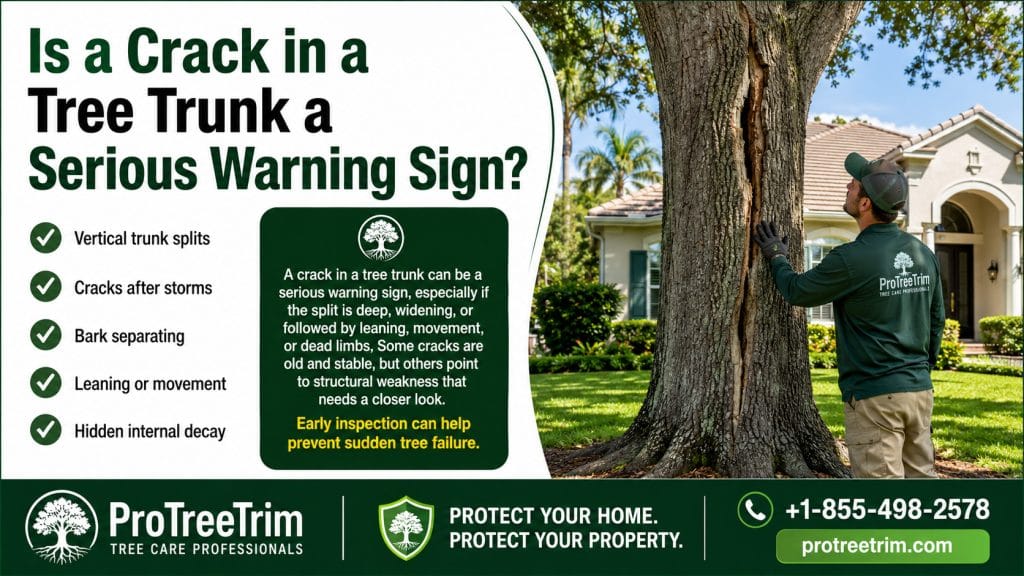
A crack in a tree trunk should not be ignored, especially in a Florida yard where wind, heavy rain, sandy soil, and storm season can add stress quickly. Some cracks are old and stable. Others may signal splitting, decay, storm damage, or a weakening tree that deserves a closer look before it threatens a roof, driveway, pool cage, or fence.
Not Every Crack Means Immediate Removal
The first thing to notice is whether the crack looks old or new. An old scar with sealed edges may be part of the tree’s history. A fresh split with exposed wood, loose bark, moisture, insects, or widening separation is more concerning.
Look at the direction of the crack. A vertical crack running through the main trunk can matter more if it appears deep, long, or connected to a major branch union. A crack where two large stems meet can also be worth attention, especially if the tree has a heavy canopy leaning toward the house or street.
Do not push on the trunk, peel bark away, or try to “test” the crack. Take photos from the ground and compare them over time if the tree is not an immediate hazard.
| What you notice | Why it matters |
|---|---|
| Fresh exposed wood | May indicate recent splitting |
| Crack widening after storms | Could show movement |
| Crack at a major branch union | May affect limb or stem strength |
| Mushrooms or soft wood nearby | Can suggest decay may be present |
| Tree has a new lean | Could signal broader stability concern |
| Crack faces roof, pool cage, or driveway | Raises property risk |
What Else to Check Around the Tree
A trunk crack becomes more important when other warning signs show up with it. Check the base for lifted soil, exposed roots, soft ground, or mulch piled against the trunk. Look up for heavy limbs, dead branches, or one side of the canopy pulling most of the weight.
Location matters too. A cracked tree in the far back of a large yard is different from one beside a bedroom, screened lanai, septic area, driveway, or neighbor’s fence. If the tree could damage something important if it fails, do not wait until the next storm to ask questions.
If the crack appeared after wind, lightning, heavy rain, or a falling limb, document it before cleanup. Photograph the full tree, the crack, the root area, and nearby targets.
If you are unsure whether a cracked tree, palm, stump, or root issue needs professional attention, ProTreeTrim can help connect Florida homeowners with local tree service support. Call +1-855-498-2578 or visit protreetrim.com.
FAQs
Does a trunk crack always mean the tree must be removed?
No. Some cracks are old wounds. Fresh, widening, deep, or structural cracks deserve closer attention.
Should I seal or fill a crack in a tree trunk?
Do not guess with sealants or fillers. The better first step is understanding whether the crack is cosmetic, old damage, or a structural concern.
Is a cracked tree more risky before storm season?
It can be, especially if the crack is paired with a lean, heavy limbs, decay, root movement, or nearby structures.
ProTreeTrim™ can help you take the next step.
If you are dealing with a damaged tree, fallen branch, stump, root issue, palm concern, or storm cleanup question in Florida, call ProTreeTrim for tree service support.