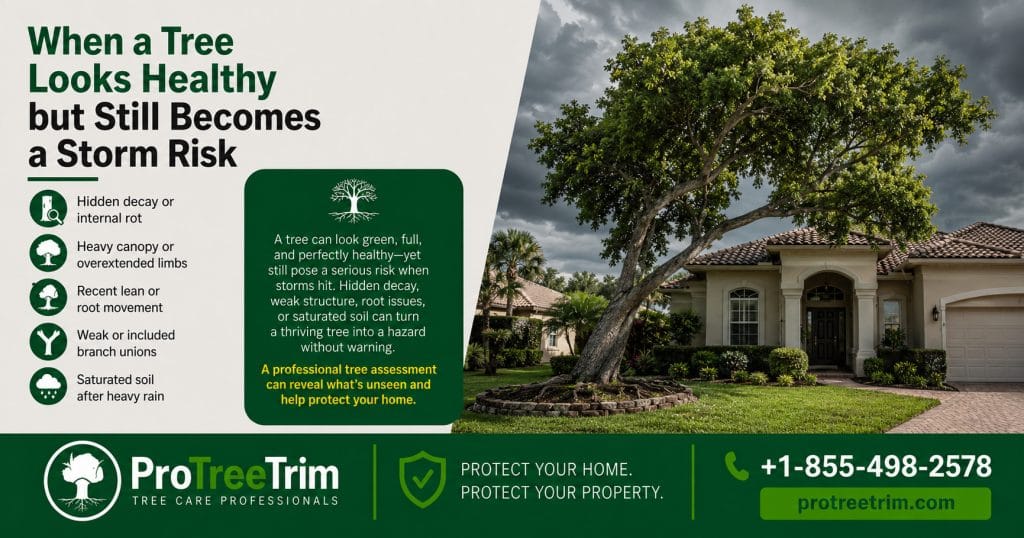
A tree can have green leaves, good shade, and a full canopy but still create storm concerns. Florida homeowners should look beyond “healthy-looking” growth and check structure, roots, limb weight, nearby targets, and recent changes around the yard. The question is not only whether the tree is alive. It is whether it can handle wind, rain, and saturated soil safely.
Green Leaves Do Not Tell the Whole Story
Many homeowners look up first. If the canopy is full, the tree feels fine. That is understandable, but storm risk often starts lower or deeper in the structure.
Look at the trunk. Are there cracks, old wounds, cavities, peeling bark, or a split where two large stems meet? A tree with a tight V-shaped union can sometimes hold included bark, which may make that connection weaker than it looks from the ground. You do not need to diagnose the tree yourself, but you should notice changes that were not there last season.
The root area matters just as much. In Florida’s sandy soil, heavy rain can soften the ground around shallow roots. Watch for fresh lifting near the base, mushrooms at the trunk, soil pulling away, or roots that seem newly exposed after drainage problems. Mulch piled too high against the trunk can also hide decay or moisture issues.
Large limbs deserve attention before storm season. A heavy branch stretching over a roof, driveway, pool cage, fence, or parked vehicle may become a problem even if the leaves look healthy. The same goes for palms with loose fronds or trunks leaning toward a structure.
Check the Yard Around the Tree
A tree does not have to fall completely to cause damage. A cracked limb can tear a gutter, puncture a screen enclosure, block a driveway, or break irrigation lines. In tighter Florida yards, one tree can affect several areas at once: pavers, fences, neighboring lots, septic areas, and overhead service lines.
Think about what changed recently. Was there construction near the roots? Did a new patio, driveway edge, or drainage project alter the soil? Has water been standing near the trunk after storms? Has the canopy become much heavier on one side?
Take photos from a safe distance and compare them with older pictures if you have them. That small step can help you explain the issue clearly if you decide to ask for a professional opinion.
If you are unsure whether a tree, palm, stump, or root issue needs professional attention, ProTreeTrim can help connect Florida homeowners with local tree service support. Call +1-855-498-2578 or visit protreetrim.com.
FAQs
Can a healthy tree still fall in a storm?
Yes. A tree may look alive and still have structural, root, or limb problems that make storm damage more likely.
What should I check before hurricane season?
Look for cracked limbs, trunk splits, root movement, heavy branches over structures, and drainage problems near the base.
Should I trim a risky-looking tree myself?
Avoid cutting large limbs, overhead branches, or anything near utility lines. Those situations are safer for trained crews.
ProTreeTrim™ can help you take the next step.
If you are dealing with a damaged tree, fallen branch, stump, root issue, palm concern, or storm cleanup question in Florida, call ProTreeTrim for tree service support.