
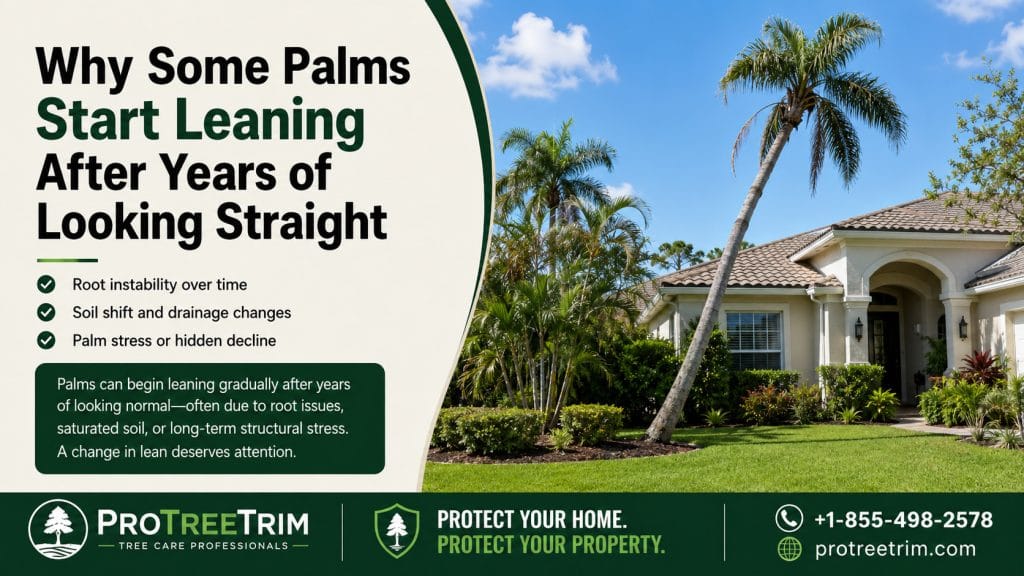
A palm that has stood straight for years and then begins to lean should not be dismissed as “just how palms grow.” Some palms do develop a natural angle over time, but a new lean can point to soil movement, root stress, drainage changes, wind exposure, or damage near the base. The key question is whether the lean is old, slow, and stable—or recent and changing.
A New Lean Is Different From a Natural Lean
Many palms have a slight curve or angle, especially if they grew toward light or away from a nearby structure. That type of lean often develops gradually and may stay consistent for years.
The concern starts when the lean appears after a storm, heavy rain, irrigation problem, construction work, or soil washout. A palm beside a driveway, pool cage, fence, or roofline may also become more noticeable as it grows taller and the crown carries more weight higher above the ground.
Start at the base. Do not judge only by the fronds. A palm can have a green crown while the soil around the root area is shifting.
| What you notice | Why it matters |
|---|---|
| Lean has looked the same for years | May be a stable growth pattern |
| Lean appeared after rain or wind | Root or soil movement may be involved |
| Soil lifted on one side of the trunk | Possible root plate movement |
| Ground feels soft near the base | Drainage or saturation may be contributing |
| Palm leans toward roof or pool cage | Property risk is higher |
| Fronds or seed pods drop near walkways | Lean and debris risk may overlap |
Check What Changed Around the Palm
A leaning palm often tells a yard story. Maybe a paver walkway was repaired nearby. Maybe irrigation has been soaking one side of the bed. Maybe soil washed away after summer rain. Maybe the palm was planted in a narrow strip between the house and driveway, and the roots never had much room.
Look for recent changes:
- Was a fence, patio, pool deck, or irrigation line installed nearby?
- Has water started collecting around the palm after storms?
- Are pavers lifting or dipping near the trunk?
- Is mulch piled high enough to hide the base?
- Has the palm dropped more fronds or seed pods than usual?
- Is the crown now hanging over a roof, screen enclosure, parked car, or neighbor’s fence?
Do not dig around the palm to “check the roots.” Palms rely on the root system they have, and disturbing the base can create more trouble. Take photos instead: full palm, trunk base, lean direction, surrounding soil, nearby structures, and any hardscape movement.
When a Leaning Palm Deserves Faster Attention
A leaning palm becomes more urgent when the lean is new, increasing, or aimed at something valuable. A palm leaning over open grass is one situation. A palm leaning toward a bedroom, pool cage, front entry, driveway, fence, or utility area is different.
Avoid trying to correct the lean with ropes, vehicles, straps, or DIY bracing. Pulling a mature palm can damage roots, shift soil, or create a sudden failure point. Trimming fronds to “balance” the palm is not a real fix either. If the problem is at the base or in the soil, removing fronds will not solve it.
If the palm is near power lines or a service line, stay back and contact the utility first. Tree cleanup or removal planning comes after the electrical concern is handled.
If you are unsure whether a leaning palm, root issue, stump, or nearby hardscape problem needs professional attention, ProTreeTrim can help connect homeowners with local tree service support. Call +1-855-498-2578 or visit protreetrim.com.
FAQs
Is a leaning palm always dangerous?
No. Some palms lean naturally and remain stable for years. A new or worsening lean is more concerning.
Can heavy rain make a palm start leaning?
Heavy rain can soften soil or reveal existing root and drainage problems, especially if the palm is in a low or wet area.
Should I trim the crown to reduce the lean?
No. Trimming fronds does not correct root or soil movement. It may also stress the palm if healthy fronds are removed.
What should I photograph before calling for help?
Photograph the full palm, trunk base, soil movement, lean direction, nearby roofline, pool cage, driveway, fence, or walkway.
ProTreeTrim™ can help you take the next step.
If you are dealing with a damaged tree, fallen branch, stump, root issue, palm concern, or storm cleanup question in Florida, call ProTreeTrim for tree service support.