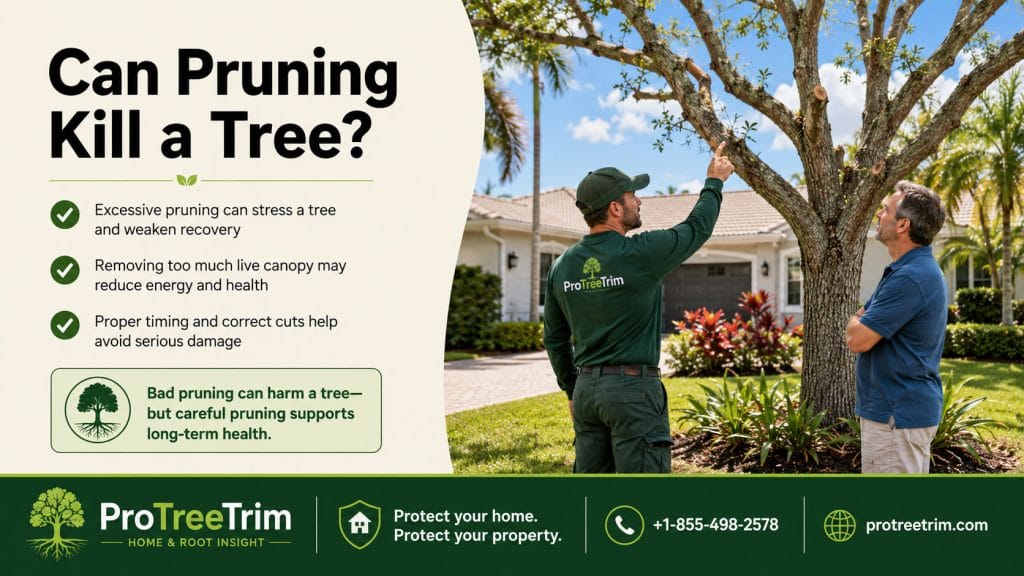
Yes, pruning can seriously damage or even help kill a tree when it is done poorly, too aggressively, at the wrong time, or for the wrong reason. Good pruning removes dead, broken, hazardous, rubbing, or poorly structured branches in a careful way. Bad pruning removes too much live canopy, creates large wounds, cuts into the trunk, tops the tree, strips palms, or stresses a tree that is already struggling.
Pruning is not automatically harmful. But it is not harmless either. Every cut is a wound the tree must respond to.
Pruning Hurts Trees When Too Much Live Canopy Is Removed
A tree’s leaves are its energy system. When too much live canopy is removed, the tree loses part of its ability to produce energy, support roots, respond to stress, and grow normally.
Over-pruning is especially risky when the tree is already dealing with:
- drought
- flooding
- root damage
- construction stress
- transplant shock
- pest pressure
- disease symptoms
- storm damage
- soil compaction
- poor drainage
A healthy tree may tolerate light, selective pruning. A stressed tree may decline after the same cuts.
Topping Can Severely Damage a Tree
Topping is one of the most harmful pruning practices. It means cutting the top or major limbs back to large stubs. Homeowners sometimes request topping because a tree feels too tall, too close to the house, or too risky before storm season.
Topping can cause:
| Problem | Why it matters |
|---|---|
| Large wounds | Harder for the tree to close |
| Weak regrowth | New shoots may attach poorly |
| Decay | Large cut surfaces may deteriorate |
| Poor structure | Natural branch pattern is lost |
| Repeated pruning cycle | Fast sprouts need cutting again |
| Sun exposure | Bark and limbs may be newly exposed |
| Long-term risk | The tree may become weaker over time |
A topped tree may grow back, but fast regrowth is not the same as healthy recovery.
Bad Cuts Can Create Long-Term Wounds
A proper pruning cut respects the branch collar, the natural area where a branch joins the trunk or larger limb. Bad cuts either cut too close or leave too much behind.
Two common mistakes:
- Flush cuts: cutting flat against the trunk and removing important collar tissue
- Long stubs: leaving dead wood that may decay before the tree can close the wound
Both can slow wound closure and increase long-term decay concerns.
Large Limb Removal Should Not Be Casual
Removing a large branch creates a large wound. Sometimes that is necessary, especially when the limb is dead, cracked, storm-damaged, or threatening a roof, driveway, walkway, or patio. But large healthy limbs should not be removed just for appearance.
Before removing a large limb, ask:
- Is it dead or broken?
- Is it cracked or weak?
- Is it touching the roof?
- Is it over a driveway or walkway?
- Is there a smaller cut that solves the issue?
- Will removing it unbalance the tree?
- Is the tree already stressed?
A large cut made for a weak reason can create more harm than benefit.
Heavy Pruning Can Push a Stressed Tree Further Into Decline
A struggling tree often does not need aggressive pruning. It may need root-zone correction, better watering, drainage improvement, mulch adjustment, pest identification, or time to recover.
Heavy pruning can make things worse when the tree has:
- brown leaf edges
- early leaf drop
- thinning canopy
- recent root disturbance
- mushrooms near the base
- trunk cracks
- buried root flare
- standing water
- major deadwood
- recent transplant shock
Dead or hazardous branches may still need removal. But cutting healthy branches from a stressed tree should be done cautiously.
Palm Over-Trimming Can Hurt Palms
Palms are often damaged by over-trimming. A palm should not be stripped of green fronds just to look clean or “storm ready.” Healthy green fronds help the palm produce energy.
Bad palm trimming includes:
- removing many green fronds
- hurricane-cutting the palm
- cutting into the trunk
- shaving the trunk aggressively
- damaging the crown
- pulling off tight old boots
- removing fronds just because they point downward
Good palm work removes fully dead fronds, broken fronds, hazardous hanging fronds, and seed pods when needed.
Evergreen Pruning Can Leave Permanent Damage
Pines, spruce, fir, arborvitae, junipers, and similar evergreens often do not regrow well from old bare wood. If they are cut too deeply, the bare spot may stay bare.
Be careful with:
- privacy rows
- arborvitae screens
- mature pines
- spruce near homes
- evergreens already turning brown
- branches cut back past green growth
- topping evergreen trees
A leafy shade tree and an evergreen do not respond to pruning the same way.
Pruning Near Power Lines Can Be Dangerous
Pruning can harm people too. Branches near power lines should not be handled with ladders, pole saws, ropes, or DIY tools.
Do not:
- cut limbs touching wires
- pull branches away from wires
- climb a tree near power lines
- use metal tools near service lines
- stand under storm-damaged branches near wires
Utility clearance is not normal homeowner pruning. It requires proper safety handling.
Can a Tree Recover From Bad Pruning?
Sometimes. A healthy tree may recover from limited bad pruning, especially if the wounds are small and the tree has enough canopy left. But severe topping, repeated over-pruning, large flush cuts, root stress, or trunk decay can leave long-term damage.
Recovery is more likely when:
- enough live canopy remains
- the tree is otherwise healthy
- roots are not damaged
- large wounds are limited
- future pruning is corrected
- the tree is not repeatedly topped
- watering and mulch are managed properly
Recovery is less likely when the tree is already weak, mostly dead, decayed, leaning, or severely over-pruned.
What Good Pruning Should Do
Good pruning should solve a real problem while preserving the tree’s natural structure.
Good pruning may:
- remove deadwood
- remove broken branches
- clear roof contact
- improve driveway or walkway clearance
- reduce rubbing branches
- correct young tree structure
- remove storm-damaged limbs
- reduce a specific overextended branch carefully
Good pruning should not leave the tree topped, gutted, scalped, or unbalanced.
When Pruning Should Wait
Pruning may be better delayed when:
- the tree is newly planted
- the tree is drought-stressed
- roots were recently damaged
- the canopy is already thin
- the requested work is only cosmetic
- cuts would be large
- the tree was recently over-pruned
- the cause of decline is unclear
Waiting is often better than cutting without a clear purpose.
When Pruning Should Not Wait
Pruning should not wait when a branch creates a clear safety or property concern.
Act sooner when:
| Situation | Why action may be needed |
|---|---|
| Dead limb over driveway | People and vehicles are exposed |
| Broken branch hanging | Could fall unpredictably |
| Branch touching roof | Can damage shingles or gutters |
| Limb blocking walkway | Access and safety issue |
| Palm frond over pool cage | Screen damage possible |
| Cracked limb after storm | Failure concern may increase |
| Branch near wires | Needs proper utility-safe help |
Urgent pruning should solve the urgent issue without turning into excessive cutting.
Final Homeowner Takeaway
Pruning can help a tree when it is careful, selective, and done for a clear reason. It can damage or help kill a tree when it removes too much live canopy, creates large bad wounds, tops the tree, strips palms, cuts evergreens too deeply, or adds stress to an already declining tree.
The safest pruning starts with a simple question: what problem are we solving? If the answer is deadwood, storm damage, roof clearance, driveway clearance, rubbing branches, or young-tree structure, pruning may help. If the answer is “cut it way back,” “make it much smaller,” or “it will grow back,” slow down.
If you are unsure whether pruning will help or hurt your tree, ProTreeTrim can help connect homeowners with local tree service support. Call +1-855-498-2578 or visit protreetrim.com.
FAQs
Can pruning kill a tree?
Yes, severe over-pruning, topping, bad cuts, palm over-trimming, or pruning a stressed tree too hard can seriously damage or contribute to decline.
How much pruning is too much?
It depends on the tree, species, health, season, and branch size. Removing too much live canopy at once is one of the biggest risks.
Can a tree recover after being over-pruned?
Sometimes, if enough healthy canopy and roots remain. Repeated topping or severe canopy loss can cause long-term problems.
Is topping worse than normal pruning?
Yes. Topping cuts major limbs to stubs and often creates weak regrowth, large wounds, decay risk, and poor future structure.
ProTreeTrim™ can help you take the next step.
If you are dealing with a damaged tree, fallen branch, stump, root issue, palm concern, or storm cleanup question in Florida, call ProTreeTrim for tree service support.