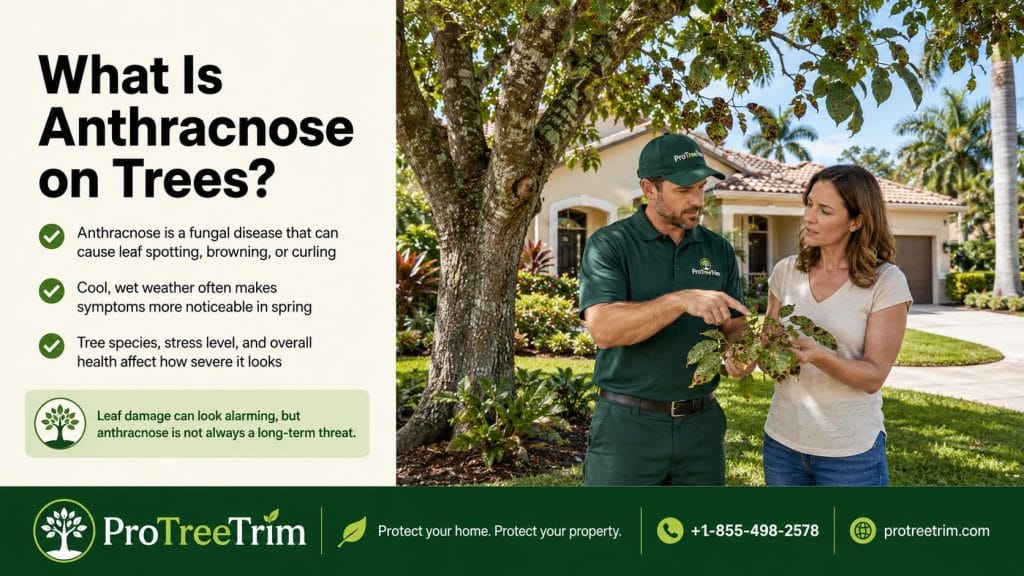
Anthracnose is a common name for a group of fungal leaf and twig diseases that can affect many trees. Homeowners usually notice it when leaves develop brown spots, dark blotches, curling, distorted growth, or early leaf drop. On some trees, anthracnose looks dramatic but may be mostly seasonal. On stressed, young, or repeatedly affected trees, it can become more concerning.
The important question is not only “Does my tree have anthracnose?”
It is “How much of the tree is affected, and is the tree otherwise healthy?”
What Anthracnose Can Look Like
Anthracnose symptoms vary by tree species and weather conditions. It may look like brown leaf patches, dark spots, dead areas along leaf veins, curled leaves, twig dieback, or early leaf drop.
| What you see | What it may suggest |
|---|---|
| Brown or black leaf spots | Leaf disease or weather-related fungal issue may be possible |
| Blotchy dead areas on leaves | Anthracnose-type symptoms may be involved |
| Curling or distorted new leaves | New growth may have been affected |
| Early leaf drop | Tree stress may be greater |
| Twig dieback | More concerning than leaf spots alone |
| Repeated symptoms each year | Tree may need closer monitoring |
| Leaf spots plus dead limbs | Look beyond the leaf disease |
A few ugly leaves are usually not the same as a serious structural tree problem.
Weather Often Plays a Big Role
Anthracnose problems are often more noticeable after cool, wet, or humid conditions during leaf development. When leaves stay wet for long periods, fungal leaf problems can become more visible.
This is why a tree may look worse one year and better the next. The disease pressure can change with weather, tree stress, airflow, and timing.
If several trees in the neighborhood show similar spotting or early leaf drop, the issue may be seasonal rather than one tree suddenly failing.
Trees Commonly Associated With Anthracnose Symptoms
Different trees can show anthracnose-like symptoms, including sycamore, maple, oak, ash, dogwood, and other landscape trees. The exact pattern may look different from one species to another.
For homeowners, the tree species matters because symptoms can be more dramatic on some trees.
| Tree type | What homeowners may notice |
|---|---|
| Sycamore | Leaf browning, curling, early drop, twig dieback in some cases |
| Maple | Brown blotches, dark spots, leaf distortion |
| Oak | Brown patches, leaf spots, possible twig concerns |
| Ash | Leaf spots, browning, early leaf drop |
| Dogwood | Leaf spots, blotches, stress symptoms |
| Young ornamentals | More visible impact because canopy is smaller |
Identification helps, but the tree’s overall condition matters more.
Anthracnose Is Often a Leaf Problem, Not a Tree-Failure Problem
Many mature trees can tolerate some anthracnose symptoms, especially if the issue is mostly on leaves and the tree refoliates or continues growing normally.
A tree may look unattractive for a season without being unsafe.
Anthracnose is less concerning when:
- the tree is mature and otherwise vigorous
- symptoms are mostly on leaves
- the canopy remains reasonably full
- new growth continues
- branches are not dying heavily
- the trunk and root area look stable
- there are no mushrooms, cracks, cavities, or lean
- symptoms appear during a wet season and then stabilize
In that case, monitoring and cleanup may be enough.
When Anthracnose Deserves More Attention
Anthracnose becomes more important when the tree is young, newly planted, already stressed, repeatedly defoliated, or showing twig and branch dieback.
Look closer if you see:
- heavy early leaf drop
- repeated severe symptoms year after year
- branch-tip dieback
- dead twigs throughout the canopy
- large dead limbs
- one-sided canopy thinning
- recent construction near roots
- poor drainage or standing water
- root flare buried under mulch or soil
- mushrooms or decay signs near the base
Leaf disease may be only one part of a larger tree-health issue.
Do Not Panic-Prune the Tree
Anthracnose symptoms can make homeowners want to cut out every spotted or curled branch. That is usually not the right approach.
Heavy pruning can stress the tree, create unnecessary wounds, and reduce the leaf area the tree uses to recover. Pruning should target dead, broken, cracked, rubbing, or hazardous branches—not every leaf with a spot.
Good pruning reasons include:
- dead limbs
- broken storm branches
- branches touching the roof
- limbs over driveways or walkways
- cracked or hanging branches
- rubbing branches
- clearance problems
Poor pruning reasons include:
- cutting large healthy limbs because leaves are spotted
- topping the tree
- stripping the canopy
- removing branches just to make the tree look cleaner temporarily
The disease may be on the leaves, but the pruning decision should be about structure.
Rake and Remove Heavy Fallen Leaves
For recurring leaf disease issues, leaf cleanup may help reduce some disease pressure and keep the yard cleaner. It is not a magic cure, but it is a practical low-risk step.
Raking is especially useful around:
- small ornamental trees
- front yards
- patios
- pool decks
- walkways
- gutters and roof valleys
- tight planting beds
- areas where leaves stay wet and packed
Do not pile diseased leaves against the trunk or bury the root flare under leaf debris.
Improve Airflow Without Over-Thinning
Dense canopies and crowded plantings can stay wet longer after rain or irrigation. Better airflow may help reduce leaf wetness, but that does not mean the tree should be aggressively thinned.
A careful approach may include:
- removing deadwood
- correcting crossing or rubbing branches
- avoiding dense shrubs against the trunk
- spacing nearby plantings better
- keeping irrigation from spraying the canopy constantly
- avoiding excessive interior stripping
The goal is better tree health, not making the canopy unnaturally thin.
Check the Root Zone
A tree with good root conditions is usually better able to tolerate leaf problems. A stressed tree may react more severely.
Walk around the base and check:
| Root-zone issue | Why it matters |
|---|---|
| Mulch piled against trunk | Moisture and decay concerns can be hidden |
| Root flare buried | Long-term stress may be present |
| Soil compacted | Roots may lack oxygen |
| Standing water | Root stress can worsen leaf symptoms |
| Recent trenching | Root damage may weaken recovery |
| Pavers or driveway work nearby | Root-zone disturbance may be involved |
| Exposed or cut roots | Stress and stability concerns may overlap |
| Mower or trimmer wounds | Trunk injury adds stress |
If the root zone is poor, leaf disease may look worse and recovery may be slower.
Watering Still Matters
Anthracnose is not solved by simply watering more. But a drought-stressed tree may be less resilient, and a waterlogged tree may have root stress that makes symptoms worse.
The goal is balanced soil moisture.
Avoid:
- watering on autopilot
- letting young trees dry out completely
- keeping soil constantly soggy
- spraying leaves late in the day
- letting irrigation hit the trunk repeatedly
- allowing downspouts to flood the root zone
Healthy roots support recovery after leaf loss.
Young Trees Need Closer Monitoring
A mature tree can often tolerate some leaf disease. A young tree has a smaller canopy and fewer reserves. Heavy defoliation on a young tree can slow establishment and make it more vulnerable to heat, drought, or pests.
For young trees, check:
- planting depth
- root flare visibility
- mulch placement
- watering consistency
- drainage
- trunk protection from mowers
- signs of twig dieback
- whether new growth is appearing
Young trees with repeated severe symptoms may need more attention than a mature shade tree with a temporary leaf issue.
Should Homeowners Use Fungicide?
Fungicide decisions depend on the tree species, timing, severity, value of the tree, and whether the problem recurs. For many mature landscape trees, treatment may not be necessary or practical after symptoms are already visible.
If treatment is considered, timing matters. Spraying after the leaves are already spotted may not change that season’s leaf damage much.
Before considering treatment, ask:
- Is the tree young or high-value?
- Does the issue recur severely each year?
- Is there twig dieback, or only leaf spotting?
- Are site conditions making the problem worse?
- Is the tree close to important property areas?
- Is the tree otherwise healthy?
- Would cleanup and monitoring be enough?
Random spraying without a clear diagnosis is not a good first step.
Anthracnose on Sycamores Can Look Dramatic
Sycamores are known for dramatic leaf and twig symptoms in some seasons. A sycamore may drop leaves, look thin, then push new growth later. That can be alarming but not always fatal.
However, repeated severe dieback, large dead limbs, or a sycamore near a roof, driveway, sidewalk, or pool area should not be ignored.
With sycamores, separate:
- normal peeling bark
- seasonal leaf symptoms
- twig dieback
- large deadwood
- root or trunk problems
- placement and cleanup issues
A messy sycamore is not always a dangerous sycamore, but large dead limbs are a separate concern.
Anthracnose and Property Risk Are Different Questions
A leaf disease may affect appearance. Property risk depends more on branch structure, deadwood, trunk condition, root stability, and what is below the tree.
A tree with leaf spots over open lawn may be monitored. A tree with dead limbs over a driveway or roof needs more attention, even if the leaf disease itself is not severe.
Pay closer attention when affected trees stand near:
- houses
- driveways
- sidewalks
- pool cages
- patios
- fences
- parked vehicles
- utility lines
- neighbor property
Location changes the urgency.
What Homeowners Should Photograph
Photos help track whether the issue is improving or worsening.
Take photos of:
- full tree from multiple angles
- close-up affected leaves
- branch tips
- dead twigs or limbs
- trunk base and root flare
- any mushrooms, cracks, or wounds
- surrounding mulch and soil
- nearby driveway, roof, pool, or sidewalk
- leaf drop on the ground
Repeat photos every few weeks during the growing season if symptoms are active.
What to Do First
A practical first response:
- Identify the tree if possible.
- Check whether symptoms are on leaves only or also twigs.
- Look for new growth.
- Rake heavy fallen leaf debris.
- Inspect the trunk and root flare.
- Check soil moisture and drainage.
- Avoid panic pruning.
- Avoid random spraying.
- Monitor whether the canopy recovers.
- Get help if dieback, dead limbs, or structural signs appear.
This keeps the response focused on tree health instead of leaf appearance alone.
Final Homeowner Takeaway
Anthracnose can cause brown spots, blotches, curling, twig dieback, and early leaf drop on trees. It often looks worse than it is, especially on mature trees during wet seasons.
Worry less when symptoms are mostly cosmetic and the tree remains vigorous. Worry more when anthracnose appears with repeated defoliation, twig dieback, large dead limbs, root stress, trunk cracks, mushrooms, or a tree located near important property areas.
If you are unsure whether anthracnose symptoms are cosmetic or part of a larger tree-health concern, ProTreeTrim can help connect homeowners with local tree service support. Call +1-855-498-2578 or visit protreetrim.com.
FAQs
Is anthracnose fatal to trees?
Often no. Many mature trees tolerate anthracnose symptoms, especially when the issue is mostly on leaves and the tree is otherwise healthy.
What does anthracnose look like on trees?
It may appear as brown or black leaf spots, blotches, curled leaves, distorted new growth, twig dieback, or early leaf drop.
Should I prune branches with anthracnose?
Do not prune only because leaves are spotted. Prune dead, broken, cracked, rubbing, or hazardous branches when needed.
Can raking leaves help with anthracnose?
Yes, removing heavy fallen leaf debris can be a useful cleanup step, especially when leaf disease recurs in the same area.
ProTreeTrim™ can help you take the next step.
If you are dealing with a damaged tree, fallen branch, stump, root issue, palm concern, or storm cleanup question in Florida, call ProTreeTrim for tree service support.