
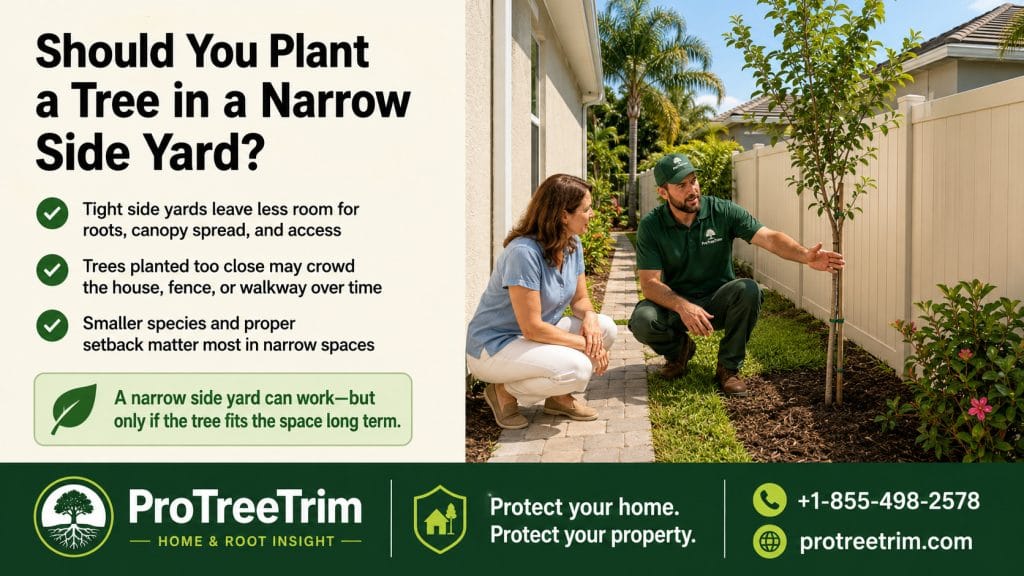
You can plant a tree in a narrow side yard, but it has to be the right tree in the right spot. Side yards often have limited soil, fences, walls, rooflines, utility lines, drainage paths, AC units, gates, pavers, and neighbor boundaries all packed into one small space. A tree that looks harmless when young can become difficult to prune, remove, or live with once it matures.
A Side Yard Is Not Empty Space
A narrow side yard may look like unused space, but it usually performs several important jobs. It may provide drainage, service access, utility access, trash-bin movement, side-gate entry, pool equipment access, or a path for maintenance crews.
Planting a tree there can improve privacy or soften a blank wall, but it can also block the very functions the side yard needs to serve.
| Side-yard feature | Why it matters before planting |
|---|---|
| Fence | Branches and roots may create neighbor or repair issues |
| House wall | Canopy may crowd siding, windows, gutters, or roofline |
| Side gate | Tree may block access as trunk and roots expand |
| AC unit or equipment | Leaves, roots, and clearance can become problems |
| Utility lines | Digging, roots, and pruning may create conflicts |
| Drainage path | Roots or mulch beds may interrupt water flow |
| Pavers or walkway | Roots may lift surfaces or narrow the path |
| Neighbor boundary | Canopy, shade, debris, and pruning may cross the line |
A narrow side yard is one of the worst places to “just try” a tree without planning.
Mature Width Matters More Than Height
Homeowners often ask how tall a tree will get. In a side yard, width may matter more.
A tree that grows wide can press into the house on one side and the fence on the other. If it has to be cut flat every year just to fit, the tree is wrong for the space. Repeated side-pruning can make the canopy unbalanced, unattractive, and stressful for the tree.
Before planting, ask:
- How wide will this tree be at maturity?
- Will branches touch the house or fence?
- Will the canopy cross into the neighbor’s yard?
- Can the tree be pruned from your side?
- Will it block the side gate or walkway?
- Will it still look natural if kept narrow?
- Is a shrub, hedge, or small ornamental a better fit?
A narrow side yard usually needs narrow mature plants, not large trees forced into narrow shapes.
Roots Need Space Too
The root zone is easy to forget in a side yard because everything above ground feels tight. But roots may have even less room than branches.
A tree planted between a house foundation area, fence footing, paver path, driveway edge, or utility trench may be forced into limited soil. Over time, roots may appear at the surface, lift pavers, press near posts, or follow moisture from irrigation and drainage.
Look down before planting:
- Is the soil compacted?
- Is the area mostly pavers or gravel?
- Does water collect there after rain?
- Are irrigation lines nearby?
- Are there downspouts draining into the side yard?
- Is the side yard part of a drainage route?
- Would future digging or utility repair cut roots?
If the tree will have almost no real soil space, choose a different planting solution.
Do Not Block Drainage
Side yards often carry water away from the house. Planting beds, mulch, roots, raised soil, and tree trunks can interfere with that if placed poorly.
A tree may not cause a drainage problem on day one. But a raised bed around it, compacted mulch, or expanding roots can change how water moves through the area. If water starts pooling near the house, fence, pavers, or AC pad, the side yard has lost one of its most important jobs.
Before planting, watch the side yard after rain. Water should move away from the structure, not collect around the trunk or foundation-side bed.
Side Yards Often Have Utility Conflicts
Many side yards contain service lines, meters, AC equipment, cable, irrigation, drainage pipes, lighting wires, or access routes. Tree planting should not block or complicate those systems.
Before digging, underground utilities should be located. But even after safe digging, think about the mature tree. A trunk or root flare should not block meters, valves, cleanouts, drainage access, or repair paths.
Avoid planting where future service workers would have to cut through roots, remove branches, or damage the tree just to reach equipment.
Privacy May Be Better With Shrubs Than Trees
Many homeowners want side-yard trees for privacy. That makes sense, especially between close homes or along a fence. But a tree may not be the best privacy tool in a narrow side yard.
Shrubs, layered planting, trellises, narrow hedges, or small ornamental trees may create privacy with fewer long-term problems. A full-sized tree may eventually block light, drop debris, crowd the neighbor’s side, or require pruning that removes the privacy you wanted.
For side-yard privacy, ask whether you need:
- height
- width
- year-round screening
- lower-level coverage
- a softer fence line
- shade
- noise reduction
- a view block from one window
A smaller, layered solution may work better than one tree trying to do everything.
Be Careful Near Rooflines and Gutters
A side-yard tree may grow directly toward the roof edge. That can lead to branches touching gutters, rubbing siding, dropping leaves into roof valleys, or crowding windows.
This is especially important where homes are close together. A tree may create roofline problems for your home and debris issues for the neighbor’s side.
Do not plant a tree where it will naturally need repeated cutting away from:
- gutters
- soffits
- siding
- windows
- roof valleys
- chimney areas
- service lines
- exterior lights or cameras
If roofline clearance will be a constant fight, move the tree or choose a smaller plant.
Think About Future Removal Before You Plant
This may sound negative, but it is practical. Every tree may eventually need major pruning, storm cleanup, or removal.
A narrow side yard can make that work difficult. Crews may not be able to use normal equipment. Limbs may have to be cut in small sections. Debris may need to be carried by hand. A stump grinder may not fit through the gate. Pavers, fences, screens, and AC units may need protection.
Before planting, ask:
- Can equipment reach this spot later?
- Is the gate wide enough?
- Could a stump grinder fit?
- Can branches be lowered safely?
- Would the neighbor’s property be affected?
- Is there room to haul debris out?
- Would removal damage pavers or irrigation?
A tree that is easy to plant but impossible to service is not a good side-yard tree.
When a Side-Yard Tree Can Work
A tree can work in a narrow side yard when it is truly matched to the space.
Better side-yard tree traits include:
| Better trait | Why it helps |
|---|---|
| Narrow mature form | Reduces house and fence crowding |
| Small to medium size | Keeps pruning and removal realistic |
| Moderate root behavior | Reduces paver and fence conflicts |
| Low debris burden | Keeps walkways, gutters, and equipment cleaner |
| Strong branch structure | Reduces storm cleanup concerns |
| Good local climate fit | Lowers stress and decline risk |
| Manageable pruning needs | Avoids constant hard cutting |
The key is honest mature-size planning.
When You Should Avoid Planting a Tree There
Avoid planting a tree in a narrow side yard if the space is already crowded, poorly drained, full of utilities, blocked by pavers, or too close to the house and fence.
A tree may be a poor choice if:
- the canopy will touch both house and fence
- the roots will have almost no open soil
- the tree will block the only side access
- the spot is part of a drainage path
- utilities or meters need access
- the tree will grow into the neighbor’s side
- future pruning or removal would be difficult
- the tree will need harsh cutting to stay narrow
In those cases, shrubs, hedges, climbing plants, container plants, or smaller landscape features may be smarter.
Final Side-Yard Planting Test
Before planting, stand in the side yard and picture the mature tree.
Will people still be able to walk through?
Will water still drain correctly?
Will branches touch the roof or fence?
Will roots lift pavers?
Will utility access stay open?
Will the neighbor be affected?
Will a crew be able to prune or remove the tree later?
If the mature tree makes the side yard harder to use, choose a smaller plant or move the tree elsewhere.
If you are unsure whether a tree is a good fit for a narrow side yard, fence line, roofline, walkway, or utility area, ProTreeTrim can help connect homeowners with local tree service support. Call +1-855-498-2578 or visit protreetrim.com.
FAQs
Can you plant a tree in a narrow side yard?
Yes, but only if the tree stays small or narrow enough at maturity and does not block drainage, access, utilities, fences, or rooflines.
What kind of tree works best in a side yard?
A small or narrow-form tree with manageable roots, low debris, and modest pruning needs is usually better than a large shade tree.
Should I plant a tree for privacy between two houses?
Sometimes, but shrubs, hedges, or layered planting may work better in tight side yards because they are easier to maintain and control.
What is the biggest side-yard planting mistake?
Planting a tree that looks good when young but grows too wide for the space, forcing constant pruning or eventual removal.
ProTreeTrim™ can help you take the next step.
If you are dealing with a damaged tree, fallen branch, stump, root issue, palm concern, or storm cleanup question in Florida, call ProTreeTrim for tree service support.