
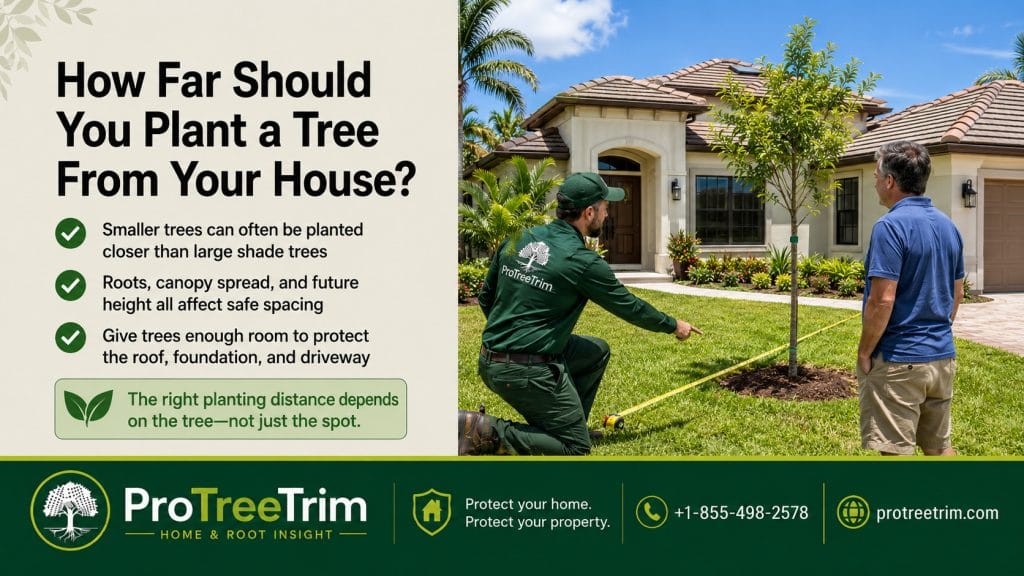
A tree planted near a house can add shade, curb appeal, privacy, and comfort. A tree planted too close can become a future problem for the roof, gutters, driveway, foundation area, pool cage, walkway, fence, or utility lines. The right distance depends on the tree’s mature size, root behavior, canopy spread, soil, drainage, and the structures around it.
Do Not Plant for the Tree You Bought Today
The biggest planting mistake is judging the tree by its nursery size.
A young tree may look harmless in a five-gallon or fifteen-gallon container. It may sit neatly beside the front walk or under a window. But that tree is not staying that size. If it matures into a broad canopy tree, the cute planting spot can become a roofline problem later.
Before planting, think about the mature tree:
- How wide will the canopy become?
- How tall can it get?
- Will limbs grow over the roof?
- Will roots compete with pavers, driveway edges, or sidewalks?
- Will the tree block windows, exterior lights, or the front door?
- Will future crews be able to access it for pruning or removal?
- Are utility lines overhead or underground?
A good planting decision starts with the tree’s future shape, not its current size.
The House Is Only One Part of the Question
“Distance from the house” is important, but it is not the only distance that matters. Many tree problems begin because a tree was planted in a narrow space between several hard surfaces.
A tree may be far enough from the wall but too close to the driveway. It may be clear of the roof but too close to the pool cage. It may look fine from the front but eventually block the side gate where crews need access.
| Nearby feature | Why it matters |
|---|---|
| Roof and gutters | Branches may rub shingles, clog gutters, or drop debris |
| Driveway | Roots may lift edges, and limbs may hang over vehicles |
| Walkway | Roots can create uneven walking surfaces |
| Pool cage | Branches, palm fronds, and debris can damage screens |
| Fence | Roots and limbs may create neighbor or repair issues |
| Septic area | Roots and service access should be considered carefully |
| Utility lines | Tree size and placement must account for safety and clearance |
| Windows and entry | The tree may block light, visibility, or access |
A good planting spot gives both the tree and the property room to function.
There Is No One Perfect Distance for Every Tree
A small ornamental tree and a large shade tree should not be planted by the same rule. A palm, oak, crape myrtle, magnolia, pine, maple, or fruit tree may have very different mature size, structure, cleanup needs, and pruning requirements.
This is why homeowners should avoid one-size-fits-all advice. The better approach is to match the tree to the space.
Ask:
- Is this a small, medium, or large tree at maturity?
- Does it develop large surface roots?
- Does it drop heavy limbs, fruit, seed pods, or fronds?
- Does it need frequent pruning?
- Is the canopy broad or narrow?
- Is the trunk likely to lean or curve toward light?
- Will this tree still fit the site in 10, 20, or 30 years?
If the answer feels uncertain, choose a smaller tree or plant farther away.
Roofline Problems Usually Start Years Before They Are Visible
A tree touching the roof usually did not become a problem overnight. It was often planted too close years earlier, then trimmed repeatedly as it grew into the structure.
That creates a cycle: branches touch the roof, the homeowner trims them back, the tree regrows, and the same problem returns. Over time, the tree may become misshapen, over-pruned, or difficult to manage without large cuts.
Better planting prevents that cycle.
Avoid planting future large trees where they will naturally grow into:
- shingles
- gutters
- soffits
- siding
- windows
- chimney areas
- roof valleys
- pool screen enclosures
- service lines
A tree should not need harsh pruning every few years just to keep it off the house.
Roots Matter, but Not in the Way Many Homeowners Think
People often worry first about roots “attacking” the house. In real yards, the more common visible problems are often around hardscape and soil movement: lifted pavers, cracked walkways, driveway edges, compacted soil, poor drainage, or roots exposed by erosion.
Roots grow where conditions support them. Moisture, oxygen, loose soil, irrigation, and drainage patterns all matter. A tree planted near a downspout, wet bed, patio edge, or irrigation zone may grow differently than expected.
Before planting, check:
- where water flows after rain
- where irrigation runs
- where downspouts discharge
- where pavers or concrete may limit root space
- whether soil stays wet or compacted
- whether the root flare will remain visible
- whether future root growth will conflict with walking or parking areas
The goal is not to fear roots. The goal is to give roots a better place to grow.
Think About Future Maintenance Access
This is one of the most overlooked planting decisions.
A tree planted in a tight side yard, behind a narrow gate, beside a pool cage, or between the house and fence may be easy to plant but expensive to prune or remove later. Access affects cost, safety, cleanup, and property protection.
Before planting, imagine a crew working on that tree years later.
Can they reach it?
Can branches be lowered safely?
Will pavers, irrigation, lighting, fences, or screens be in the way?
Is there room for debris removal?
Would removal require special care near the house?
A tree that fits visually today may still be a poor choice if future maintenance access is terrible.
When Planting Closer May Be Acceptable
Planting closer to a house may be reasonable with smaller trees, narrow-form trees, or carefully chosen ornamental species that stay in scale with the property. The key is honest mature-size planning.
Closer planting may work when:
- the tree remains small at maturity
- branches will not touch the roof
- roots have enough soil space
- the tree will not block access
- there are no overhead utility conflicts
- pruning needs will be modest
- the tree is not in a drainage problem area
Even then, the root flare should stay visible, mulch should not touch the trunk, and the tree should not be planted in a cramped bed that forces future conflict.
When to Plant Farther Away
Plant farther away when the tree is expected to become large, broad, heavy-limbed, messy, fast-growing, or difficult to maintain.
Extra space is especially important near:
- roofs
- driveways
- pool cages
- patios
- sidewalks
- septic systems
- utility lines
- fences
- neighbor-facing boundaries
- narrow side yards
If a tree will become large enough that it needs constant pruning to avoid the house, it is probably the wrong tree for that spot.
A Simple Planting-Site Walkthrough
Before planting, stand at the proposed spot and look in every direction.
Look up: Are there wires, rooflines, gutters, windows, or overhangs?
Look down: Are there pavers, roots, irrigation, compacted soil, or drainage issues?
Look sideways: Is there a fence, driveway, sidewalk, pool cage, or neighbor property nearby?
Look ahead: How will this tree look and function when it is mature?
Then ask the most important question: Will this tree still make sense here when it is full size?
If the answer is no, move the tree or choose a smaller species.
Planting Is Cheaper Than Correcting
It is much easier to plant the right tree in the right place than to fix a poor planting decision years later. Repeated pruning, driveway repair, roofline clearance, stump grinding, and removal can all cost more than better planning at the beginning.
A good tree should improve the property as it grows. It should not become a constant argument with the house.
If you are unsure whether a tree is too close to your house, driveway, pool cage, walkway, or fence, ProTreeTrim can help connect homeowners with local tree service support. Call +1-855-498-2578 or visit protreetrim.com.
FAQs
How far should a tree be planted from a house?
There is no single distance for every tree. The answer depends on mature height, canopy spread, root behavior, pruning needs, soil, drainage, and nearby structures.
Can I plant a small tree close to the house?
Sometimes, if the tree truly stays small at maturity and will not crowd the roof, foundation area, walkway, utilities, or windows.
What happens if a tree is planted too close to the house?
It may eventually touch the roof, clog gutters, lift nearby hardscape, block access, require repeated pruning, or become difficult to remove later.
Should I remove a tree that was planted too close?
Not automatically. Some trees can be managed with selective pruning. Removal becomes more likely if the tree is damaging property, repeatedly growing into structures, leaning, declining, or too large for the space.
ProTreeTrim™ can help you take the next step.
If you are dealing with a damaged tree, fallen branch, stump, root issue, palm concern, or storm cleanup question in Florida, call ProTreeTrim for tree service support.