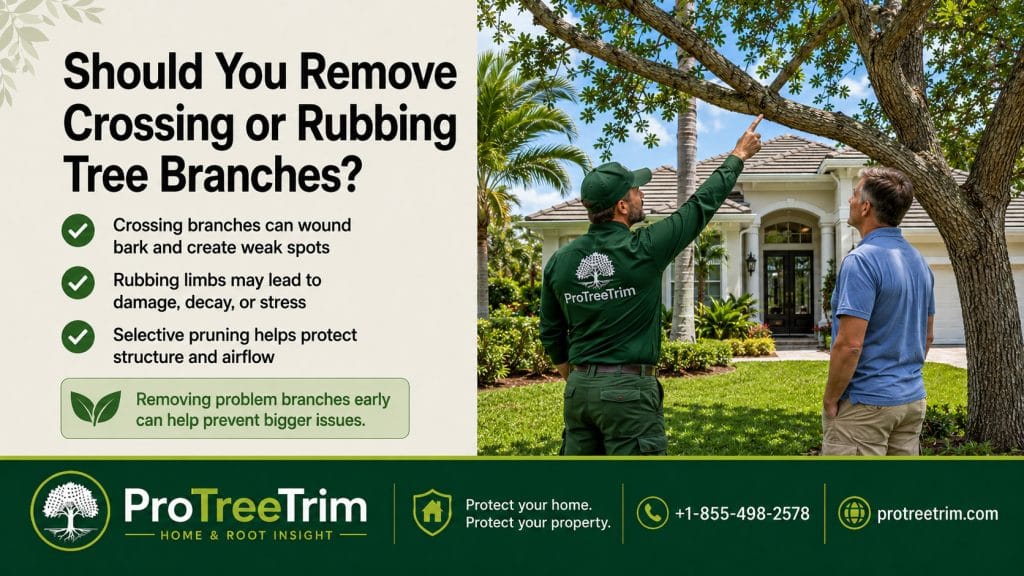
Crossing or rubbing branches are worth paying attention to because they can damage bark, create wounds, and lead to weaker branch structure over time. But that does not mean every crossing branch needs to be cut immediately. The right decision depends on branch size, tree age, location, health, and whether the branches are actually rubbing or just growing near each other.
Crossing Branches Are Not Always a Crisis
A crossing branch is a branch that grows across another branch or through the canopy in an awkward direction. Sometimes it only looks messy. Sometimes it rubs bark off another limb every time the tree moves in wind.
That rubbing is the real concern.
When bark is repeatedly scraped away, the branch can develop wounds. Over time, those wounds may become entry points for decay, insects, or weak spots. On a young tree, a small crossing branch is usually easier to correct. On a mature tree, removing a large crossing limb may create a bigger wound than the rubbing itself.
| What you see | What it may mean |
|---|---|
| Two small branches crossing on a young tree | Easy structural correction may be possible |
| Branches lightly touching but not rubbing | Monitor before cutting |
| Bark scraped where branches meet | Pruning may be useful |
| One branch growing back toward the trunk | Poor structure may develop later |
| Large crossing limb on mature tree | Needs careful decision, not automatic removal |
| Crossing branch over roof or driveway | Location increases priority |
| Rubbing limb with cracks or decay | More serious pruning concern |
Young Trees Are the Best Time to Correct the Problem
Crossing branches are easiest to manage while they are small. A young tree can often be guided with light structural pruning before awkward branches become large limbs.
If a small branch is growing across the canopy, rubbing another branch, or competing with a better-positioned limb, removing or shortening it early may prevent a much larger problem later. The cut is smaller, the wound is easier for the tree to close, and the shape can be improved gradually.
This is especially useful for trees planted near driveways, walkways, homes, pool cages, or fences. A small crossing branch today can become a large branch in exactly the wrong place five or ten years from now.
Mature Trees Need a Slower Decision
On a mature tree, the decision is more complicated. A large crossing branch may be important to the canopy. Removing it could create a major wound or change the tree’s balance.
Before removing a large live branch, ask what problem it is truly causing.
Is it rubbing bark off another limb?
Is it cracked or poorly attached?
Is it growing into the roofline?
Is it over a driveway, patio, pool cage, or walkway?
Is the tree already stressed?
Would a smaller reduction cut solve the issue instead of full removal?
If the branch is large, healthy, and only visually awkward, leaving it alone may be better than making a major cut for appearance.
Rubbing Branches Can Become Wound Problems
Rubbing branches are different from branches that simply cross. When wind moves the canopy, the two limbs scrape against each other. That repeated contact can remove bark and expose inner wood.
Once the bark is damaged, the branch has less protection. Moisture can sit in the wound. Insects may investigate. Decay can begin if the tree cannot close or compartmentalize the injury well.
The sooner rubbing is corrected while branches are small, the better. Waiting until both limbs are large makes every option harder.
Which Branch Should Be Removed?
If two branches rub, the usual question is which one to keep. The answer depends on structure.
A better branch is usually the one that is:
- better attached
- better positioned
- less likely to grow into the roof, driveway, or fence
- not cracked or damaged
- not crossing back through the canopy
- helping the tree’s natural shape
- less likely to require future large cuts
The weaker, damaged, inward-growing, or poorly placed branch is usually the better candidate for removal or reduction.
This is where judgment matters. Cutting the wrong branch can leave the tree unbalanced or remove a limb that was actually helping the canopy.
Do Not Turn One Rubbing Branch Into Over-Pruning
A rubbing branch may need correction. That does not mean the whole tree needs to be thinned heavily.
Homeowners sometimes ask for “cleaning” when they see tangled branches. A good pruning job should remove the specific problem, not strip the interior canopy. Over-thinning can create bare limbs, sun exposure, weak sprouts, and a canopy that looks hollow.
A clear scope is better:
- remove one rubbing branch
- reduce a crossing limb away from the roofline
- remove deadwood over the driveway
- correct small structural defects on a young tree
- preserve healthy interior branches where possible
The tree should still look natural after the work.
When Crossing Branches Become More Urgent
Crossing or rubbing branches deserve faster attention when they are connected to property risk.
Pay closer attention if the branch is:
- over a roof
- above a driveway or parked vehicle area
- near a pool cage
- rubbing a fence or shed
- close to a walkway or front entry
- cracked or partly broken
- attached to a storm-damaged limb
- near utility lines
A rubbing branch in the middle of a backyard canopy may be a routine pruning item. A rubbing branch over the main walkway is different.
When You Can Wait
Waiting may be reasonable if the branches are not actually rubbing, the tree is healthy, the branch is large, and removing it would create a major wound. You can monitor the contact area and take photos every few months to see whether bark damage is developing.
Waiting may also be reasonable if the tree is under stress from drought, flooding, root damage, construction, or recent heavy pruning. In those cases, removing live canopy without a clear reason can add stress.
Dead, cracked, or hazardous branches are different. Those should be handled based on risk, not convenience.
Questions to Ask Before Pruning
Before approving work, ask:
- Are the branches crossing, or are they actually rubbing?
- Is bark already damaged?
- Which branch has better structure?
- Can one branch be reduced instead of removed?
- How large will the final cut be?
- Is the tree young enough for structural correction?
- Is the branch over a roof, driveway, pool cage, or walkway?
- Will the pruning preserve the tree’s natural shape?
If the answer is simply “we’ll cut out the messy stuff,” slow down. Messy-looking branches are not always bad branches.
The Best Time to Fix Crossing Branches
For many trees, crossing branches are best corrected during planned pruning, often in the dormant season or during a suitable pruning window for the species. But if a branch is cracked, hanging, or rubbing a structure, waiting for ideal timing may not be practical.
Young-tree structural pruning can often be done gradually over several years. Mature-tree pruning should be more conservative and specific.
A Good Pruning Result Should Look Balanced
After crossing or rubbing branches are corrected, the tree should not look stripped. It should look more open where the conflict existed, but still natural. The remaining branch should have room to grow without scraping another limb.
Good pruning often looks subtle. That is usually a sign it was done with purpose.
If you are unsure whether crossing branches, rubbing limbs, deadwood, or roofline conflicts need pruning, ProTreeTrim can help connect homeowners with local tree service support. Call +1-855-498-2578 or visit protreetrim.com.
FAQs
Do crossing branches always need to be removed?
No. Branches that cross visually but do not rub or create structural problems may simply be monitored.
Why are rubbing branches a problem?
Repeated rubbing can scrape bark, create wounds, and weaken the affected area over time.
Should I remove crossing branches on a young tree?
Often, yes, if they are small and clearly poorly placed. Young-tree correction is usually easier than waiting until the branches are large.
Can removing a large crossing branch hurt the tree?
It can, especially if the branch is large and healthy. Mature-tree pruning should be specific and avoid unnecessary large cuts.
ProTreeTrim™ can help you take the next step.
If you are dealing with a damaged tree, fallen branch, stump, root issue, palm concern, or storm cleanup question in Florida, call ProTreeTrim for tree service support.