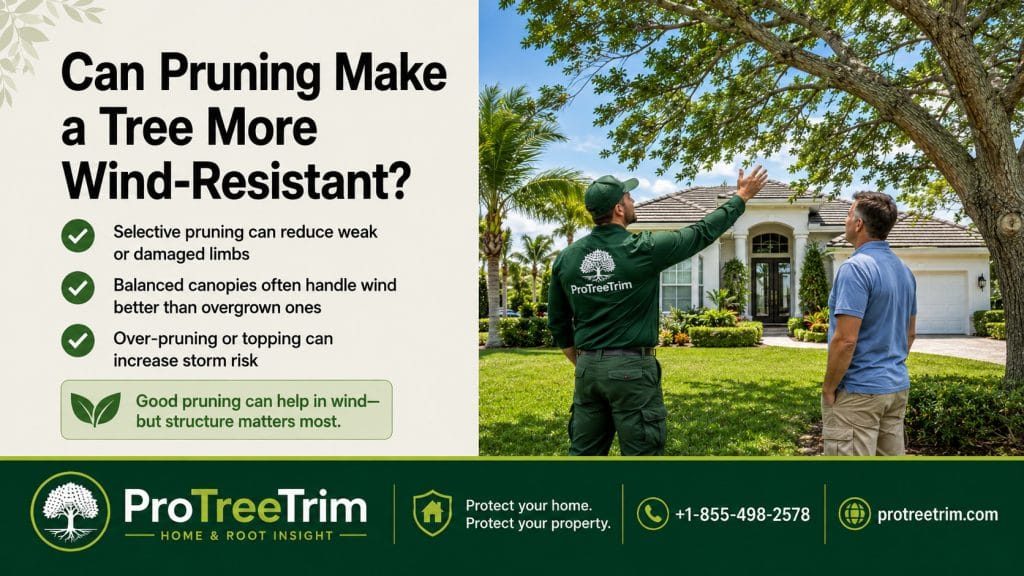
Pruning can help a tree handle wind better when it removes real problems: dead limbs, cracked branches, rubbing limbs, heavy overextended branches, or branches touching the house. But pruning does not automatically make a tree safer just because more branches are removed. Bad pruning can leave a tree weaker, more exposed, and more likely to need corrective work later.
Wind-Resistant Does Not Mean “Cut Back Hard”
Many homeowners think a tree should be heavily thinned before storm season so wind can pass through it. The idea sounds reasonable, but trees are not safer just because they look emptier.
A well-pruned tree keeps a balanced canopy, strong branch structure, and enough interior growth to distribute movement. A badly pruned tree may have long bare limbs with foliage only at the ends. Those limbs can become tip-heavy and more exposed during wind.
| Pruning choice | Likely result |
|---|---|
| Remove dead limbs | Reduces obvious branch-fall risk |
| Remove cracked or hanging branches | Helps prevent known weak points from failing |
| Clear branches from rooflines | Reduces structure contact and debris problems |
| Lightly reduce overextended limbs | May improve branch balance when done carefully |
| Strip interior branches | Can create long bare limbs and poor weight distribution |
| Top the tree | Often creates weak regrowth and future defects |
| Remove too much live canopy | Can stress the tree and reduce recovery ability |
The goal is not to make the tree look smaller. The goal is to remove defects while keeping the tree naturally strong.
What Pruning Can Actually Improve
Pruning is useful when it targets branches that are already more likely to fail or cause damage.
A careful storm-minded pruning plan may address:
- dead branches over driveways, roofs, patios, or pool cages
- cracked limbs that could split under wind pressure
- branches rubbing against each other
- limbs touching shingles, gutters, siding, fences, or screens
- broken branches left from past storms
- heavy limbs stretched far over a structure
- weak sprouts from old topping cuts
- low limbs blocking access or evacuation paths
This kind of pruning helps because it solves specific problems. It does not rely on cutting randomly through the canopy.
Why Over-Thinning Can Backfire
Over-thinning can make a tree look “clean,” but clean does not always mean strong.
When too much interior growth is removed, the main limbs may be left long and bare. The leaves remain only at the outer edges. That changes how the branch moves in wind and where weight sits. It can also expose bark that used to be shaded by interior foliage.
The tree may respond by producing fast water sprouts. Those sprouts can grow quickly but may not be well placed or strongly attached. A tree that was over-thinned this year may need more corrective pruning in the next few seasons.
Bad thinning can create a cycle: cut too much, force weak growth, cut again, weaken structure, repeat.
Topping Is Not Storm Preparation
Topping is one of the most damaging answers to storm fear. Cutting the top off a tree may make it shorter temporarily, but it also removes a large amount of leaf area and often leaves poor cuts behind.
After topping, many trees push out fast-growing shoots near the cuts. Those shoots may look like recovery, but they can become weak, crowded, and poorly attached. Over time, the tree may be more complicated to maintain than it was before.
If a tree is truly too tall, too close to the house, or in the wrong place for the yard, topping is not the honest solution. A better conversation may include selective reduction, long-term pruning, or removal and replacement with a better-sized tree.
Roots and Trunk Matter as Much as Branches
A tree can have a beautifully pruned canopy and still be storm-vulnerable if the roots or trunk are compromised.
Before storm season, look at the whole tree:
| What to check | Why it matters |
|---|---|
| Trunk cracks | May point to structural weakness |
| Mushrooms near the base | Possible decay or moisture issue |
| Exposed or cut roots | May affect stability |
| Soil lifting on one side | Could suggest root plate movement |
| New lean after rain | Needs attention beyond pruning |
| Hollow areas or cavities | Tree strength may be reduced |
| Dead top branches | Root or trunk stress may be involved |
Pruning can remove a dead limb. It cannot fix a failing root system or a split trunk.
The Best Storm Pruning Looks Subtle
Good pruning often does not look dramatic. The tree may still look full. That is usually a good thing.
A properly pruned tree should still have natural shape, balanced branch distribution, and healthy foliage. The work may be noticeable in the details: fewer dead limbs, better roof clearance, less rubbing, cleaner structure, and no obvious hanging branches.
A bad storm-prep job often looks extreme: bare limbs, flat-topped canopy, huge cuts, or a tree that suddenly looks thin and stressed.
The best question to ask after pruning is not “Does the tree look smaller?” It is “Were the real weak points addressed without damaging the tree’s structure?”
When Pruning Is Not Enough
Sometimes pruning can reduce risk, but it cannot make the tree a good candidate to keep.
Removal may need to be discussed if the tree is dead, severely leaning, split, hollow, root-damaged, or repeatedly dropping large limbs. A tree that is too close to the house, pool cage, driveway, or utility area may also be a long-term site problem rather than a pruning problem.
Pruning may help manage:
- one overextended branch
- roofline contact
- deadwood
- minor storm damage
- rubbing limbs
- clearance problems
Pruning may not solve:
- major trunk split
- root plate movement
- severe decay
- dead tree
- repeated large limb failure
- utility-line conflict
- tree planted in the wrong place
Knowing that difference can save homeowners from paying for repeated trimming when the real issue needs a larger decision.
What to Ask Before Storm-Season Pruning
Before hiring a crew, ask for a clear explanation of the pruning plan.
Good questions include:
- Which branches are the main concern?
- Are we removing deadwood, live branches, or both?
- Are any limbs cracked, overextended, or rubbing?
- How much live canopy will be removed?
- Will the tree be topped or heavily thinned?
- Are roof, driveway, pool cage, fence, or walkway conflicts being addressed?
- Are there root, trunk, or lean concerns?
- Will debris be removed before storms arrive?
If the answer is simply “we’ll thin it out a lot,” slow down. Storm pruning should be more thoughtful than that.
A Better Way to Think About Wind
A tree does not need to be empty to handle wind. It needs good structure, healthy roots, sound wood, and fewer obvious defects.
Pruning can help when it is careful. It can hurt when it is aggressive. The right job removes what is risky and preserves what helps the tree function.
If you are unsure whether your tree needs storm pruning, deadwood removal, roofline clearance, or a more serious safety decision, ProTreeTrim can help connect homeowners with local tree service support. Call +1-855-498-2578 or visit protreetrim.com.
FAQs
Can pruning make a tree safer in high winds?
It can help when pruning removes dead, cracked, rubbing, or overextended branches. It does not help when the tree is topped or stripped too aggressively.
Should trees be thinned before hurricane season?
Only selectively. Removing obvious defects can help, but over-thinning can create long bare limbs and weak regrowth.
Is topping a good way to make a tree wind-resistant?
No. Topping can stress the tree, create weak sprouts, and lead to more future problems.
What if the tree has root or trunk problems?
Pruning may not be enough. A tree with root movement, trunk cracks, mushrooms, or a new lean needs a broader condition review.
ProTreeTrim™ can help you take the next step.
If you are dealing with a damaged tree, fallen branch, stump, root issue, palm concern, or storm cleanup question in Florida, call ProTreeTrim for tree service support.