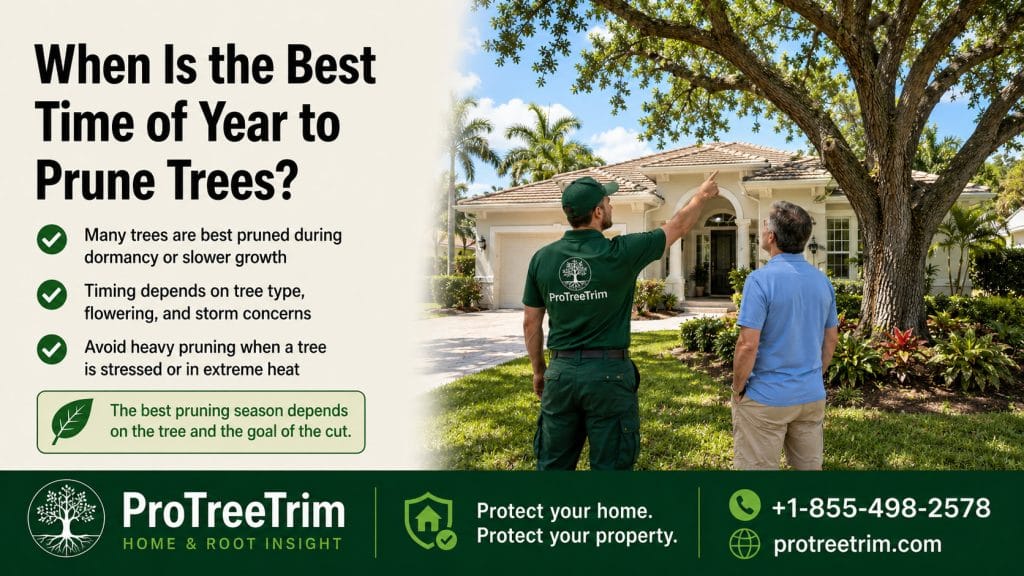
The best time to prune most trees is usually during the late dormant season, before strong spring growth begins. But timing depends on the reason for pruning. Dead, broken, or dangerous branches may need attention right away, while heavy live-branch pruning is usually better planned more carefully.
Start With the Reason for Pruning
The calendar matters, but the reason matters first.
If a dead limb is hanging over a driveway, roof, walkway, or pool cage, waiting for the “perfect season” may not make sense. If the tree simply looks too dense or too tall, that is different. Cosmetic or heavy pruning should be timed with the tree’s health in mind, not rushed because the yard feels overgrown.
UF/IFAS notes that dying, diseased, broken, or dead limbs can generally be removed at any time with little negative effect on the tree. It also warns that live-branch pruning during or soon after the initial growth flush can reduce growth and add stress, especially on already stressed trees.
| Reason for pruning | Timing mindset |
|---|---|
| Dead branch over driveway | Address promptly if it could fall |
| Broken storm limb | Handle when safe, not based only on season |
| Roof or gutter contact | Schedule before damage or debris gets worse |
| Light structural pruning | Often best during dormant season |
| Heavy canopy reduction | Avoid rushing; tree health matters |
| Tree already stressed | Be cautious with live pruning |
| Utility-line conflict | Contact utility first |
Why Late Dormant Season Is Often Best
For many landscape trees, late winter to early spring is a strong pruning window. The tree is not in full leaf, the branch structure is easier to see, and new growth is close enough that pruning wounds are not left exposed through a long active season.
University of Minnesota Extension says late dormant season, from late winter to early spring, is best for most pruning because wounds are exposed for a shorter time before growth begins, and branch structure is easier to see without leaves. Montana State Extension gives similar guidance, noting that dormant-season pruning can make structure easier to see and may reduce pest and disease issues around pruning cuts.
For homeowners, that means winter or very early spring is often the right time to plan pruning that is not urgent: structural cleanup, selective branch removal, clearance work, and reducing future conflicts before storm season or heavy growth.
When Waiting Can Be a Mistake
The dormant season is not a reason to ignore a risky branch.
If a limb is cracked, hanging, dead, or already resting on a roof, fence, pool screen, or service area, the better question is safety and property risk. The same applies after storms. A broken branch over open lawn may be monitored briefly; a broken branch over a driveway or walkway should not sit there just because the timing is inconvenient.
Deadwood removal is different from heavy live pruning. UF/IFAS specifically says removing dead branches is good for trees, but cuts should avoid injuring the branch collar.
When Pruning Can Stress a Tree
Bad timing is not the only problem. Too much pruning, poor cuts, topping, or cutting a stressed tree can create bigger issues than the original branch.
Be more cautious if the tree already shows:
- small leaves
- early leaf drop
- branch-tip dieback
- trunk cracks
- mushrooms near the base
- recent root damage
- drought or flood stress
- construction or paver work nearby
- a new lean after rain or wind
A stressed tree may still need deadwood removed for safety, but that does not mean the whole canopy should be thinned or reduced aggressively.
Different Trees May Need Different Timing
Not every tree follows the same schedule. Flowering trees, fruit trees, palms, evergreens, and broad shade trees can have different pruning needs. Some trees are pruned after flowering so buds are not removed. Evergreens may need lighter, more selective work. Palms should not be treated like shade trees; removing too many healthy green fronds can weaken the look and function of the crown.
The Morton Arboretum notes that for most deciduous trees, pruning is often best from late fall after dormancy through very early spring, while dead, diseased, or broken branches can be removed anytime.
The practical homeowner rule: do not use one pruning calendar for every tree in the yard. Match timing to the tree, the problem, and the risk.
What to Ask Before Scheduling Tree Work
Before approving pruning, ask what the crew plans to remove and why.
Good pruning has a clear purpose. It may remove deadwood, improve roof clearance, reduce rubbing branches, raise a low limb over a walkway, or address storm damage. Vague instructions like “cut it way back” can lead to over-pruning.
Ask:
- Are we removing deadwood, live branches, or both?
- Is the timing right for this tree?
- Is the tree already stressed?
- Are any limbs over a roof, driveway, pool cage, or walkway?
- Will this preserve the tree’s natural structure?
- Are utility lines involved?
- Will large cuts be avoided where possible?
If the answer is unclear, slow down before the saws start.
When Professional Help Makes Sense
Homeowners can handle some small, reachable cleanup from the ground. But large branches, storm damage, roofline limbs, palms near pool cages, trees near wires, and high limbs over driveways are different.
Do not climb ladders with saws, pull branches with ropes, or trim near electrical lines. The safest pruning decision is sometimes not about season at all. It is knowing when the work is too risky for DIY.
If you are unsure whether a tree should be pruned now, later, lightly, or not at all, ProTreeTrim can help connect homeowners with local tree service support. Call +1-855-498-2578 or visit protreetrim.com.
FAQs
What is the best season to prune most trees?
For many landscape trees, late winter to early spring is often best because the tree is dormant and branch structure is easier to see.
Can dead branches be removed any time of year?
Yes. Dead, broken, dying, or diseased branches can generally be removed when needed, especially if they create a safety or property concern.
Should I prune a stressed tree?
Be careful. A stressed tree may need hazardous deadwood removed, but heavy live pruning can add stress and should not be rushed.
Is summer pruning bad?
Light, specific pruning may be acceptable in some cases, but heavy live-branch pruning during active growth can stress certain trees. The reason for pruning matters.
ProTreeTrim™ can help you take the next step.
If you are dealing with a damaged tree, fallen branch, stump, root issue, palm concern, or storm cleanup question in Florida, call ProTreeTrim for tree service support.