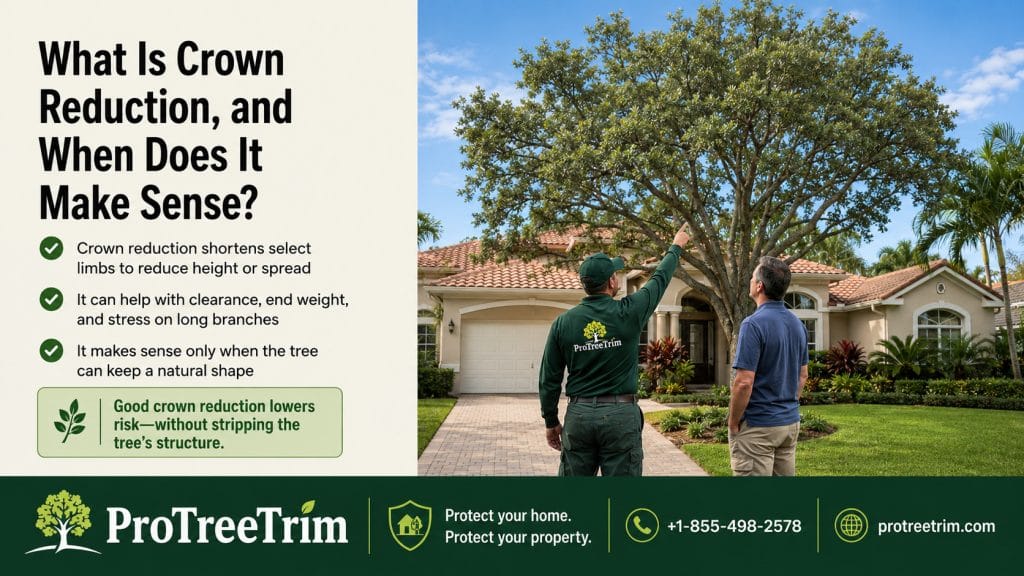
Crown reduction is a pruning method used to reduce the height or spread of a tree by cutting selected branches back to suitable side branches. Done well, it can help manage clearance, weight, and structure. Done poorly, it can become topping by another name.
Crown Reduction Is Not “Cutting the Tree Back Hard”
The difference between crown reduction and topping is the quality and purpose of the cuts.
Crown reduction removes specific branches back to smaller, healthy lateral branches that can continue the tree’s growth. Topping cuts limbs back to stubs or random points, often leaving the tree stressed, ugly, and full of weak regrowth later.
| Homeowner request | Better pruning conversation |
|---|---|
| “Make the tree smaller” | Which branches are creating the conflict? |
| “Cut the top down” | Is crown reduction possible, or is this topping? |
| “Keep it off the roof” | Can selective roofline clearance solve it? |
| “It is too wide” | Which limbs are overextended or interfering? |
| “Reduce storm risk” | Are there dead, cracked, or poorly attached limbs? |
| “Open it up” | Is thinning actually needed, or will it weaken structure? |
A proper reduction should still leave the tree looking like a tree. It should not look chopped, flat-topped, or stripped.
When Crown Reduction Can Make Sense
Crown reduction may be useful when a tree has outgrown part of its space but is still healthy enough to manage. It can help when branches are pushing toward a roofline, reaching over a driveway, crowding a pool cage, or extending too far over a fence or patio.
It can also help reduce the length of a specific overextended limb, especially when that limb has too much weight toward the end. In that case, the goal is not to shrink the whole tree. The goal is to reduce a particular branch conflict while preserving structure.
Good reasons may include:
- branches growing too close to a roof or gutter
- a long limb extending over a driveway or patio
- canopy spread crowding a house, fence, or pool cage
- a young tree needing structural correction
- a tree that needs size management but should not be topped
- reducing weight on a specific limb with a careful cut
- improving clearance without removing the entire branch
When Crown Reduction Is the Wrong Answer
Reduction is not a magic way to make any tree fit anywhere.
If a large tree is planted too close to the house, repeatedly grows into the roof, interferes with utility lines, or needs severe cutting every few years, the real problem may be placement. Repeated crown reduction can become expensive and stressful for the tree.
Reduction may also be a poor choice when the tree is already declining. A tree with small leaves, early leaf drop, dead branch tips, root damage, mushrooms near the base, trunk cracks, or recent construction stress may not respond well to live canopy removal.
In those cases, the better decision may be deadwood removal, monitoring, selective clearance, or a larger discussion about whether the tree still fits the site.
Good Reduction Cuts Are Selective
A good reduction cut is not random. It is made back to a suitable side branch that can take over growth. The side branch should be large enough and well positioned enough to continue the branch structure.
Bad reduction cuts leave long stubs, cut back to weak shoots, or remove too much foliage from the branch. That can lead to decay, weak sprouts, sun exposure, and a cycle of repeated pruning.
A homeowner does not need to know every technical detail, but you can ask the right questions:
- Which branches are being reduced?
- Are cuts being made back to healthy side branches?
- How much live canopy will be removed?
- Will the tree keep a natural shape?
- Are large stubs being avoided?
- Is this reduction, or is it actually topping?
- Is the tree healthy enough for this work?
If the answer sounds like “we will just cut it down lower,” slow down.
Reduction Should Solve a Specific Problem
The best crown reduction jobs are targeted. They do not remove canopy just because the tree feels big.
For example, if one limb extends over the roof, the plan may reduce that limb and create clearance. If the tree blocks a driveway, the plan may reduce or raise only the branches causing access problems. If the canopy is crowding a pool cage, the plan may create space without stripping the entire side of the tree.
A poor plan tries to make the whole tree dramatically smaller in one visit. That often leads to large cuts, weak regrowth, and a tree that needs more frequent correction later.
What About Storm Preparation?
Homeowners sometimes ask for crown reduction before storm season because they think a smaller tree is always safer. That is not always true.
A tree with dead, cracked, or overextended limbs may benefit from targeted pruning. But reducing the entire canopy heavily can stress the tree and create weak regrowth later. Storm-minded pruning should focus on clear defects, not simply making the tree shorter.
Better storm-related goals include:
- remove dead limbs
- reduce a specific overextended branch
- address cracked or rubbing limbs
- clear branches from the roofline
- avoid topping
- preserve a balanced canopy
- check root, trunk, and lean concerns
A shorter tree is not automatically a safer tree. A better-structured tree is the goal.
When Removal May Be More Practical
Sometimes crown reduction is possible but not practical long term. If a tree needs major reduction repeatedly, it may be the wrong tree for the space.
Removal may deserve discussion if the tree is:
- too close to the house
- growing into utility lines
- repeatedly damaging rooflines or gutters
- lifting hardscape badly
- leaning toward structures
- declining or hollow
- too large for a narrow side yard
- creating repeated pool cage or driveway conflicts
This does not mean removal should be the first answer. It means pruning should not become a cycle of expensive temporary fixes.
Ask for a Clear Scope Before Work Starts
Before approving crown reduction, ask for a clear explanation. The crew should be able to describe what they will reduce, why they will reduce it, and how they will avoid topping.
A good scope might sound like:
“Reduce two overextended limbs away from the roofline, remove deadwood over the driveway, and preserve the main canopy structure.”
A weak scope sounds like: “Cut the tree back hard.”
That difference matters.
If you are unsure whether a tree needs crown reduction, roofline clearance, deadwood removal, or a bigger long-term decision, ProTreeTrim can help connect homeowners with local tree service support. Call +1-855-498-2578 or visit protreetrim.com.
FAQs
Is crown reduction the same as topping?
No. Crown reduction uses selective cuts back to appropriate side branches. Topping cuts branches back harshly to stubs or random points.
Can crown reduction make a tree safer?
It can help when it reduces specific overextended, damaged, or conflicting branches. It does not automatically make a tree safer just because the canopy is smaller.
How much of the crown can be reduced at once?
That depends on the tree’s species, health, age, structure, and reason for pruning. Removing too much live canopy at once can stress the tree.
When is crown reduction not worth it?
It may not be worth it when the tree is already declining, too large for the site, repeatedly interfering with structures, or would require severe cutting to meet the goal.
ProTreeTrim™ can help you take the next step.
If you are dealing with a damaged tree, fallen branch, stump, root issue, palm concern, or storm cleanup question in Florida, call ProTreeTrim for tree service support.