
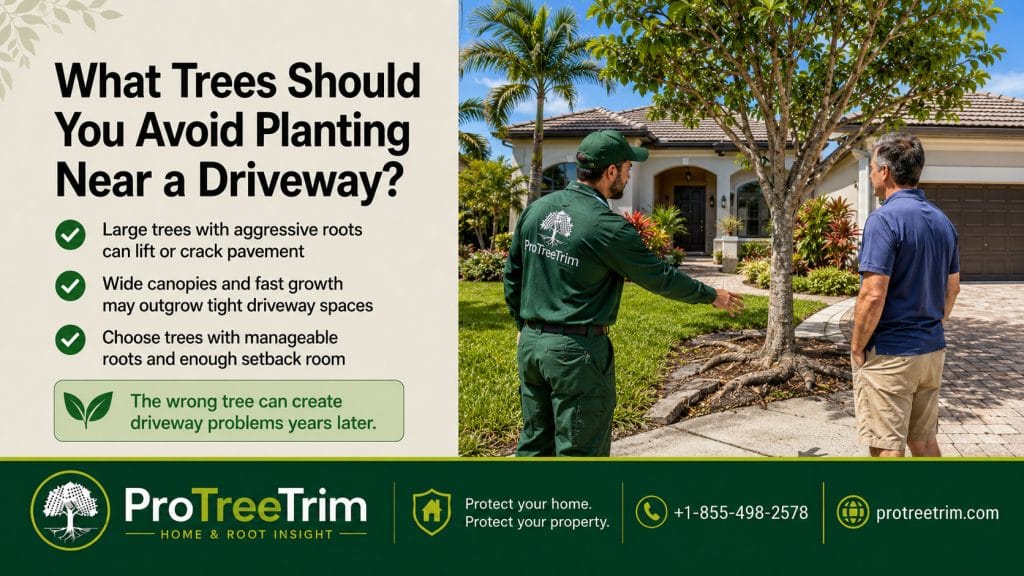
A tree near a driveway can be a great feature. It can shade parked cars, soften the front of the home, and make the property feel more established. But the wrong tree in the wrong spot can create years of frustration: lifted pavers, cracked edges, low limbs, sticky residue, falling seed pods, blocked access, and expensive pruning or removal later.
Do Not Plant Only for Shade
Shade is usually the reason homeowners want a driveway tree. That makes sense. A shaded driveway is more comfortable, especially in hot climates. But shade alone is not enough reason to plant a large tree close to pavement.
The driveway is a working part of the property. Cars park there. People walk there. Trash bins roll across it. Delivery drivers use it. Tree crews, roofers, movers, and emergency vehicles may need access someday.
A driveway tree should not only look good. It should work with the space.
| Tree trait | Why it can become a driveway problem |
|---|---|
| Large surface roots | May lift pavers, concrete, or asphalt edges |
| Low spreading limbs | Can block vehicles, trucks, or delivery access |
| Heavy fruit or seed pods | Can stain pavement or damage cars |
| Sticky sap or honeydew issues | Can coat vehicles and attract insects |
| Brittle branches | May drop limbs over parking areas |
| Fast aggressive growth | Can outgrow the space quickly |
| Messy seasonal debris | Can make the driveway look constantly dirty |
Avoid Trees That Will Outgrow the Width of the Space
A narrow planting strip beside a driveway is not the right place for a broad, heavy-limbed shade tree. Even if the young tree looks perfect at planting, it may eventually push into the driveway, garage, walkway, or roofline.
Before planting, measure the space honestly. How far is the planting spot from the driveway edge? How far from the house, sidewalk, fence, or street? How wide will the tree’s canopy become when mature?
A tree that needs repeated heavy pruning just to keep cars from scraping branches is probably the wrong tree for that spot.
Better driveway planting starts with scale:
- small ornamental tree for narrow strips
- medium tree for wider planting beds
- large shade tree only where there is real room
- narrow upright tree where side clearance is limited
- no tree at all if the site is too cramped
Sometimes the best driveway tree decision is choosing a smaller species rather than forcing a large tree into a small space.
Be Careful With Surface Roots
Roots are often the first thing homeowners worry about, and for good reason. Driveways, pavers, sidewalks, and compacted soil can all conflict with tree roots over time.
Not every root near pavement causes damage. But trees with large, shallow, or expanding surface roots can become a problem in tight driveway areas. The issue may appear slowly: one lifted paver, then an uneven edge, then a trip hazard or cracked section.
Before planting, ask:
- Will this tree develop large surface roots?
- Is the planting bed wide enough for root growth?
- Is the soil compacted from vehicle traffic?
- Will irrigation or runoff draw roots toward the driveway?
- Is there enough room to repair pavement later without cutting major roots?
- Would a smaller tree or shrub be a better fit?
The wrong choice may create a future decision nobody likes: cut roots and stress the tree, repair the driveway repeatedly, or remove the tree.
Avoid Messy Trees Over Parking Areas
Mess is not always a dealbreaker. Every tree drops something. Leaves, flowers, small twigs, and seasonal debris are part of owning trees.
But a tree directly over parked vehicles should be judged more strictly. Heavy fruit, large seed pods, staining berries, sticky sap, or frequent branch drop can make the driveway frustrating to use.
A tree may be fine in the back corner of the yard and still be a poor choice over the driveway.
Think carefully before planting trees known for:
- large fruit drop
- messy seed pods
- heavy acorn or nut drop
- sticky residue problems
- brittle branch habits
- constant twig shedding
- staining debris on pavement
The question is not whether the tree is “bad.” It is whether it belongs over cars and daily access.
Watch for Low Branches and Clearance
A tree near a driveway needs vertical clearance. A branch that is cute at planting height can become a problem when it spreads over a vehicle path.
Think beyond your own car. Delivery vans, moving trucks, service vehicles, emergency vehicles, and tree-care equipment may need more clearance than a sedan. A low canopy can also block sightlines near the street or make the garage entrance feel crowded.
A good driveway tree should be pruned gradually as it grows, not stripped suddenly after it becomes a problem. Young-tree structural pruning matters here. It is easier to train a small branch than to remove a large limb later.
Do Not Plant Too Close to the Garage or Roofline
Driveways often sit beside garages, front entries, and roof edges. A tree planted too close may eventually create several problems at once: limbs over cars, branches touching gutters, roots near pavement, and debris collecting near the garage.
Before planting, stand at the proposed spot and look up and around.
Will the tree grow toward:
- garage roof
- gutters
- front entry
- exterior lights
- driveway edge
- overhead wires
- walkway
- mailbox
- neighbor’s driveway
- street visibility area
A tree that interferes with three or four of these areas is probably wrong for the spot.
Driveway Trees Need Future Access Too
Planting is easy. Future maintenance may not be.
A tree beside a driveway may need pruning, storm cleanup, pest review, or eventual removal. If it is squeezed between the driveway, house, fence, and utility line, that work can become complicated.
Good planting leaves room for:
- future pruning access
- safe branch lowering
- debris hauling
- stump grinding if removal ever happens
- driveway repair without major root cutting
- visibility for drivers and pedestrians
A tree should not make the most practical part of the property harder to use every year.
Better Tree Traits for Driveway Areas
Instead of choosing only by beauty, choose by fit.
A better driveway tree is usually:
| Good trait | Why it helps |
|---|---|
| Appropriate mature size | Reduces future hard pruning |
| Strong branch structure | Lowers risk of repeated limb drop |
| Moderate root behavior | Reduces pavement conflicts |
| Manageable debris | Keeps parking areas easier to maintain |
| Good clearance potential | Allows vehicles and people to pass |
| Right canopy shape | Fits the driveway without crowding |
| Suitable for local soil and weather | Reduces stress and decline |
No tree is maintenance-free. But a well-matched tree creates normal maintenance, not constant conflict.
When a Tree Near the Driveway Is Still Worth It
Do not avoid all driveway trees. A well-chosen tree can be one of the best parts of the front yard.
It may be worth planting if the site has enough room, the tree stays in scale, the canopy can be trained for clearance, and roots will not be forced into a narrow strip of compacted soil.
A good driveway tree should feel intentional. It should shade and frame the space without threatening the pavement, cars, roofline, or access.
Final Planting Check
Before planting near a driveway, ask one simple question:
Will this tree still make sense here when it is fully grown?
If the mature tree will crowd the driveway, lift hardscape, drop heavy debris on cars, or need severe pruning to fit, choose something smaller or move the planting location.
If you are unsure whether a tree is a good fit near your driveway, walkway, roofline, or parking area, ProTreeTrim can help connect homeowners with local tree service support. Call +1-855-498-2578 or visit protreetrim.com.
FAQs
Can tree roots damage a driveway?
Yes, some trees can contribute to lifted pavers, cracked concrete, or uneven driveway edges, especially when planted too close or in narrow soil spaces.
Are shade trees bad near driveways?
Not always. A shade tree can be valuable if it has enough room, strong structure, manageable roots, and good clearance over vehicles.
What kind of tree should not be planted over parked cars?
Avoid trees that drop heavy fruit, large seed pods, sticky residue, brittle branches, or constant messy debris directly over parking areas.
Is it better to plant a small tree near a driveway?
Often, yes. A smaller tree that fits the space is usually better than a large tree that requires repeated pruning or causes pavement conflicts later.
ProTreeTrim™ can help you take the next step.
If you are dealing with a damaged tree, fallen branch, stump, root issue, palm concern, or storm cleanup question in Florida, call ProTreeTrim for tree service support.