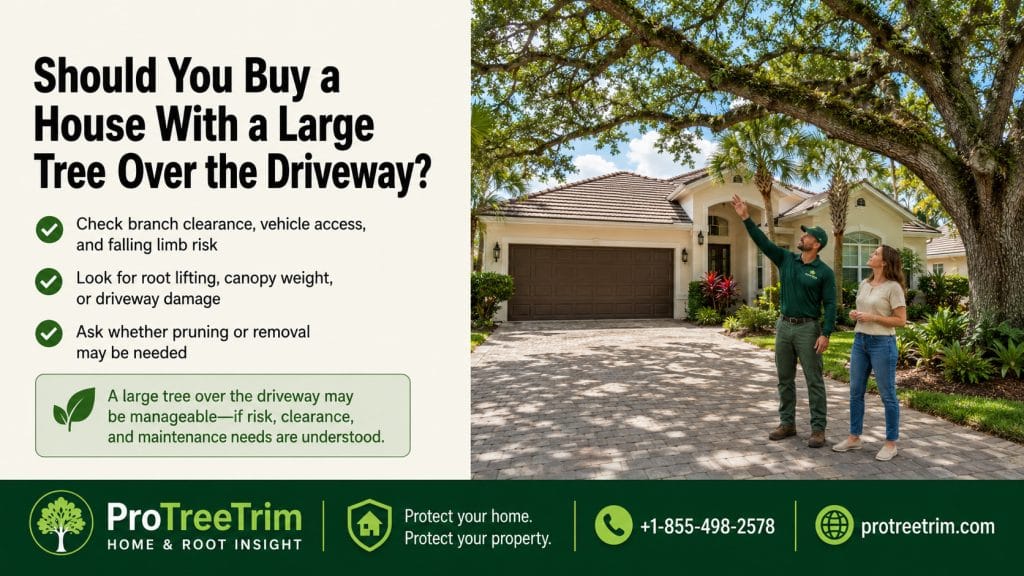
A large tree over the driveway is not automatically a problem. In many homes, it adds shade, curb appeal, and a more established feel. The concern starts when limbs are low, dead, cracked, dripping sticky residue, lifting the driveway, blocking access, or hanging over the exact place where vehicles and people pass every day.
Start With Daily Use
Driveways are not decorative space. They are used constantly. Buyers park there, walk through them, unload groceries, roll trash bins, receive deliveries, and sometimes use them as the main access route to the home.
That means a tree over the driveway should be judged differently from a tree over open lawn.
| What you see | Why it matters as a buyer |
|---|---|
| Healthy canopy with good clearance | May be a useful shade feature |
| Low limbs over parking area | Vehicle clearance may be a problem |
| Dead branch above driveway | Future safety and cleanup concern |
| Sticky residue on pavement or cars | Pest or sap issue may create maintenance cost |
| Roots lifting driveway edge | Hardscape repair may be needed |
| Tree leaning toward garage or cars | Needs closer review before closing |
| Branches near service line | Utility coordination may be required |
A shaded driveway can be a real benefit. A driveway that feels like a branch could fall on your car is a different story.
Look at the Branches Above the Parking Area
Stand back and look directly over the place where vehicles would sit. Are the limbs alive and well-attached? Are there large dead branches? Is one limb stretched far over the driveway with most of its weight at the end? Are there old pruning cuts, cracks, bark loss, or hanging branches?
You do not need to diagnose the tree yourself. You are looking for buyer-level clues that may justify a closer look before closing.
Pay extra attention if the branch is above:
- garage entrance
- front walkway
- parked vehicle area
- mailbox or delivery path
- side gate
- trash-bin route
- neighbor-facing driveway edge
The more often people or vehicles pass under that branch, the more important its condition becomes.
Check the Ground Under the Tree
A driveway tree is also a root and hardscape question.
Look for cracked concrete, lifted pavers, raised asphalt edges, exposed roots, soil washout, or a driveway section that has been patched before. Do not assume every crack is caused by the tree, but do not ignore the pattern either.
A tree can be healthy and still create driveway maintenance. A driveway can be old and cracked without the tree being the main cause. The important question is whether the tree, roots, drainage, and driveway surface are now in conflict.
| Driveway clue | What to ask |
|---|---|
| Raised pavers near trunk side | Are roots actively lifting the surface? |
| Concrete cracked upward | Is root pressure part of the issue? |
| Driveway sinking near old stump | Was a tree removed and roots left to decay? |
| Water pooling under the tree | Is drainage weakening the driveway base? |
| Fresh repair near roots | Was the repair cosmetic or root-aware? |
| Exposed roots beside parking area | Could mowing, tires, or repair work damage them? |
If the driveway already needs repair, ask whether the repair can be done without cutting major roots. Cutting large roots close to the tree can create new tree-health or stability problems.
Ask About Sticky Drips and Debris
A tree over the driveway may create more than shade. Some trees drop leaves, flowers, acorns, seed pods, sap, honeydew, fronds, or small branches. Some of that is normal. Some of it becomes annoying when it lands on cars every day.
Sticky residue is worth asking about. It may be sap from a wound, but it may also be honeydew from insects such as aphids, scale, or whiteflies. That does not make the tree a dealbreaker, but it may mean future treatment, pruning, or regular cleaning.
Ask the seller:
- Does the tree drop sticky residue on cars?
- Does it drop large limbs after storms?
- Was pest treatment ever done?
- Has the tree been pruned recently?
- Are there invoices or records?
- Has the driveway been repaired because of roots?
- Has any branch damaged a vehicle, roof, or fence?
The answer may be simple: yes, it sheds seasonally. Or it may reveal a recurring maintenance issue.
Consider Access for Future Tree Work
A driveway can make tree work easier because crews may have solid access. But not always.
If the tree is close to the garage, roofline, fence, utility line, or narrow side yard, future pruning or removal may still be complicated. Large limbs over cars, pavers, or roof edges may need controlled lowering rather than simple cutting.
Look at the work area as a future homeowner:
- Can a crew reach the tree safely?
- Are pavers, irrigation heads, or lights under the canopy?
- Is the tree close to overhead wires?
- Would vehicles need to be moved for pruning?
- Is there enough room for debris removal?
- Would removal require stump grinding beside the driveway?
A tree that looks manageable today may still represent a future cost if access is tight.
When the Tree Is a Plus
A large driveway tree may be a positive feature if it is healthy-looking, well placed, high enough for vehicle clearance, away from wires, not damaging the driveway, and not dropping heavy limbs or constant sticky residue.
In that case, the tree may add curb appeal and comfort. You may simply budget for regular pruning, gutter cleaning, leaf cleanup, or occasional pest monitoring.
When to Slow Down Before Closing
Take the issue more seriously if you see large dead limbs, low heavy branches, trunk cracks, mushrooms near the base, roots lifting the driveway, a new lean toward the garage, or branches near utility lines.
Also slow down if the seller recently trimmed the tree but cannot explain why. Fresh cuts over a driveway may be responsible maintenance, or they may be a sign that deadwood, storm damage, or roofline conflict was recently addressed.
Ask for records when possible: tree service invoice, driveway repair receipt, stump grinding note, before-and-after photos, or debris hauling record.
If you are unsure whether a large driveway tree, roots, dead limbs, or stump issues should be handled before or after buying a home, ProTreeTrim can help connect homeowners with local tree service support. Call +1-855-498-2578 or visit protreetrim.com.
FAQs
Is a large tree over the driveway a bad sign when buying a house?
Not necessarily. It can provide valuable shade and curb appeal. The concern is dead limbs, low clearance, sticky residue, root damage, leaning, or branches near utility lines.
Should I ask the seller to trim the driveway tree before closing?
If branches are dead, low, touching the garage, or hanging over parking areas, it is reasonable to ask about trimming, records, or further evaluation during the inspection period.
Can tree roots damage a driveway?
They can contribute to lifting or cracking, but driveway damage can also come from settling, water, age, poor base preparation, or heavy vehicles. Check the full pattern before blaming roots alone.
What should I photograph during inspection?
Photograph the full tree, branches over the driveway, visible roots, driveway cracks, trunk base, lean direction, nearby garage, utility lines, and any fresh pruning cuts.
ProTreeTrim™ can help you take the next step.
If you are dealing with a damaged tree, fallen branch, stump, root issue, palm concern, or storm cleanup question in Florida, call ProTreeTrim for tree service support.