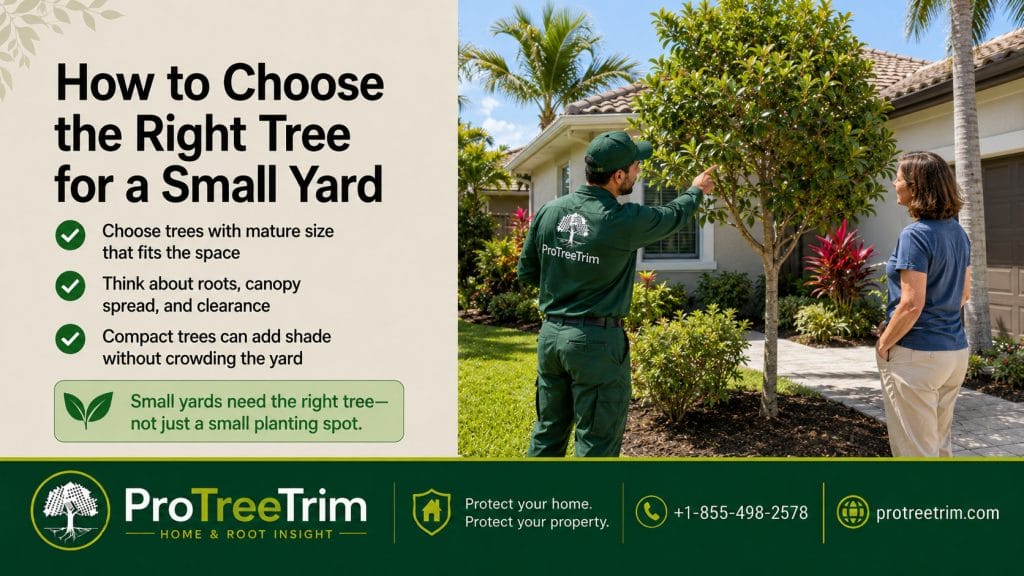
A small yard does not mean you have to avoid trees. It means the tree has to be chosen with more care. The wrong tree can crowd the house, lift pavers, block windows, rub the roof, drop messy debris, or become expensive to prune later. The right tree can add shade, privacy, curb appeal, and structure without taking over the property.
Start With the Mature Size, Not the Nursery Size
Most planting mistakes begin at the garden center.
A young tree looks small, balanced, and harmless in a container. It may seem perfect beside the front walk, near the driveway, or outside a window. But the tree you plant is not the tree you will live with ten or twenty years later.
Before choosing a tree, ask how large it can become when mature.
| What to check | Why it matters in a small yard |
|---|---|
| Mature height | Determines roofline, utility, and shade impact |
| Mature canopy spread | Shows whether branches may crowd the house or fence |
| Root behavior | Helps avoid hardscape and planting-bed conflicts |
| Debris type | Affects patios, driveways, pools, and walkways |
| Branch strength | Matters near cars, roofs, and high-use areas |
| Pruning needs | Some trees require more frequent correction |
| Growth rate | Fast growth may mean faster conflict in tight spaces |
A tree that grows large is not “bad.” It may simply be wrong for a small yard.
Match the Tree to the Actual Space
Do not look only at the open patch of soil. Look at everything around it.
A small yard is usually full of hidden limits: rooflines, gutters, windows, fences, sidewalks, driveways, patios, pool cages, downspouts, irrigation lines, overhead wires, and neighbor boundaries. The tree must fit between all of those things as it matures.
Stand in the planting spot and turn in a circle.
Ask:
- How close is the house?
- Will branches touch the roof?
- Will the tree block windows or exterior lights?
- Is the driveway close enough for roots or low limbs to matter?
- Will the canopy cross the fence line?
- Are there overhead wires?
- Is there enough room for future pruning access?
- Will this tree drop debris where people walk, park, or sit?
If the mature tree will conflict with two or three of those areas, choose a smaller tree or move the planting location.
Small Yard Trees Should Not Need Constant Fighting
A good small-yard tree should not require hard pruning every year just to stay out of trouble.
If a tree must be repeatedly cut away from the roof, driveway, walkway, fence, or pool cage, the problem is not only pruning. It is fit. The tree may be too large, too fast-growing, too messy, or planted too close.
Repeated hard cutting can create weak regrowth, ugly shape, large wounds, and higher maintenance costs. A better tree choice reduces that cycle from the beginning.
A well-matched tree should need normal care, not constant correction.
Think About Shape, Not Just Height
Height gets most of the attention, but canopy shape matters just as much.
Some trees grow tall and narrow. Some spread wide. Some have low horizontal limbs. Some develop dense shade. Some drop branches as they mature. A tree with a broad canopy may cause more problems in a small front yard than a taller, narrower tree placed correctly.
| Tree shape | Small-yard consideration |
|---|---|
| Narrow upright form | Can work better near tight spaces if roots and height fit |
| Broad spreading canopy | Needs more room away from rooflines and fences |
| Low branching habit | May interfere with walkways, driveways, or windows |
| Dense shade | May make turf struggle underneath |
| Open canopy | May allow more light but still needs structural strength |
| Multi-stem form | Can be attractive but may need careful placement |
The best tree is not always the smallest tree. It is the tree whose mature shape fits the yard.
Avoid Messy Trees Near Patios, Pools, and Driveways
Every tree drops something. Leaves, flowers, twigs, bark, fruit, seed pods, cones, fronds, or acorns are part of tree ownership. In a large yard, that may not matter much. In a small yard, debris often lands exactly where people live: the patio, pool deck, driveway, walkway, or front entry.
Be careful with trees that drop:
- large fruit
- staining berries
- heavy seed pods
- sticky sap or honeydew
- brittle twigs
- sharp or hard debris
- frequent palm fronds
- large acorns or nuts
A messy tree in the back corner may be acceptable. The same tree over a small patio or driveway may become a daily annoyance.
Roots Need Room Too
Small yards often have compacted soil and too much hardscape. That can make root planning more important.
Roots need oxygen, moisture, and space. When a tree is squeezed between a driveway, sidewalk, wall, and patio, roots may grow where conditions allow. Over time, that can contribute to lifted pavers, exposed roots, cracked edging, or uneven walkways.
Before planting, look down:
- Is the soil compacted?
- Is there enough open soil for roots?
- Are pavers or concrete nearby?
- Does water collect in the planting area?
- Will irrigation hit the trunk?
- Is the root flare likely to stay visible?
- Will mulch be kept away from the bark?
A tree that fits above ground but has no real root space below ground is still a poor choice.
Consider Privacy Without Overcrowding
Many homeowners plant trees in small yards for privacy. That can work beautifully, but privacy planting can go wrong when trees are placed too close together or too close to the fence.
A row of young trees may look sparse at first, so homeowners plant them tightly. A few years later, the canopies crowd each other, lower branches die back, roots compete, and pruning becomes difficult.
For privacy, think in layers rather than forcing one large tree to solve everything.
A better small-yard privacy plan may include:
- one properly placed small tree
- shrubs in the right scale
- mulch beds instead of turf under shade
- careful spacing along fences
- pruning access on both sides
- avoiding trees that will lean or grow into the neighbor’s yard
Privacy should not become a future fence-line dispute.
Do Not Ignore Utilities
Overhead wires should strongly influence tree choice. A tree that grows into power lines can become a safety issue and a recurring maintenance problem. Underground utilities matter too, especially irrigation, drainage, septic components, gas, water, cable, and electrical service lines.
Before planting, check the area carefully. If digging is involved, follow local utility-marking requirements before work begins.
A small ornamental tree may be suitable where a large shade tree would be a mistake. Near overhead wires, mature height is not negotiable. Choose a tree that will stay below the conflict zone.
Choose for Maintenance Style
Some homeowners enjoy pruning, raking, and seasonal cleanup. Others want the lowest-maintenance option possible. There is no shame in either preference, but the tree should match the owner’s reality.
If you do not want frequent cleanup, avoid trees known for heavy fruit, brittle branches, or constant debris near high-use spaces. If you do not want frequent pruning, avoid fast-growing trees in tight locations. If you want shade quickly, understand that fast-growing shade may come with tradeoffs.
A tree is not just a planting choice. It is a maintenance relationship.
Good Places for Small-Yard Trees
A small-yard tree usually works best where it can add value without crowding daily-use areas.
Good potential locations include:
| Location | Why it may work |
|---|---|
| Offset from the front corner of the house | Frames the home without blocking the entry |
| Beside a patio with enough root space | Adds shade without lifting hardscape |
| Away from driveway edges | Reduces root and vehicle-clearance conflicts |
| Inside a wide planting bed | Gives roots and mulch room |
| Near a fence with proper spacing | Adds privacy while allowing maintenance access |
| Away from roof valleys and gutters | Reduces debris and roof contact issues |
The key is not just where the tree looks good today. It is where it will still work later.
When Not to Plant a Tree
Sometimes the best tree decision is not planting one.
Avoid planting if the only available spot is:
- directly under power lines with no suitable small-tree option
- too close to the house for the mature canopy
- squeezed between driveway and sidewalk
- in a drainage problem area
- over septic components
- where roots will have almost no soil space
- where future pruning access will be impossible
- where the tree will immediately crowd a neighbor’s property
In those cases, shrubs, palms, ornamental beds, trellises, or smaller landscape features may be better choices.
The Best Small-Yard Tree Feels Intentional
A good small-yard tree should look like it belongs. It should frame the house, shade the right area, add privacy, or create a focal point without threatening the roof, driveway, fence, or walkway.
The test is simple:
Will this tree still make sense here when it is fully grown?
If the answer is yes, you are probably choosing well. If the answer depends on constant cutting, future root repair, or hoping it “doesn’t get too big,” choose another tree.
If you are unsure whether a tree is the right fit for your small yard, driveway, roofline, patio, or fence area, ProTreeTrim can help connect homeowners with local tree service support. Call +1-855-498-2578 or visit protreetrim.com.
FAQs
Can you plant a tree in a small yard?
Yes. The key is choosing a tree with the right mature size, canopy shape, root behavior, and maintenance needs for the available space.
What makes a tree bad for a small yard?
A tree may be a poor fit if it grows too large, drops heavy debris, develops large surface roots, needs frequent hard pruning, or crowds the house, driveway, fence, or roofline.
Should I choose a fast-growing tree for quick shade?
Be careful. Fast-growing trees may create faster conflicts in small spaces. Shade is useful, but structure, mature size, and maintenance matter too.
Is a small ornamental tree always safer near a house?
Not always, but smaller trees are often easier to fit near homes than large shade trees. Placement, root space, pruning needs, and mature shape still matter.
ProTreeTrim™ can help you take the next step.
If you are dealing with a damaged tree, fallen branch, stump, root issue, palm concern, or storm cleanup question in Florida, call ProTreeTrim for tree service support.