
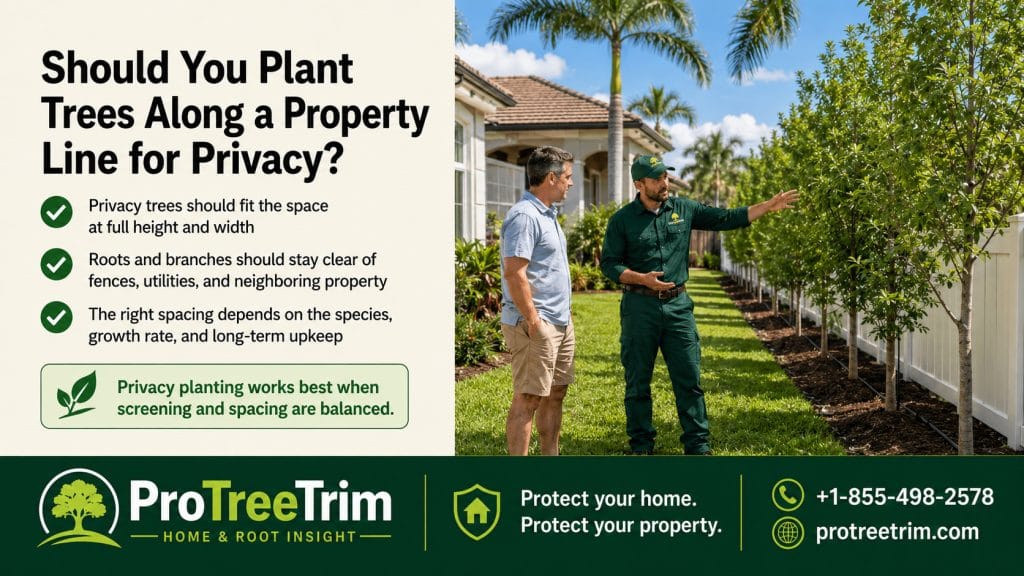
Planting trees along a property line can be a smart way to add privacy, soften a fence, reduce views from neighbors, and make a yard feel more complete. But privacy trees can also create future problems if they are planted too close, spaced too tightly, or chosen only for fast growth. A good privacy planting should screen the view without becoming a fence, root, pruning, or neighbor issue later.
Privacy Trees Need More Space Than They Seem to Need
Young privacy trees can look small and thin when first planted. That is why homeowners often plant them too close together. The row looks better at first, but the problem shows up later.
As trees mature, canopies widen, trunks expand, roots spread, and lower branches compete for light. A row that looked neat at planting may become crowded, uneven, and difficult to maintain.
| Planting mistake | What can happen later |
|---|---|
| Trees planted too close together | Crowding, dead lower branches, weak structure |
| Trees planted too close to fence | Branches cross property line and roots push posts |
| Fast growers planted for quick screening | More pruning and faster conflicts |
| Large trees used in a narrow strip | Canopy and roots outgrow the space |
| Messy trees planted near neighbor side | Debris may fall into another yard |
| Trees planted without access | Future pruning or removal becomes difficult |
Privacy planting should be planned for the mature row, not the first year.
Start With the View You Want to Block
Before choosing trees, decide what you are trying to screen.
Do you want to block a second-story window, a road, a neighboring patio, a pool area, or a bare fence? Different goals need different planting strategies.
A tall narrow tree may help with an upper-window view. A layered mix of shrubs and small trees may work better along a fence. A single well-placed tree may do more than a crowded row if the view problem is specific.
Ask:
- What exact view needs screening?
- Does the screen need to be tall, wide, or both?
- Is privacy needed year-round?
- Will the trees block useful light?
- Will the trees crowd a fence, patio, pool cage, or driveway?
- Can you maintain them from your side?
The best privacy plan solves the view problem without overplanting the whole boundary.
Do Not Plant Directly on the Fence Line
Planting too close to the fence is one of the easiest ways to create future trouble. The trees may grow through, over, or into the fence. Roots may shift posts. Branches may rub panels. If the fence needs repair, the tree row may block access.
A little extra space can prevent years of frustration.
Leave room for:
- trunk expansion
- branch spread
- root growth
- mulch maintenance
- fence repair
- pruning access
- storm cleanup
- future removal or stump grinding
A privacy tree should not depend on the fence to hold its shape or hide poor spacing.
Think About the Neighbor’s Side Too
A property-line tree does not stay fully private in practice. Branches, leaves, flowers, fruit, seed pods, roots, shade, and storm debris may affect the neighbor’s yard.
That does not mean you should avoid planting. It means you should choose and place trees responsibly.
Be cautious with trees that will drop heavy debris into a neighbor’s pool, driveway, roof, shed, or patio. Avoid trees that will need frequent pruning from the neighbor’s side. Avoid fast-growing species that will cross the boundary quickly and become hard to manage.
A good privacy tree should be maintainable mostly from your side.
Fast Privacy Can Become Fast Maintenance
Fast-growing trees are tempting for privacy. They make the yard feel screened sooner. But fast growth can also mean faster pruning, weaker branch structure, more debris, root conflicts, and quicker crowding.
A fast privacy tree planted too close to a fence can become a problem in only a few seasons. It may grow into the neighbor’s yard, shade out its own lower branches, or need repeated hard trimming to stay in bounds.
Fast is not always wrong. But fast-growing trees need more planning, not less.
A better question is not “How fast will it grow?”
It is: Will this tree still fit the property line when it is mature?
Consider Layered Privacy Instead of One Tight Row
A straight wall of trees may not be the best privacy solution. Layered planting often looks more natural and is easier to maintain.
A layered plan might include:
| Layer | Purpose |
|---|---|
| Small or medium trees | Block higher views and add structure |
| Shrubs | Fill lower gaps near the fence |
| Groundcover or mulch | Reduce weeds and mowing around roots |
| Select ornamental plants | Add seasonal interest without large-tree problems |
| One focal shade tree | Screen a specific view without overcrowding |
Layering can also reduce the pressure to plant large trees too close together. Instead of forcing one row to do everything, each plant has a clearer role.
Choose Trees With Manageable Debris
Privacy trees are often planted near patios, pool cages, fences, walkways, and neighbor-facing yards. That makes debris important.
Avoid using messy trees directly on a property line if they drop:
- staining berries
- large fruit
- heavy seed pods
- brittle twigs
- sticky sap or honeydew
- large palm fronds
- sharp leaves or thorns
- frequent branch litter
Every tree sheds something. The issue is whether the debris will create constant cleanup, neighbor frustration, or damage to nearby structures.
Watch for Roots Near Fences and Hardscape
Property lines often include fences, pavers, retaining edges, sidewalks, driveways, patios, or pool decks. Tree roots may eventually conflict with those features if the planting strip is too narrow.
Before planting, check the ground:
- Is there enough open soil?
- Is the area compacted?
- Are pavers or concrete nearby?
- Does water collect along the fence?
- Are there irrigation lines?
- Will roots grow toward a driveway or sidewalk?
- Could fence posts be pushed later?
A tree row should not create the next hardscape repair project.
Leave Maintenance Access
Privacy trees are often planted in the exact place where access is already tight: along fences, behind pools, beside sheds, near gates, or in narrow side yards. That can make future care harder.
Before planting, imagine future work:
Can someone prune the trees from your side?
Can a crew remove a dead tree without damaging the fence?
Can a stump grinder reach the area?
Can branches be lowered safely?
Will the row block access to utilities, drains, or septic components?
A privacy screen that cannot be maintained becomes a liability.
Avoid Blocking Important Yard Functions
A privacy row should not block practical use of the property.
Be careful not to plant where trees will interfere with:
- side gates
- drainage paths
- septic access
- pool equipment
- utility meters
- fence repair
- driveway visibility
- walkway clearance
- emergency or service access
Privacy is valuable, but it should not make the yard harder to live in.
When Evergreen Privacy Makes Sense
Evergreen trees or shrubs can be useful when year-round screening matters. But evergreen does not automatically mean low-maintenance. Some grow large, dense, and wide. Others need regular shaping or may brown out if planted too close or in poor soil.
Before choosing evergreen privacy trees, check:
- mature height
- mature width
- sun needs
- water needs
- spacing requirements
- root behavior
- disease or pest tendencies
- pruning tolerance
- local climate fit
A row of evergreens can look excellent when spaced correctly. It can look terrible when overcrowded.
When One Tree Is Better Than a Row
Sometimes one well-placed tree solves the privacy problem better than a full boundary planting. If the view is from one neighbor window or one road angle, a single small or medium tree may block the line of sight without crowding the fence.
One tree may also be easier to maintain, easier to water, and less likely to create neighbor or root issues.
A row makes sense when you need broad screening. A single tree makes sense when the privacy problem is specific.
Final Property-Line Planting Test
Before planting privacy trees, stand at the property line and picture the mature plants.
Will branches cross the fence?
Will roots push posts or pavers?
Will lower branches die from crowding?
Will debris fall into the neighbor’s yard?
Can you prune everything from your side?
Will the trees block access to gates, utilities, or fence repairs?
Will this still feel like a good plan in 10 years?
If the mature planting creates too many conflicts, use fewer trees, smaller trees, wider spacing, or a layered shrub-and-tree plan.
If you are unsure whether privacy trees are a good fit along your fence, property line, patio, pool cage, or side yard, ProTreeTrim can help connect homeowners with local tree service support. Call +1-855-498-2578 or visit protreetrim.com.
FAQs
Is it a good idea to plant trees along a property line?
It can be, if the trees are properly spaced, fit the mature size of the area, and can be maintained without creating fence or neighbor problems.
How close should privacy trees be planted to a fence?
There is no one distance for every tree. Spacing depends on mature width, root behavior, fence type, access needs, and whether branches will cross the boundary.
Are fast-growing privacy trees a bad idea?
Not always, but they can create faster pruning, root, debris, and crowding problems if planted too close or in a narrow strip.
What is better than a tight row of privacy trees?
A layered planting with properly spaced trees, shrubs, mulch, and smaller plants often creates better privacy with fewer long-term maintenance problems.
ProTreeTrim™ can help you take the next step.
If you are dealing with a damaged tree, fallen branch, stump, root issue, palm concern, or storm cleanup question in Florida, call ProTreeTrim for tree service support.