
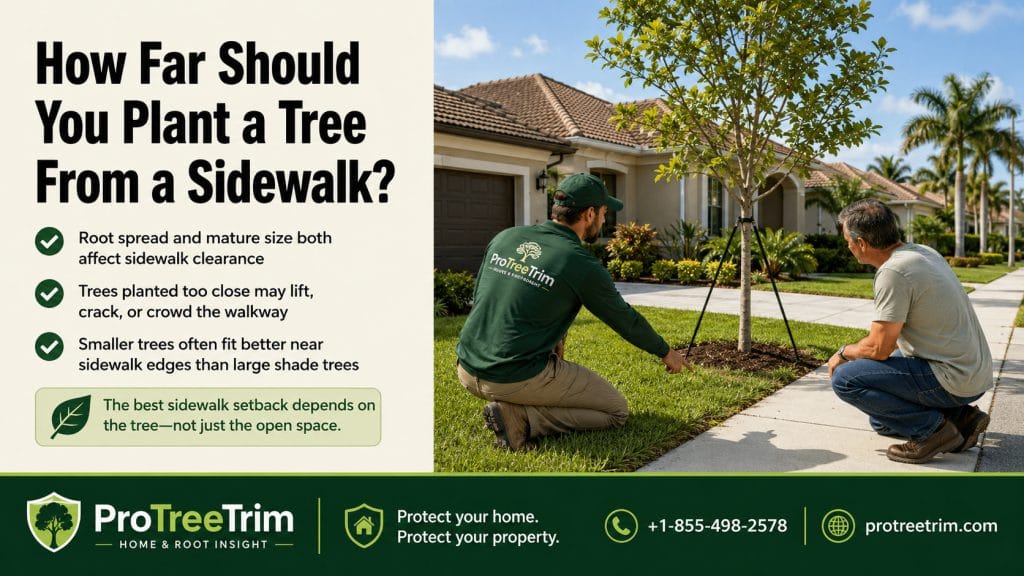
A tree near a sidewalk can make a front yard feel shaded, finished, and welcoming. But if it is planted too close, the same tree can eventually lift concrete, expose roots, narrow the walking path, create trip hazards, and force hard decisions about root cutting or tree removal. The right distance depends on the tree’s mature size, root behavior, sidewalk width, soil space, drainage, and how people use the area.
Do Not Plant for the Empty Strip You See Today
A young tree in a narrow strip beside a sidewalk may look perfect at first. It adds curb appeal without taking up much space. The problem comes later, when the trunk expands, roots spread, branches lower over the walking path, and the sidewalk starts to move.
The planting space has to fit the mature tree, not the young tree.
| What changes over time | Why it matters near sidewalks |
|---|---|
| Trunk gets wider | May crowd the walkway or curb |
| Roots expand | Can lift or crack sidewalk panels |
| Canopy spreads | May block pedestrians, signs, or visibility |
| Surface roots appear | Can create mowing and trip issues |
| Branches lower or droop | May require clearance pruning |
| Soil compacts | Roots may struggle in narrow strips |
| Water runoff changes | Erosion or root exposure may increase |
A tree that looks small today may become a sidewalk conflict years later if the planting strip is too narrow.
There Is No One Distance for Every Tree
A small ornamental tree and a large shade tree should not be planted by the same rule. A tree with modest roots, smaller mature size, and upright form may work closer to a sidewalk than a large, broad-canopied tree with major surface roots.
The better question is not only “How many feet away?” It is: Will this tree still fit the sidewalk area when it is mature?
Before planting, check:
- mature height
- mature canopy spread
- trunk size
- root behavior
- branch strength
- debris drop
- sidewalk width
- available soil volume
- nearby curb, driveway, fence, or utility line
If the tree will need repeated pruning or future root cutting just to keep the sidewalk usable, it is probably the wrong tree for that spot.
Narrow Planting Strips Are the Highest-Risk Areas
The narrow strip between a sidewalk and street, driveway, or curb is one of the hardest places to grow a tree well. There may be limited soil, reflected heat, compacted ground, road salt in some regions, irrigation gaps, and heavy pedestrian pressure.
In Florida-style neighborhoods, the challenge may be different: sandy soil, fast drainage in one area, standing water in another, mower damage, hurricane-season wind exposure, and roots competing with concrete edges.
A narrow strip can work for the right small tree, but it is usually a poor place for a large shade tree.
Be cautious if the planting strip is:
- very narrow
- surrounded by concrete on multiple sides
- close to a driveway apron
- near a curb or storm drain
- under overhead utility lines
- heavily walked across
- already showing compacted or bare soil
- difficult to water consistently
A tree cannot grow well long term if the site gives it almost no room.
Sidewalk Damage Is Often a Root-and-Site Problem
When a sidewalk lifts, homeowners often blame the tree alone. Sometimes the tree is the main factor. Other times, the problem is a combination of roots, compacted soil, poor sidewalk base, water movement, settling, age, or limited planting space.
Tree roots grow where oxygen, moisture, and soil conditions allow. If the best available space is just under or beside the sidewalk edge, roots may move there over time. If the sidewalk base is weak or the soil settles unevenly, the surface may shift even more.
Before planting, think about the whole site:
| Site condition | Why it matters |
|---|---|
| Compacted soil | Roots may stay shallow or struggle |
| Poor drainage | Roots and sidewalk base may both be affected |
| Narrow soil area | Roots have fewer places to grow |
| Existing sidewalk cracks | Future tree conflicts may appear sooner |
| Heavy mower traffic | Root flare and bark may be damaged |
| Nearby driveway | Roots, concrete, and vehicle access can overlap |
| Downspout or runoff nearby | Water may expose or redirect roots |
Planting farther away is often cheaper than repairing sidewalk damage later.
Choose Trees With Sidewalk-Friendly Traits
No tree is completely risk-free near pavement. But some traits are better than others.
A better sidewalk-area tree usually has:
- smaller mature size
- moderate root behavior
- strong branch structure
- upright or controlled canopy form
- manageable debris
- tolerance for local soil and weather
- limited need for aggressive pruning
- enough space for roots and trunk expansion
A poor sidewalk tree is usually one that grows too large, spreads too wide, develops large surface roots, drops heavy debris, or needs constant cutting to stay out of the path.
The goal is not to find a “perfect” tree. The goal is to choose a tree that matches the sidewalk space honestly.
Think About Pedestrian Clearance Early
Sidewalk trees need branch clearance. A low limb that looks charming when the tree is young may eventually force people to duck, step around the tree, or walk into the street.
Clearance pruning should be gradual. Do not strip a young tree bare just to create a tall trunk immediately. But do not ignore branch structure either. A tree planted beside a sidewalk should be trained over time so it develops safe pedestrian clearance without large cuts later.
Watch for:
- low branches over walking paths
- branches growing toward street signs
- limbs blocking driveway sightlines
- branches rubbing fences or mailboxes
- canopy blocking exterior lighting
- limbs hanging over parked cars
A good sidewalk tree is easy to walk under, easy to maintain, and not constantly in the way.
Avoid Planting Too Close to Driveway Corners
Sidewalks often meet driveways, curbs, and front walks. These intersections are already busy spaces. A tree planted too close to a driveway corner can create several problems at once: root lift, visibility issues, vehicle clearance, and future access trouble.
Before planting near a driveway-side sidewalk, ask:
- Will drivers be able to see pedestrians?
- Will branches block parked vehicles?
- Will roots lift both sidewalk and driveway edge?
- Will trash bins, delivery drivers, or strollers have room?
- Will tree crews have access later?
- Will the tree interfere with the mailbox or street view?
If the answer is uncertain, move the tree farther away or choose a smaller planting.
What If a Tree Is Already Too Close to the Sidewalk?
If a tree is already lifting a sidewalk, do not jump straight to cutting roots. Large roots may be important for tree stability. Cutting them can stress the tree, increase decline, or affect how it stands during wind and rain.
The right solution depends on the tree, sidewalk, root size, and location. Possible options may include:
| Situation | Possible approach |
|---|---|
| Small lift from minor roots | Sidewalk repair may be possible |
| Large root under main walking path | Needs careful tree-and-hardscape decision |
| Tree is healthy and valuable | Consider root-sensitive sidewalk design options |
| Tree is declining or poorly placed | Removal may need discussion |
| Sidewalk is unsafe | Public access and liability concerns rise |
| Roots are near driveway too | Broader hardscape planning may be needed |
A sidewalk problem is rarely just a sidewalk problem. It is usually a tree, root, soil, and access problem together.
Do Not Cover Exposed Roots With Deep Soil
If roots are visible near a sidewalk, homeowners often want to bury them with soil. Be careful. Adding too much soil can reduce oxygen around roots, bury the root flare, change drainage, and create new stress.
A shallow mulch bed may be better than repeatedly trying to force grass over roots. But mulch should stay away from the trunk and should not create a mound.
If exposed roots are in a walking path, the issue may need a different solution: redirecting foot traffic, expanding a planting bed, repairing the sidewalk, or evaluating whether the tree still fits the space.
Sidewalk Trees Need Future Maintenance Access
A tree near a sidewalk may one day need pruning, deadwood removal, storm cleanup, or removal. If it is planted between a sidewalk, fence, street, driveway, and utility line, that work can become more complicated.
Before planting, think ahead:
- Can a crew reach the tree safely?
- Can branches be lowered without damaging pavement or cars?
- Would stump grinding be possible later?
- Will pedestrians need to be redirected during work?
- Are overhead or underground utilities nearby?
- Will the tree block access to the front yard?
A tree should not become impossible to maintain because it was squeezed into the wrong strip of land.
When a Sidewalk Tree Works Well
A sidewalk tree can be an excellent choice when it is matched to the space.
It works best when:
- the planting strip is wide enough
- the tree stays in scale at maturity
- roots have adequate soil space
- branches can be trained for clearance
- debris is manageable
- utilities are not in conflict
- the sidewalk remains accessible
- future pruning is realistic
A good sidewalk tree adds shade and character without turning the walkway into a repair project.
Final Planting Test
Before planting, stand at the proposed spot and imagine the tree at full size.
Will roots lift the sidewalk?
Will people have room to walk?
Will branches block the path?
Will the tree crowd the driveway?
Will future crews be able to work there?
Will this still look like a good decision in 15 years?
If the answer is no, plant farther away or choose a smaller tree.
If you are unsure whether a tree is a good fit near your sidewalk, driveway, walkway, curb, or front yard, ProTreeTrim can help connect homeowners with local tree service support. Call +1-855-498-2578 or visit protreetrim.com.
FAQs
How far should a tree be planted from a sidewalk?
There is no single distance for every tree. The right spacing depends on mature size, root behavior, canopy spread, sidewalk width, and available soil space.
Can tree roots lift a sidewalk?
Yes. Roots can contribute to lifted or uneven sidewalk panels, especially when large trees are planted in narrow or compacted spaces.
Should I cut roots that are lifting a sidewalk?
Not without careful evaluation. Cutting large roots can stress the tree or affect stability, especially if the roots are close to the trunk.
What kind of tree is best near a sidewalk?
A smaller, well-structured tree with manageable roots, moderate canopy spread, and enough soil space is usually better than a large shade tree in a narrow strip.
ProTreeTrim™ can help you take the next step.
If you are dealing with a damaged tree, fallen branch, stump, root issue, palm concern, or storm cleanup question in Florida, call ProTreeTrim for tree service support.