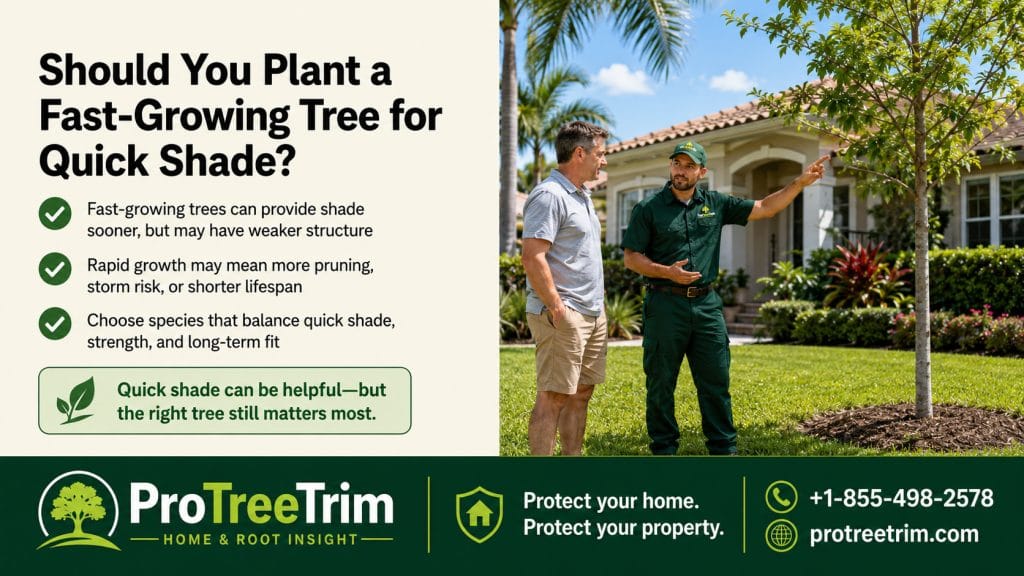
A fast-growing tree can be tempting when the yard feels too hot, empty, or exposed. Quick shade sounds like an easy win. But speed is not the only thing that matters. Some fast-growing trees can develop weak branches, messy debris, surface roots, storm problems, or a size that overwhelms the yard sooner than expected.
Fast Shade Can Be Useful
There are good reasons homeowners look for fast-growing trees. A new house may have no shade. A patio may bake in afternoon sun. A driveway may feel exposed. A neighbor’s view may need softening. A young landscape may look unfinished.
A faster-growing tree can help the yard feel established sooner. It may improve comfort, privacy, and curb appeal in the first few years.
The mistake is assuming fast growth automatically means a better tree.
| Why homeowners want fast growth | What should also be checked |
|---|---|
| Quick shade | Mature size and canopy spread |
| Privacy from neighbors | Branch structure and spacing |
| Cooler patio | Debris, roots, and access |
| Front yard curb appeal | Long-term fit near roof and driveway |
| Lower heat around hardscape | Root space and drainage |
| Fast landscape impact | Future pruning and removal cost |
A tree that gives shade quickly but becomes a maintenance problem is not a shortcut. It is a delayed expense.
Fast Growth Can Come With Tradeoffs
Some fast-growing trees invest energy in height and spread before they develop strong, durable structure. That can mean longer limbs, weaker branch attachments, more frequent pruning, or higher storm cleanup risk later.
Not every fast-growing tree is bad. But fast growth should make you ask better questions.
Before planting, ask:
- Does this species have strong branch structure?
- Does it shed limbs easily?
- Does it develop large surface roots?
- How wide will the canopy become?
- Will it outgrow the yard?
- Does it drop messy fruit, seed pods, or twigs?
- Will it need frequent pruning to stay away from the house?
- Is it suitable for local soil, wind, and drainage?
A tree can be “fast” and still be a poor fit for the site.
Do Not Use Fast Growth to Fix Poor Placement
If the planting spot is too close to the house, driveway, sidewalk, pool cage, fence, or power line, fast growth makes the mistake show up sooner.
A slow-growing tree planted too close may take years to become a problem. A fast-growing tree can reach the roofline, driveway, or fence much faster. That can lead to repeated trimming, root conflicts, debris buildup, or early removal.
Fast-growing trees need at least as much planning as slower trees—sometimes more.
| Planting area | Why fast growth can become a problem |
|---|---|
| Near roofline | Branches may touch gutters and shingles sooner |
| Beside driveway | Low limbs and roots may interfere with vehicles |
| Near sidewalk | Roots and canopy clearance may become issues |
| Along fence | Canopy may cross property line quickly |
| By pool or patio | Debris and shade may become excessive |
| Under power lines | Utility conflict may happen sooner |
| Near septic area | Roots and access planning matter more |
If the tree only works while it is small, it does not really work.
Quick Shade Over a Patio Needs Extra Care
A patio is one of the most common places homeowners want fast shade. That makes sense, but a patio is also one of the worst places to plant the wrong tree.
A fast-growing tree near a patio may quickly drop leaves, flowers, fruit, twigs, sap, or seed pods where people sit. It may shade the space so heavily that pavers stay damp. It may lift nearby hardscape. It may grow into a pergola, roof edge, or pool cage.
For patios, choose for comfort and cleanliness—not just speed.
A better patio tree should:
- fit the mature space
- drop manageable debris
- have strong branch structure
- stay clear of the roof and furniture area
- allow future pruning access
- not lift pavers too quickly
- create shade where people actually sit
Shade is useful only when the space remains easy to enjoy.
Fast Privacy Trees Can Become Fence Problems
Fast-growing trees are also popular along fences. Homeowners want quick screening from neighbors, roads, or nearby buildings. The risk is planting too many trees too close together.
A row of fast growers can crowd itself quickly. Lower branches may die back from shade. Roots may compete. Branches may cross the fence. Trimming may become constant. If one tree declines, the whole privacy screen can look uneven.
For privacy, a layered plan often works better than a wall of fast trees.
Consider:
- properly spaced small or medium trees
- shrubs that match the fence height
- staggered planting rather than a tight line
- enough room for pruning from your side
- avoiding trees that drop heavy debris into the neighbor’s yard
- leaving access to fence panels and gates
Privacy should not create a future boundary problem.
Fast-Growing Trees May Need Earlier Structural Pruning
A fast-growing tree can develop awkward structure quickly if it is ignored. Competing leaders, narrow branch angles, crossing limbs, and low heavy branches can become larger problems in only a few seasons.
That does not mean the tree should be cut hard. It means young-tree structural pruning matters.
Watch for:
- two upright stems competing to be the main trunk
- branches clustered too close together
- limbs growing toward the roof or driveway
- weak V-shaped branch unions
- rubbing branches
- low branches that may block access later
- water sprouts after damage or heavy pruning
Small corrections early are usually easier than large cuts later.
Debris Matters More Than People Expect
A fast-growing tree may also be a fast-shedding tree. Leaves, twigs, seed pods, flowers, fruit, bark, or small branches can become part of daily maintenance.
That matters most when the tree is planted near:
- patios
- pools
- driveways
- walkways
- gutters
- roof valleys
- front entries
- outdoor furniture
- parked vehicles
A tree that drops constant debris in open lawn may be fine. The same tree over the pool cage or driveway may become frustrating.
Think About Storm Season Before Planting
In storm-prone areas, fast growth should be evaluated carefully. A tree with weak branch structure, brittle wood, or shallow root behavior may create future cleanup or risk concerns.
Do not plant a fast-growing tree only because you want immediate shade before summer. Ask whether that tree will still be a good choice during wind, heavy rain, and saturated soil conditions.
Storm-aware planting means thinking about:
- branch strength
- root space
- mature canopy size
- distance from roof and driveway
- clearance from power lines
- soil drainage
- future pruning access
- whether the tree can grow naturally without topping
A tree should not need severe pruning every year to feel safe.
Slower Trees May Be Better Investments
A slower-growing tree may take longer to provide shade, but it may develop stronger structure, better form, and fewer long-term conflicts. In many yards, the better tree is not the fastest one. It is the one that will still fit the property when mature.
A slower tree may be worth it if it offers:
- stronger branch architecture
- better mature size for the yard
- less debris
- fewer root conflicts
- longer lifespan
- lower pruning pressure
- better curb appeal over time
Fast impact is nice. Long-term fit is better.
When a Fast-Growing Tree Can Make Sense
A fast-growing tree may be a reasonable choice when the site has enough space, the species is well matched to the soil and climate, the tree has acceptable structure, and the homeowner understands the maintenance.
It may work well when:
- planted far enough from the house
- given enough root space
- kept away from power lines
- not placed over a pool or patio if messy
- structurally pruned while young
- monitored after storms
- chosen for mature size, not nursery appeal
Fast growth is not the problem by itself. Fast growth in the wrong place is the problem.
When to Avoid Fast-Growing Trees
Avoid fast-growing trees when the planting space is tight, the yard has lots of hardscape, or the tree would need constant pruning to stay out of structures.
Be especially cautious near:
- rooflines
- small front yards
- narrow side yards
- pool cages
- driveways
- sidewalks
- septic systems
- power lines
- fences and neighbor boundaries
- patios with pavers
If the tree will outgrow the site quickly, choose a smaller or slower species.
A Better Way to Get Shade Faster
There are ways to improve shade without choosing the fastest large tree available.
You can:
- choose a medium-growing tree with better structure
- plant a slightly larger nursery tree if budget allows
- add temporary shade sails or umbrellas near patios
- use shrubs for faster privacy while trees mature
- plant a layered landscape with different heights
- place the tree where afternoon shade will be most useful
- mulch and water correctly so the tree establishes well
A healthy tree in the right spot often catches up better than a fast tree planted poorly.
Final Homeowner Takeaway
A fast-growing tree can be a good choice, but only when it fits the yard at full size. Do not choose speed over structure, roots, debris, storm performance, or placement.
The best shade tree is not always the one that grows fastest. It is the one that gives useful shade without crowding the house, lifting hardscape, dropping constant debris, or becoming a pruning problem.
If you are unsure whether a fast-growing tree is a good fit for your yard, driveway, patio, pool cage, or roofline, ProTreeTrim can help connect homeowners with local tree service support. Call +1-855-498-2578 or visit protreetrim.com.
FAQs
Are fast-growing trees bad?
Not always. Some can be useful, but fast growth often comes with tradeoffs such as weaker structure, more pruning, debris, or faster site conflicts.
What is the biggest risk of planting a fast-growing tree?
The biggest risk is planting it in a space it will outgrow quickly, such as near a roof, driveway, sidewalk, fence, pool cage, or utility line.
Can a fast-growing tree provide good shade?
Yes, but shade is only helpful if the tree also has strong structure, manageable roots, and enough room to mature safely.
Should I choose a slower-growing tree instead?
Often, yes, if the slower tree fits the site better, has stronger structure, creates less debris, and needs less corrective pruning later.
ProTreeTrim™ can help you take the next step.
If you are dealing with a damaged tree, fallen branch, stump, root issue, palm concern, or storm cleanup question in Florida, call ProTreeTrim for tree service support.