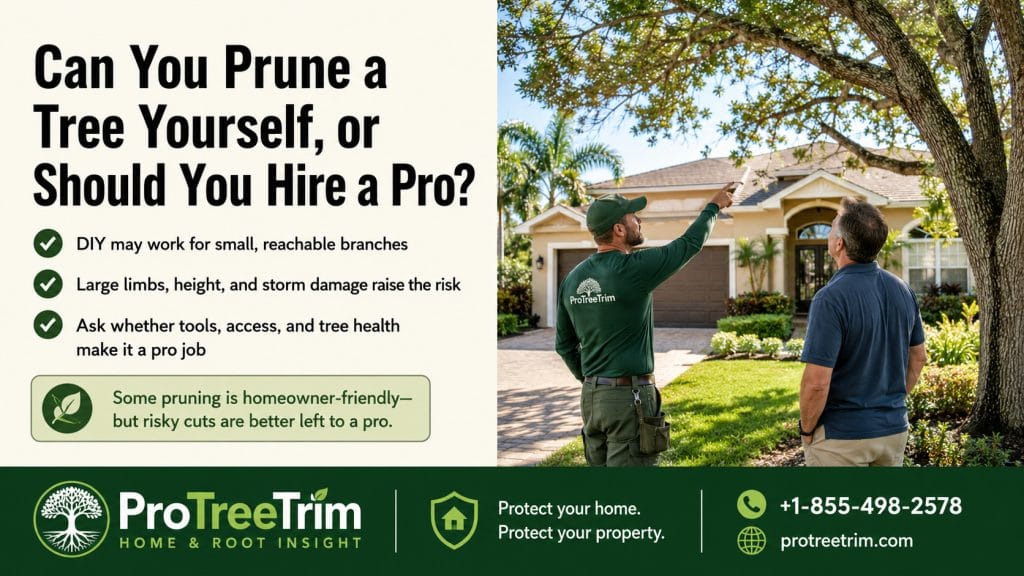
Some tree pruning can be done by a careful homeowner from the ground. Small dead twigs, light clearance around a walkway, or minor branch cleanup may be manageable with hand tools. But large limbs, high branches, storm damage, roofline branches, leaning trees, and anything near utility lines should not become a weekend ladder project.
Start With the Size and Location of the Branch
The branch itself tells you a lot. A small branch you can reach from the ground is one kind of job. A heavy limb over a driveway, roof, pool cage, fence, or walkway is another.
Homeowners often underestimate how heavy branches are. A limb that looks manageable while attached to the tree can twist, swing, split, or fall unpredictably once cut. That is especially true when the branch is under tension, storm-damaged, cracked, or hanging.
| Pruning situation | DIY or professional? |
|---|---|
| Small dead twig reachable from the ground | Usually homeowner-friendly |
| Low branch lightly blocking a path | May be manageable if small |
| Large limb over roof or driveway | Professional job |
| Branch near power line | Utility/professional issue, not DIY |
| Storm-broken hanging limb | Professional job |
| Palm fronds high above a pool cage | Professional job |
| Tree leaning or cracked | Needs closer professional review |
| Cutting from a ladder with a chainsaw | Avoid DIY |
A simple rule works well: if you need a ladder, rope, chainsaw, or guesswork, the job is probably beyond casual homeowner pruning.
Small Pruning Still Needs Clean Cuts
DIY pruning can hurt a tree when cuts are sloppy. Flush cuts against the trunk, long stubs, torn bark, and random heading cuts can slow healing and create future structure problems.
For small branches, the goal is to remove the branch cleanly without damaging the branch collar, the slightly swollen area where the branch meets a larger limb or trunk. Do not cut flat against the trunk. Do not leave a long dead stub.
Also avoid cutting just because a branch “looks messy.” A branch should have a reason to come off: it is dead, broken, rubbing, blocking access, touching a structure, or growing in a way that will create a future conflict.
Do Not Use Pruning to Make a Tree Smaller Fast
Many bad pruning jobs begin with a reasonable feeling: the tree is too big, too shady, too close to the house, or too messy. The homeowner wants it “cut back.”
The problem is that trees do not respond like hedges. Cutting back large limbs randomly can create weak regrowth, sun-exposed bark, large wounds, and an unbalanced canopy. Topping or harsh reduction may make the tree look controlled for a short time, but it often creates more maintenance later.
If a tree is truly too large for its space, the better conversation may be long-term pruning, selective clearance, or whether the tree is simply wrong for that location. Repeated hard cutting is not a good substitute for a proper plan.
When DIY Pruning Makes Sense
Homeowner pruning is most reasonable when the branch is small, reachable from the ground, away from structures, and clearly safe to remove.
Examples include:
- small dead twigs on a young tree
- light clearance around a garden path
- a small branch rubbing a fence at eye level
- minor cleanup on a newly planted tree
- removing broken small branches after they have already fallen
- trimming small suckers or water sprouts when appropriate
Even then, use sharp hand tools, work slowly, and avoid removing too much live growth at once.
When to Hire a Pro
Hire help when the branch is large, high, heavy, cracked, hanging, or near anything valuable. Also get help if the tree itself shows warning signs: trunk cracks, mushrooms near the base, a new lean, major dead limbs, root movement, storm damage, or branches over high-use areas.
Professional help is especially important for:
- limbs over roofs
- branches above driveways or parked cars
- pool cage or patio trees
- palms with high fronds or seed pods
- trees near fences or neighbor’s property
- storm-damaged branches under tension
- dead trees or large dead limbs
- trees near electrical lines
- pruning that requires climbing or rigging
A professional crew is not just paying for cutting. You are paying for controlled lowering, cleanup, property protection, access planning, and safer decision-making.
Utility Lines Are Not a Homeowner Pruning Job
Branches near electrical lines deserve special caution. Do not use pole saws, ladders, ropes, or trimming tools near wires. Do not assume a line is harmless because it looks insulated or because the branch is only “close.”
If a tree is touching or close to a power line, contact the utility first. Tree work can happen after the electrical safety issue is understood.
What to Ask Before Hiring a Tree Crew
A good pruning conversation should be specific. Avoid vague instructions like “trim everything” or “cut it way back.”
Ask:
- Which branches are being removed?
- Are we removing deadwood, live branches, or both?
- Will any large limbs be cut?
- How much live canopy will be removed?
- Are branches being cleared from the roof, driveway, pool cage, or walkway?
- Will the natural structure of the tree be preserved?
- How will nearby pavers, fences, screens, or landscaping be protected?
- Will debris be hauled away?
- Are utility lines involved?
The better the scope, the less likely you are to end up with an over-pruned tree or unfinished cleanup.
Do Not Let Cost Push You Into a Risky DIY Job
Tree pruning can feel expensive until something goes wrong. A falling limb can damage a roof, gutter, fence, pool cage, vehicle, or person. A bad cut can also create long-term tree problems that require more work later.
DIY is fine for small, safe, ground-level pruning. It is not worth gambling on heavy limbs, high work, electrical hazards, storm damage, or trees close to valuable property.
If you are unsure whether a pruning job is safe to handle yourself or should be handled professionally, ProTreeTrim can help connect homeowners with local tree service support. Call +1-855-498-2578 or visit protreetrim.com.
FAQs
Can I prune small branches myself?
Yes, if they are small, reachable from the ground, away from structures, and you can make clean cuts without damaging the trunk or larger limbs.
Should I use a ladder to prune a tree?
It is usually better not to. If pruning requires a ladder, chainsaw, rope, or overhead cutting, the job is safer for a professional crew.
Can I cut branches touching my roof myself?
Small reachable branches may be manageable, but larger roofline limbs can fall unpredictably and damage shingles, gutters, or siding. Professional help is usually safer.
When is tree pruning not a DIY job?
Avoid DIY when branches are large, high, storm-damaged, near wires, over structures, or connected to a leaning, cracked, or declining tree.
ProTreeTrim™ can help you take the next step.
If you are dealing with a damaged tree, fallen branch, stump, root issue, palm concern, or storm cleanup question in Florida, call ProTreeTrim for tree service support.