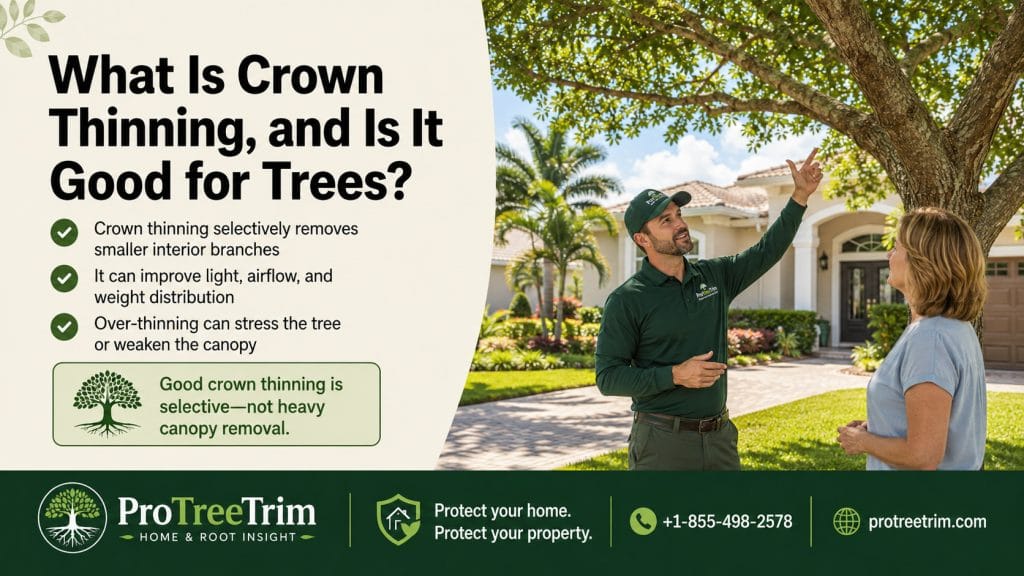
Crown thinning is a pruning method that selectively removes some live branches from a tree’s canopy to reduce density. Homeowners often ask for crown thinning because a tree feels too dark, too heavy, too crowded, or too close to the house.
When done carefully, crown thinning can improve light penetration, airflow, branch spacing, and visibility through the canopy. When done poorly, it can remove too much live foliage, expose branches to sun, create weak-looking limbs, and make the tree more stressed.
The goal is not to “empty out” the tree. The goal is to make careful, limited cuts that preserve the tree’s natural structure.
Crown Thinning Means Selective Branch Removal
Crown thinning does not mean topping the tree, cutting the ends of every branch, or stripping the inside of the canopy. It should be selective.
A proper crown thinning job may remove:
- small crossing branches
- rubbing branches
- weak interior branches
- crowded live branches
- some small branches to improve spacing
- minor branches blocking light or airflow
- selected branches contributing to imbalance
It should not remove large healthy limbs without a clear reason.
| Pruning type | Main purpose |
|---|---|
| Crown thinning | Reduces canopy density selectively |
| Crown cleaning | Removes dead, broken, damaged, or diseased branches |
| Crown raising | Removes selected lower branches for clearance |
| Crown reduction | Carefully reduces height or spread when appropriate |
| Topping | Harmful cutting of major limbs or tree tops to stubs |
Crown thinning is one pruning tool. It is not the answer to every tree problem.
Why Homeowners Ask for Crown Thinning
Many homeowners ask for thinning because a tree feels “too full.” Sometimes that concern is practical. A dense canopy may block light from a lawn, hold moisture over a roof, crowd a patio, or make a yard feel closed in.
Crown thinning may be considered when:
- the canopy is very dense
- branches are rubbing each other
- light cannot reach the lawn or plants below
- branches are crowded near the roof
- the tree has poor interior branch spacing
- visibility through the canopy is needed
- storm-damaged branches need selective correction
But “too full” is not always a problem. A full canopy is also how a tree makes energy.
Over-Thinning Is the Main Risk
The biggest mistake is removing too much live canopy. A tree’s leaves are its energy system. If too much foliage is removed, the tree may become stressed, especially during heat, drought, root damage, pests, or storm recovery.
Over-thinned trees may show:
- long bare limbs
- foliage only at branch ends
- thin, weak-looking canopy
- more sun exposure on bark
- increased branch-end weight
- reduced shade
- stress response shoots
- unnatural appearance
A tree should not look hollow after thinning.
Crown Thinning Is Not “Letting Wind Pass Through”
Homeowners sometimes believe heavy thinning makes a tree safer in storms because wind can pass through the canopy. This idea can be misleading. Removing too much inner foliage may change how branches move and can leave long limbs with foliage only at the ends.
Storm safety is not achieved by stripping the inside of a tree.
Better storm-related pruning focuses on:
- dead branches
- cracked limbs
- weak unions
- broken branches
- branches touching structures
- poor branch attachments
- overextended limbs where appropriate
- trunk or root warning signs
A tree with bad structure needs structural decisions, not random thinning.
Crown Thinning Should Preserve Natural Shape
Good crown thinning is hard to notice from a distance. The tree should look slightly lighter, better spaced, and more balanced, but still natural.
A good result:
- keeps the canopy full enough
- avoids large unnecessary cuts
- preserves interior structure
- leaves branches evenly distributed
- avoids stripping lower or inner limbs
- keeps the tree’s natural outline
- removes specific problem branches
A bad result:
- leaves bare interior branches
- removes too much foliage
- creates a “lion-tailed” look
- cuts branch ends randomly
- makes the canopy uneven
- exposes the trunk and limbs suddenly
- makes the tree look shocked
A properly thinned tree should not look like it was gutted.
What Is Lion-Tailing?
Lion-tailing is a common bad pruning outcome. It happens when too many inner branches are removed, leaving foliage mostly at the ends of long limbs. The branch then looks like a lion’s tail: bare along most of its length with a tuft at the end.
Lion-tailing can:
- reduce interior branch strength
- increase end weight
- expose limbs to sun
- encourage weak regrowth
- make branches look long and unstable
- reduce the tree’s natural wind-buffering structure
- make the tree look unnatural
Crown thinning should never become lion-tailing.
Crown Thinning vs. Crown Cleaning
Crown cleaning is often safer and more necessary than crown thinning. Crown cleaning removes dead, broken, damaged, or diseased branches. Crown thinning removes selected live branches to reduce density.
Many homeowners who ask for thinning actually need crown cleaning.
If the tree has deadwood, broken branches, or storm damage, start there. Removing dead and damaged material may improve the canopy without cutting much live growth.
| If the issue is… | Better pruning focus |
|---|---|
| Dead branches | Crown cleaning |
| Broken storm limbs | Damage cleanup |
| Branches touching roof | Clearance pruning |
| Dense but healthy canopy | Careful limited thinning |
| Tree too tall | Do not top; evaluate reduction or removal |
| Too much shade | Thinning may help, but only modestly |
| Weak branch unions | Structural pruning |
The pruning type should match the actual problem.
Crown Thinning Near Roofs
A dense canopy over a roof can trap leaves, twigs, acorns, seed pods, or moisture in roof valleys and gutters. In that case, selective pruning may help. But the goal should be roofline clearance and deadwood removal first, not excessive thinning.
Near roofs, focus on:
- branches touching shingles
- limbs rubbing gutters
- deadwood over roof areas
- branches dropping heavy debris into roof valleys
- clearance from siding and fascia
- safe access for future maintenance
Thinning the entire canopy may not solve a roof problem if the real issue is one limb touching the house.
Crown Thinning Near Lawns and Gardens
Homeowners sometimes want thinning because grass will not grow under a tree. Crown thinning may let in slightly more light, but it may not fix the lawn. Tree shade, root competition, soil compaction, and moisture competition can still make grass struggle.
Before thinning heavily for lawn growth, consider:
- expanding a mulch bed
- choosing shade-tolerant plants
- reducing foot traffic under the tree
- improving soil carefully
- avoiding root damage
- accepting that dense shade may limit turf
Do not damage a valuable tree just to force grass under it.
Crown Thinning Mature Trees Requires Caution
Mature trees should be thinned conservatively. Large live limbs should not be removed unless there is a specific structural or clearance reason. Mature trees have already developed their architecture, and large cuts can create long-term wounds.
For mature trees, ask:
- Are the branches being removed small or large?
- Is the tree healthy?
- Is there root damage or drought stress?
- Are dead branches already present?
- Is thinning truly needed?
- Will the canopy remain balanced?
- Will the tree be exposed to harsh sun?
- Is this about safety or appearance?
Mature trees usually need less cutting, not more.
Young Trees May Need Structural Pruning Instead
Young trees often need structural pruning more than crown thinning. Their branches are still developing. The goal should be to build strong form, not simply reduce density.
Young-tree pruning may focus on:
- competing leaders
- crossing branches
- rubbing branches
- weak attachment angles
- low future-clearance limbs
- damaged branches
- branch spacing
This may create a lighter canopy, but the purpose is structure.
Trees Under Stress Should Not Be Heavily Thinned
If a tree is already stressed, thinning can make things worse. Leaves help the tree recover. Removing live foliage during stress reduces the tree’s ability to produce energy.
Avoid heavy thinning when the tree has:
- drought stress
- brown leaf edges
- early leaf drop
- root damage
- recent trenching nearby
- recent transplanting
- pest pressure
- trunk wounds
- canopy thinning
- storm damage
- poor drainage
A stressed tree may need deadwood removal or safety pruning, but not aggressive thinning.
Palms Are Not Crown-Thinned
Palms do not have branching canopies like shade trees. Removing green fronds from a palm is not crown thinning. It is palm trimming, and it should be done carefully.
For palms:
- remove dead fronds
- remove broken fronds
- remove seed pods when needed
- clear roof or pool cage contact
- preserve healthy green fronds
- avoid hurricane cuts
- do not strip the crown
Do not apply crown-thinning logic to palms.
Oaks Need Conservative Thinning
Large oaks, especially mature shade oaks, should not be aggressively thinned. Their broad limbs and natural canopy structure are part of what makes them strong and valuable.
Oak thinning may be appropriate when branches are crowded, rubbing, or structurally poor. But it should be limited.
Avoid:
- removing too many inner branches
- cutting large healthy limbs for light
- opening the canopy too much
- lion-tailing long limbs
- cutting just to reduce acorns or leaves
- making the oak look sparse
A healthy oak should retain a strong, natural canopy.
When Crown Thinning May Help
Crown thinning may be useful when the tree is healthy and the work is modest.
It may help when:
| Situation | Why thinning may help |
|---|---|
| Branches are crowded | Improves spacing |
| Branches rub each other | Reduces future wounds |
| Canopy is overly dense near roof | May improve clearance and airflow |
| Interior branch structure is poor | Selective correction may help |
| Light is needed below | Limited thinning may help slightly |
| Young tree has competing branches | Structural pruning may reduce density |
| Storm damage created imbalance | Selective pruning may restore form |
Thinning should be a careful adjustment, not a major removal.
When Crown Thinning Is the Wrong Request
Crown thinning may be the wrong choice when the real issue is height, root damage, trunk decay, poor placement, or a tree that is too large for the site.
Thinning will not fix:
- a tree planted too close to the house
- roots lifting a driveway
- trunk cracks
- a severe lean
- a dead top
- major decay
- branches near power lines
- a tree that should be removed
- a canopy that has already been over-pruned
If the tree has a structural or placement problem, thinning may only hide the issue temporarily.
What Homeowners Should Ask Before Crown Thinning
Before approving crown thinning, ask:
- Why does the tree need thinning?
- Are dead branches being removed first?
- How much live canopy will be removed?
- Are large limbs being cut?
- Will interior branches be preserved?
- Will the tree avoid a lion-tailed look?
- Is the tree already stressed?
- Is the goal light, airflow, clearance, or structure?
- Would crown cleaning be more appropriate?
A good thinning plan should sound restrained and specific.
What a Good Crown Thinning Scope Sounds Like
A good scope:
- “Remove selected small rubbing branches.”
- “Lightly thin crowded interior branches while preserving structure.”
- “Focus on deadwood and minor live-branch spacing.”
- “Avoid lion-tailing.”
- “Do not remove large healthy limbs.”
- “Preserve the tree’s natural canopy.”
A poor scope:
- “Thin it out a lot.”
- “Open up the whole middle.”
- “Cut all the inside branches.”
- “Make wind pass through.”
- “Remove most of the canopy.”
- “Make it less messy.”
- “Cut it way back.”
Good thinning is subtle. Bad thinning is obvious.
Final Homeowner Takeaway
Crown thinning can be good for trees when it is light, selective, and done for a clear reason. It can improve branch spacing, reduce rubbing, slightly increase light, and help with certain clearance issues.
But over-thinning is harmful. It removes too much live foliage, exposes branches, creates lion-tailing, and can stress the tree. Many trees need crown cleaning or clearance pruning more than thinning.
If you are unsure whether your tree needs crown thinning, crown cleaning, roof clearance, or structural pruning, ProTreeTrim can help connect homeowners with local tree service support. Call +1-855-498-2578 or visit protreetrim.com.
FAQs
What is crown thinning?
Crown thinning is selective removal of some live branches to reduce canopy density while preserving the tree’s natural structure.
Is crown thinning good for trees?
It can be good when done lightly and for a clear reason. It can be harmful if too much live canopy is removed.
Is crown thinning the same as topping?
No. Crown thinning is selective pruning inside the canopy. Topping cuts major limbs or tree tops to stubs and should be avoided.
Can crown thinning help with storm risk?
Only in limited ways. Storm preparation should focus more on deadwood, weak unions, cracked limbs, and structure—not heavy thinning.
ProTreeTrim™ can help you take the next step.
If you are dealing with a damaged tree, fallen branch, stump, root issue, palm concern, or storm cleanup question in Florida, call ProTreeTrim for tree service support.