
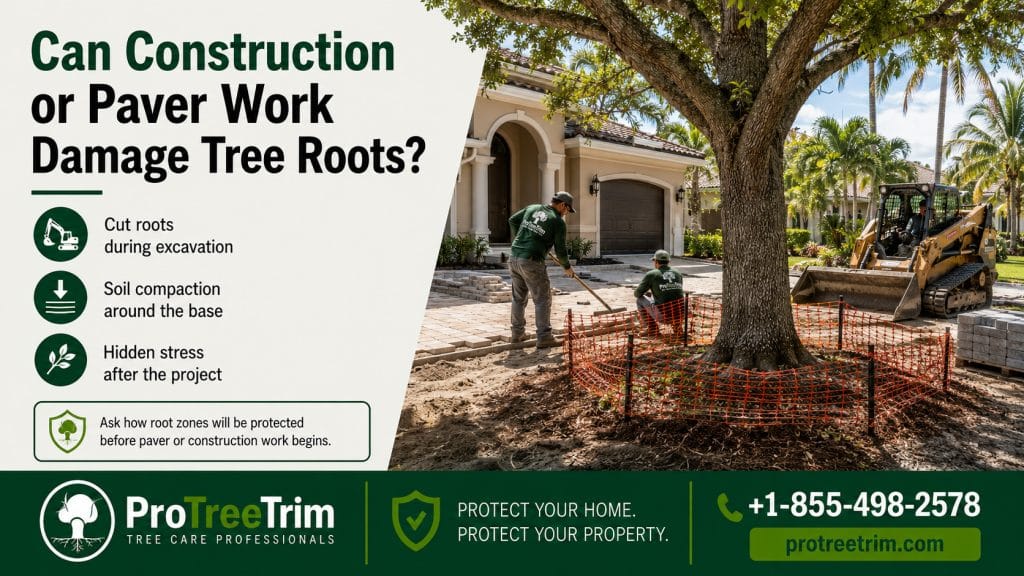
Yes, construction or paver work can damage tree roots, even when the trunk is never touched. The risk often comes from trenching, digging, soil compaction, grade changes, root cutting, or equipment traffic over the root zone. A tree may look fine right after the project and show stress weeks, months, or even seasons later.
Root Damage Is Often Hidden at First
A driveway extension, patio install, fence line, pool project, irrigation repair, or paver reset may look like a hardscape job. To the tree, it can be root-zone work.
Roots do not sit only at the base of the trunk. They spread through the soil where water, oxygen, and space are available. UF/IFAS warns that trenching and digging near trees can cut roots, leading to decline or even increased risk of the tree falling; it also notes that cutting roots larger than about one inch in diameter can create problems for the tree.
The tricky part is timing. A tree may keep its leaves after construction and still be damaged. Later, the homeowner may notice smaller leaves, early leaf drop, dead branch tips, one-sided canopy thinning, or mushrooms near the base.
| Project activity | Why it can affect trees |
|---|---|
| Trenching for utilities or irrigation | Can cut structural or absorbing roots |
| Paver or patio base excavation | May remove soil and roots near the surface |
| Heavy equipment over lawn | Can compact soil and reduce oxygen around roots |
| Adding fill soil near trunk | Can bury roots and change drainage |
| Lowering grade around tree | Can expose or sever roots |
| Repeated material storage under canopy | Can compact the root zone |
| Cutting visible roots for a clean edge | May affect stability or tree health |
Soil Compaction Can Be as Harmful as Cutting
Not all damage comes from a shovel. Heavy equipment, pallets of pavers, parked trailers, dumpsters, and repeated foot traffic can compact soil. ISA’s TreesAreGood construction guidance explains that soil compaction increases soil density, slows root growth, limits water penetration, and reduces oxygen needed for root survival.
That matters in ordinary yards. A crew may avoid hitting the trunk but still drive or stage materials over the area where roots need air and water. In Florida yards with sandy soil, irrigation, pool decks, and narrow side access, one “temporary” work path can become the same compacted strip where a tree later struggles.
UF/IFAS recommends temporary fencing at the dripline to keep construction equipment away from trunks, branches, and part of the root zone. Younger trees may tolerate construction better than older trees, but mature trees often have more to lose when roots are disturbed.
What Homeowners Should Ask Before Work Starts
Before approving construction or paver work near a tree, ask how the root zone will be protected. A contractor may be excellent at pavers, fencing, pools, or irrigation and still not be thinking like a tree professional.
Ask:
- Will digging happen inside the tree’s canopy spread?
- Will any roots need to be cut?
- Will equipment drive over the root zone?
- Where will pavers, soil, gravel, and machinery be staged?
- Will the grade be raised or lowered near the trunk?
- Can the work path avoid the tree’s base and major roots?
- Will irrigation or drainage change after the project?
If large roots are already visible near the work area, take photos before anything starts. Photograph the full tree, trunk base, roots, canopy, pavers, driveway, fence line, and proposed work area. Those photos help create a record if the tree declines later.
Signs the Tree May Be Reacting After the Project
Do not assume the tree is fine because it survived the first week. Watch it through the next few months.
Pay attention to:
- smaller leaves than usual
- branch-tip dieback
- canopy thinning on the construction side
- early leaf drop
- yellow or brown leaf edges
- soil cracking or washing away near roots
- mushrooms or soft spots near the base
- new lean after rain or wind
- large limbs dying back over driveways, roofs, or walkways
If the tree is near a house, pool cage, driveway, sidewalk, fence, or utility area, delayed decline becomes more than a tree-health issue. It can become a property-risk issue.
Do not try to fix construction stress with heavy pruning. Removing live canopy from a stressed tree can make recovery harder unless there is a clear safety reason. Dead, cracked, hanging, or structure-threatening limbs are a different matter and should be handled carefully.
If you are unsure whether construction, paver work, trenching, or root damage has affected a tree on your property, ProTreeTrim can help connect homeowners with local tree service support. Call +1-855-498-2578 or visit protreetrim.com.
FAQs
Can paver installation damage tree roots?
Yes. Excavation, base preparation, root cutting, soil compaction, and drainage changes can all affect nearby roots.
How soon will a tree show damage after construction?
Sometimes quickly, but not always. Root damage may show up later as thinning leaves, dead branch tips, early leaf drop, or one-sided decline.
Is it safe to cut roots that are in the way of a patio or walkway?
Be careful. Cutting larger roots can harm the tree or affect stability, especially near mature trees, structures, driveways, or pool areas.
What should I do before construction starts near a tree?
Photograph the tree, mark major roots and irrigation, ask how the root zone will be protected, and avoid equipment traffic or material storage under the canopy.
ProTreeTrim™ can help you take the next step.
If you are dealing with a damaged tree, fallen branch, stump, root issue, palm concern, or storm cleanup question in Florida, call ProTreeTrim for tree service support.