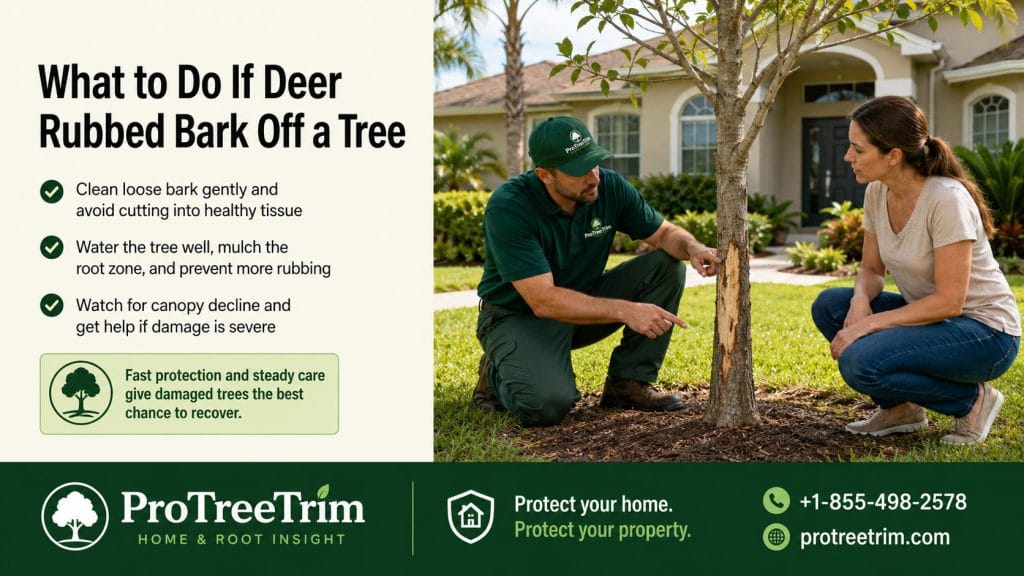
When deer rub bark off a tree, the damage can look sudden and severe. The trunk may have scraped bark, shredded strips, exposed wood, or a raw-looking wound where a buck rubbed antlers against it. Some trees can recover from limited damage. Others may struggle if the bark is removed around much of the trunk, especially young trees with thin bark.
The first step is to check how much of the trunk is damaged, whether the wound goes around the tree, and whether the tree is still structurally stable.
Why Deer Rub Trees
Deer rub trees for natural seasonal reasons, often using trunks and stems to remove velvet, mark territory, or display dominance. Unfortunately, young landscape trees are often the perfect size for this behavior.
Deer rubbing is most damaging when it affects:
- young trees
- thin-barked trees
- newly planted trees
- small ornamental trees
- trees near wooded edges
- trees along property lines
- trees in quiet side yards
- trees without trunk protection
A mature oak may handle minor surface scraping differently than a young maple, crape myrtle, or fruit tree with a thin trunk.
What Deer Rub Damage Looks Like
Deer rub damage usually appears on the trunk or lower stem. The bark may look scraped, shredded, polished, or stripped away. Sometimes the exposed wood is smooth. Sometimes loose bark hangs from the wound.
| What you see | What it may mean |
|---|---|
| Light scraping on one side | Tree may recover if tissue damage is limited |
| Bark stripped deeply on one side | Tree is stressed and should be monitored |
| Damage wraps far around trunk | More serious because water/nutrient movement may be affected |
| Loose shredded bark | Remove only loose pieces; do not cut healthy bark |
| Exposed wood drying out | Normal wound response may begin, but recovery depends on severity |
| Trunk cracked or bent | Structural stability may be affected |
| Young tree leaning after damage | Support or replacement may need discussion |
The most important question is whether the damage is limited to one side or goes around the trunk.
Why Bark Loss Matters
Tree bark is not just a protective covering. Just under the bark are tissues that move water, sugars, and nutrients between the roots and canopy. If those tissues are damaged around too much of the trunk, the tree may decline.
A small wound on one side may seal over gradually. A wound that nearly circles the trunk can interrupt the tree’s life-support system.
This is why a deer rub on a young tree can be more serious than it first appears.
Do Not Paint or Seal the Wound
It may be tempting to cover the wound with paint, tar, pruning sealer, or a homemade paste. In most cases, that is not the right move. Trees respond to wounds by sealing off damaged tissue internally and forming new growth around the edges over time.
Painting the wound may trap moisture, hide decay, or interfere with the tree’s natural response.
A better first response:
- leave attached healthy bark alone
- remove only loose, hanging bark if it is clearly detached
- avoid cutting into living tissue
- do not wrap tightly over the wound
- keep mulch away from the trunk
- protect the tree from future rubbing
- monitor the wound edge over time
The goal is to prevent more damage, not cover up the wound.
Check How Much of the Trunk Was Damaged
A tree with damage on one side may have a better chance than a tree with bark removed around most of the trunk. If the rub forms a ring or nearly a ring around the trunk, the tree is at higher risk.
Ask:
- Is the wound only on one side?
- Does it wrap around the trunk?
- Is the exposed area shallow or deep?
- Is the tree leaning?
- Are branches wilting or browning?
- Is the tree young or recently planted?
- Is the trunk split or only scraped?
- Has deer damage happened before?
If the damage circles much of the trunk, recovery becomes less certain.
Young Trees Are Most Vulnerable
Young trees often have thin bark and small trunks, which makes them easy targets. They also have less stored energy and less trunk tissue to lose.
A young tree may show stress after deer rubbing through:
- wilting leaves
- brown leaf edges
- early leaf drop
- slow growth
- branch-tip dieback
- sunscald on exposed wood
- trunk cracking
- leaning or loose root ball
If the tree was newly planted, deer damage may combine with transplant shock and make recovery harder.
Protect the Tree From a Second Rub
A tree that has been rubbed once may be rubbed again. Preventing repeat damage is often more important than trying to “treat” the wound.
Protection options may include:
| Protection method | Why it helps |
|---|---|
| Trunk guard | Creates a physical barrier around young bark |
| Wire cage | Keeps deer from reaching the trunk |
| Temporary fencing | Protects high-risk trees during active season |
| Wider plant protection zone | Keeps deer away from the stem |
| Repellents | May help in some yards but usually need reapplication |
| Removing rubbing attractants nearby | Reduces repeated traffic patterns |
Any guard or wrap should allow airflow and growth. It should not stay tight around the trunk.
Be Careful With Tree Wraps
Tree wraps can help protect young trunks in some situations, but they can also cause problems if installed poorly or left too long. A tight wrap can trap moisture, hide insects, rub bark, or restrict trunk growth.
If you use a wrap or guard:
- do not wrap too tightly
- do not cover the trunk permanently without checking
- inspect under it regularly
- keep it from trapping moisture
- remove or adjust as the tree grows
- avoid covering the root flare
- keep mulch away from the trunk base
A protective barrier should prevent damage, not create a hidden trunk problem.
Do Not Pile Mulch Against the Wound
After deer damage, homeowners sometimes add mulch around the tree to “help” it. Mulch can help the root zone, but only if it is placed correctly.
Do not pile mulch against the damaged trunk. That can hold moisture against the wound and hide the area you need to monitor.
Better mulch placement:
- wide and shallow
- pulled back from the trunk
- root flare visible
- no volcano mulch
- no mulch packed inside a trunk guard
- no soil piled over exposed roots
A clean, visible trunk base makes it easier to watch recovery.
Watch the Canopy After Damage
The canopy may not respond immediately. A tree can look fine for a while after deer rubbing, then show stress later.
Watch for:
- leaves wilting
- leaves browning at edges
- early leaf drop
- small new leaves
- branch-tip dieback
- no new growth in spring
- suckers growing below the wound
- bark cracking around the wound
- insects entering damaged tissue
If the canopy remains healthy and new woundwood starts forming around the edges, recovery is more promising.
When the Tree May Recover
A tree may recover when the damage is limited, the trunk is not girdled, the root system is healthy, and the tree is protected from further rubbing.
Recovery is more likely when:
- only one side is damaged
- the wound is not too deep
- the tree is otherwise healthy
- the canopy remains strong
- the root flare is visible
- watering is steady but not excessive
- mulch is correct
- deer are kept away going forward
Even then, the wound may remain visible for years.
When Replacement May Be More Realistic
Replacement may be more realistic when a young tree has severe bark loss around the trunk, repeated deer damage, trunk splitting, poor structure, or declining canopy.
Replacement may be worth considering if:
- bark is removed around most of the trunk
- the tree is small and newly planted
- the trunk is cracked or unstable
- the canopy wilts or dies back heavily
- the tree was already stressed
- the tree is in a poor location
- protection is not practical
- the cost of saving it exceeds replacement value
Sometimes the best decision is to replace the tree and protect the new one from day one.
Deer Rub Near Driveways, Sidewalks, and Homes
A deer-damaged tree near a driveway, sidewalk, patio, pool cage, or front entry deserves closer attention. If the tree declines or becomes unstable, it may affect people, vehicles, or structures.
Location matters more when the damaged tree is near:
- walkways
- driveways
- parked cars
- front doors
- patios
- fences
- pool areas
- neighbor property
- utility lines
A small ornamental tree in open lawn may be monitored. A damaged tree leaning near a driveway may need faster action.
Do Not Confuse Deer Rub With Other Bark Damage
Not all bark damage comes from deer. Mowers, string trimmers, rabbits, rodents, sunscald, frost cracks, pruning wounds, and mechanical injury can also damage trunks.
Deer rub is more likely when the wound is:
- on the lower trunk
- scraped or shredded vertically
- at antler height
- on a young tree
- near deer activity paths
- seen during deer rubbing season
- paired with other rubbed trees nearby
If the damage is low, circular, gnawed, or near the base, another animal or equipment damage may be involved.
What Homeowners Should Photograph
Photos help track recovery and explain the damage if you ask for help.
Take pictures of:
- full tree from several angles
- close-up trunk wound
- how far around the trunk damage extends
- loose bark
- canopy condition
- trunk base and root flare
- deer tracks or nearby rubbed trees if visible
- location near driveway, sidewalk, fence, or house
- protection installed afterward
Repeat photos every few weeks during the growing season to see whether the tree is stabilizing.
What to Do First
A practical first response:
- Check whether the damage goes around the trunk.
- Remove only loose, detached bark.
- Do not paint or seal the wound.
- Keep mulch away from the trunk.
- Water appropriately if the tree is young or stressed.
- Install a guard or cage to prevent repeat rubbing.
- Watch the canopy for wilting or dieback.
- Get help if the tree is girdled, leaning, split, or near important property areas.
The tree’s recovery depends on preventing more damage and supporting normal growth.
Final Homeowner Takeaway
Deer rubbing can be minor or serious depending on how much bark was removed. Limited damage on one side may heal over time. Bark loss that wraps around much of the trunk can threaten the tree’s survival.
Do not seal the wound or wrap it tightly. Protect the tree from repeat rubbing, keep the trunk base visible, water appropriately, and monitor the canopy. If the tree is young, severely damaged, leaning, or near a driveway, walkway, house, or fence, get a closer opinion.
If you are unsure whether deer rub damage can heal or whether the tree should be protected, pruned, or replaced, ProTreeTrim can help connect homeowners with local tree service support. Call +1-855-498-2578 or visit protreetrim.com.
FAQs
Can a tree survive deer rubbing bark off?
Sometimes. A tree has a better chance if damage is limited to one side and does not wrap around most of the trunk.
Should I paint or seal deer rub wounds?
Usually no. It is better to let the tree seal the wound naturally while protecting it from more damage.
How do I stop deer from rubbing a tree again?
Use a trunk guard, wire cage, or temporary fencing that keeps deer away without trapping moisture or restricting trunk growth.
When is deer rub damage too severe?
Damage is more serious when bark is removed around much of the trunk, the tree leans, the trunk cracks, or the canopy starts wilting or dying back.
ProTreeTrim™ can help you take the next step.
If you are dealing with a damaged tree, fallen branch, stump, root issue, palm concern, or storm cleanup question in Florida, call ProTreeTrim for tree service support.