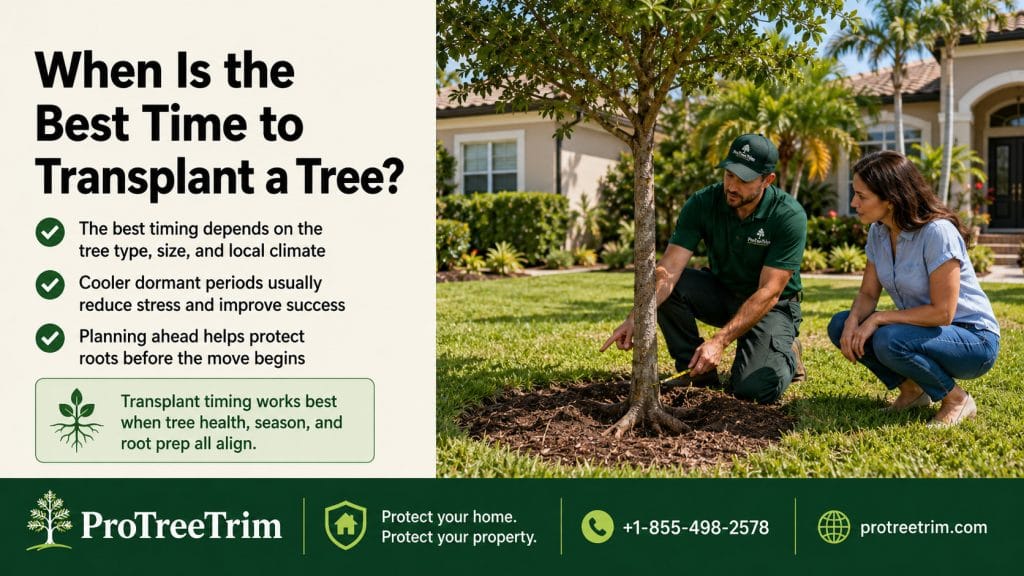
The best time to transplant a tree is usually when the tree is not under heavy heat, drought, active growth, or storm stress. For many deciduous trees, that often means the cooler dormant season. For many evergreens and palms, timing depends more carefully on local climate, soil moisture, root handling, and the tree’s ability to recover.
But timing is only part of the decision. A tree moved at the “right” time can still fail if the root ball is damaged, the new site is poor, the tree is planted too deep, or aftercare is inconsistent.
First Ask Whether the Tree Should Be Moved
Before choosing a transplant date, ask whether moving the tree is actually the best solution.
A small young tree planted too close to a walkway may be a good transplant candidate. A large mature tree near a house, driveway, pool cage, or utility area may be too risky or expensive to move successfully.
| Tree situation | Transplant outlook |
|---|---|
| Small young tree | Often more realistic |
| Newly planted tree in wrong spot | May be movable if handled early |
| Large established shade tree | Much harder and riskier |
| Tree with root damage | Poor candidate unless carefully evaluated |
| Declining tree | Transplanting may add stress |
| Tree near utilities or hardscape | Access and root loss may be major issues |
| Tree planted too deep | May need correction, not simple relocation |
Do not move a tree just because it is inconvenient. Move it only if the tree is healthy enough, small enough, and worth the effort.
Dormant Season Is Often Better for Deciduous Trees
For many deciduous trees, the best transplant window is when the tree is dormant or less actively growing. That usually means after leaf drop and before strong new spring growth.
During dormancy, the tree is not trying to support a full canopy of leaves. That can reduce transplant stress. Roots still matter, but the above-ground demand is lower.
This timing often works better for trees such as:
- maples
- oaks
- elms
- ash
- sycamore
- crape myrtle
- many ornamental shade trees
The exact timing depends on local climate. In warmer regions, the window may feel different than in colder regions. The main idea is to avoid moving a tree during extreme heat, active growth, drought, or severe weather.
Evergreens Need More Caution
Evergreens keep foliage year-round, so they continue losing moisture through needles or leaves even when deciduous trees are bare. That makes transplant timing and watering more delicate.
Pines, spruces, firs, arborvitae, junipers, and similar evergreens can struggle if moved when heat, wind, or dry soil increases moisture stress.
Evergreen transplanting is usually more successful when:
- temperatures are moderate
- soil is moist but not soggy
- the tree is not actively stressed
- roots can be moved with enough soil
- aftercare watering is consistent
- the new site has proper drainage
- the tree is protected from harsh exposure
A browning evergreen is not always a good transplant candidate. Moving it may make the stress worse.
Palms Are Different From Shade Trees
Palms are not transplanted like oaks or maples. Their structure, root system, crown, and recovery pattern are different. Palm transplant success depends heavily on palm species, size, root handling, planting depth, support, water, drainage, and crown condition.
In warm climates, palms may be moved during periods when they can actively recover, but they still should not be moved casually during severe heat, drought, flooding, or storm-risk periods.
Before moving a palm, ask:
- Is the palm healthy?
- Is the crown firm and green?
- Is the trunk sound?
- Is the palm leaning?
- Can enough root mass be preserved?
- Is the new site well drained?
- Will it need staking or support?
- Is it too close to a pool cage, house, or driveway in the new spot?
A stressed palm with yellowing, soft crown issues, or trunk wounds may not handle transplanting well.
Avoid Transplanting During Heat Stress
Hot weather increases water demand. A newly moved tree has a reduced or disturbed root system, so it may struggle to keep up. Leaves may wilt, brown, curl, or drop. Evergreens may brown at tips. Palms may yellow or decline.
Avoid transplanting when the tree is already dealing with:
- drought
- extreme heat
- dry winds
- heavy canopy stress
- recent hard pruning
- pest pressure
- root damage
- standing water
- storm damage
A tree should be moved when it has the best chance to recover, not when the calendar is convenient.
Do Not Move a Tree Right Before Storm Season If You Can Avoid It
A newly transplanted tree is not as stable as an established one. Its roots have been disturbed, and it may need time to anchor into the new site. Moving a tree right before severe wind or heavy rain can increase stress.
This matters more for:
- palms
- tall ornamentals
- trees near houses
- trees near driveways
- trees near pool cages
- trees in wet soil
- trees in exposed yards
- trees with heavy canopies
If a tree must be moved, plan support, watering, and follow-up care carefully. But when possible, avoid creating a freshly disturbed root system right before the roughest weather window.
Tree Size Matters More Than Homeowners Expect
Small trees are easier to transplant because more of the root system can be preserved relative to the tree’s canopy. Large trees lose a much greater share of active roots when moved. That makes recovery harder.
A small tree may be moved with basic equipment. A larger tree may require special machinery, root preparation, professional planning, and realistic expectations.
Size affects:
| Factor | Why it matters |
|---|---|
| Root ball size | Larger trees need much larger root balls |
| Equipment access | Gates, fences, and pavers may limit movement |
| Weight | Root balls can be extremely heavy |
| Canopy demand | Larger canopies need more water |
| Stability | Larger trees may need support after moving |
| Cost | Moving may cost more than replacement |
| Survival risk | Larger established trees are harder to relocate |
Sometimes planting a new smaller tree in the right place is smarter than moving a large tree from the wrong place.
The New Site Must Be Better Than the Old Site
Transplanting only makes sense if the new location is actually better.
Do not move a tree from one poor location to another. A tree too close to the driveway should not be moved beside the sidewalk. A palm too close to a pool cage should not be moved against the house. A tree under power lines should not be moved to another utility conflict.
Before choosing the new spot, check:
- mature height
- mature canopy spread
- root space
- distance from house
- driveway and sidewalk clearance
- fence and neighbor boundaries
- overhead utilities
- underground utilities
- drainage
- sun exposure
- future pruning access
A transplant should solve a long-term placement problem.
Roots Are the Main Transplant Challenge
Tree roots extend much farther than many homeowners realize. Digging up a tree removes or cuts many roots. The tree then has to survive while rebuilding a functional root system.
Transplant shock often starts with root loss.
Common root-related problems include:
- root ball too small
- roots drying out during the move
- root ball falling apart
- large roots cut too close to trunk
- planting hole too wet
- root flare buried
- soil mismatch between old and new site
- compacted soil around the new hole
- poor watering after planting
The visible symptoms may appear in leaves, needles, or fronds, but the cause is often below ground.
Planting Depth Can Make or Break the Transplant
A transplanted tree should not be planted too deep. The root flare should remain visible where the trunk widens into the roots. Planting too deep can trap moisture around the trunk, reduce root oxygen, and create long-term stress.
Watch for:
- trunk disappearing straight into soil
- mulch piled against the trunk
- tree settling lower after watering
- root ball placed below grade
- soil added over the root flare
- water pooling around the trunk
A tree can survive the move and still decline later because it was planted incorrectly.
Watering After Transplanting Is Critical
A transplanted tree needs careful watering, but not constant soaking. The goal is consistent moisture in the root zone, not soggy soil.
Too little water can dry the root ball. Too much water can suffocate roots. Both can cause browning, wilting, yellowing, leaf drop, or dieback.
After transplanting, check soil moisture by feel rather than watering on autopilot. The watering plan should respond to weather, soil type, drainage, tree size, and species.
Be careful when the new site is:
- sandy and fast-draining
- clay-heavy and slow-draining
- near a downspout
- near irrigation overspray
- surrounded by pavers
- in a low spot
- exposed to hot afternoon sun
- windy or coastal
Watering is not just how often. It is whether the root ball and surrounding soil are both staying balanced.
Should You Prune a Tree Before Transplanting?
Do not heavily prune a tree just because it is being moved. Old advice sometimes suggested cutting back the canopy to “balance” root loss, but unnecessary heavy pruning can reduce energy production and add wounds.
Pruning may make sense if branches are:
- broken
- dead
- cracked
- rubbing
- unsafe for moving
- blocking equipment access
- touching structures
- already damaged
A light structural or cleanup prune may be helpful. A hard cutback is usually not the answer.
Transplant Shock Can Still Happen
Even with good timing, transplant shock can happen. The tree may drop leaves, wilt, brown at the edges, thin out, or pause growth while it reestablishes.
Possible transplant shock signs include:
| Symptom | What it may mean |
|---|---|
| Wilting leaves | Root system cannot meet water demand |
| Leaf scorch | Water stress after root loss |
| Early leaf drop | Tree reducing demand |
| Brown evergreen tips | Moisture stress or root trouble |
| Yellow palm fronds | Establishment or water stress |
| Slow new growth | Tree is rebuilding roots |
| Dieback on branch tips | Stress may be significant |
Some stress is expected. Rapid decline, trunk problems, or new leaning deserves attention.
Do Not Fertilize Immediately as a Panic Fix
A newly transplanted tree usually needs root recovery, correct planting depth, proper watering, and stable soil conditions first. Fertilizer is not a cure for transplant shock.
Fertilizing too soon or too heavily can stress roots or encourage growth the damaged root system cannot support.
Before fertilizing, make sure:
- the tree is planted correctly
- watering is stable
- drainage is good
- root flare is visible
- mulch is not touching the trunk
- the tree is showing signs of establishment
- the product is appropriate for the tree
If the tree is declining rapidly, fertilizer is not the first solution.
Moving Trees Near Utilities and Hardscape
Transplanting often involves digging. That means underground utilities, irrigation lines, drainage pipes, lighting wires, and septic components must be considered. The new planting location also needs to avoid future conflicts with driveways, sidewalks, patios, pavers, and pool cages.
Before moving a tree, consider:
- utility marking before digging
- irrigation line locations
- drainage routes
- septic layout
- fence and gate access
- equipment path
- paver or driveway protection
- overhead power lines
- final mature size
A transplant project should not damage the yard systems that keep the property working.
When Transplanting Is a Bad Idea
Transplanting may be a poor choice when the tree is too large, declining, badly rooted, unstable, diseased, or growing in a location where digging will damage hardscape or utilities.
Avoid transplanting when:
- the tree is already failing
- the trunk is cracked or hollow
- roots are severely damaged
- the tree is leaning dangerously
- equipment access is impossible
- the new site is not better
- the tree is too close to utilities
- the cost exceeds replacement value
- the species does not transplant well at that size
Sometimes removal and replacement is the more honest answer.
When Transplanting Can Make Sense
Transplanting may make sense when the tree is young, healthy, small enough to move with a good root ball, and currently in the wrong place.
It may be reasonable if:
- the tree was planted too close to a walkway
- it blocks a future project
- it is still young and vigorous
- the new location has better space
- utilities and drainage are clear
- timing is favorable
- aftercare can be provided
- the tree has sentimental or landscape value
The earlier a placement mistake is corrected, the better.
Final Homeowner Takeaway
The best time to transplant a tree depends on the tree type, local climate, weather, size, and condition. For many deciduous trees, cooler dormant-season timing is often best. Evergreens and palms need more careful handling because they keep foliage or active crowns year-round.
But timing alone does not guarantee success. The tree must be healthy enough to move, the root ball must be protected, the new site must be better, planting depth must be correct, and aftercare must be consistent.
If you are unsure whether a tree should be moved, replaced, pruned, or left alone, ProTreeTrim can help connect homeowners with local tree service support. Call +1-855-498-2578 or visit protreetrim.com.
FAQs
When is the best time to transplant a tree?
For many deciduous trees, the cooler dormant season is often best. Evergreens and palms need timing based on climate, water, roots, and recovery conditions.
Can you transplant a tree in summer?
It is usually riskier because heat increases water stress. Summer transplanting may be possible in some cases but requires careful watering and root protection.
Is it better to move a small tree or a large tree?
Small, young trees are usually much easier to transplant successfully. Large established trees are harder, heavier, more expensive, and riskier.
What causes transplant shock?
Transplant shock often comes from root loss, drying roots, poor watering, planting too deep, poor drainage, heat stress, or moving a tree that was already weak.
ProTreeTrim™ can help you take the next step.
If you are dealing with a damaged tree, fallen branch, stump, root issue, palm concern, or storm cleanup question in Florida, call ProTreeTrim for tree service support.