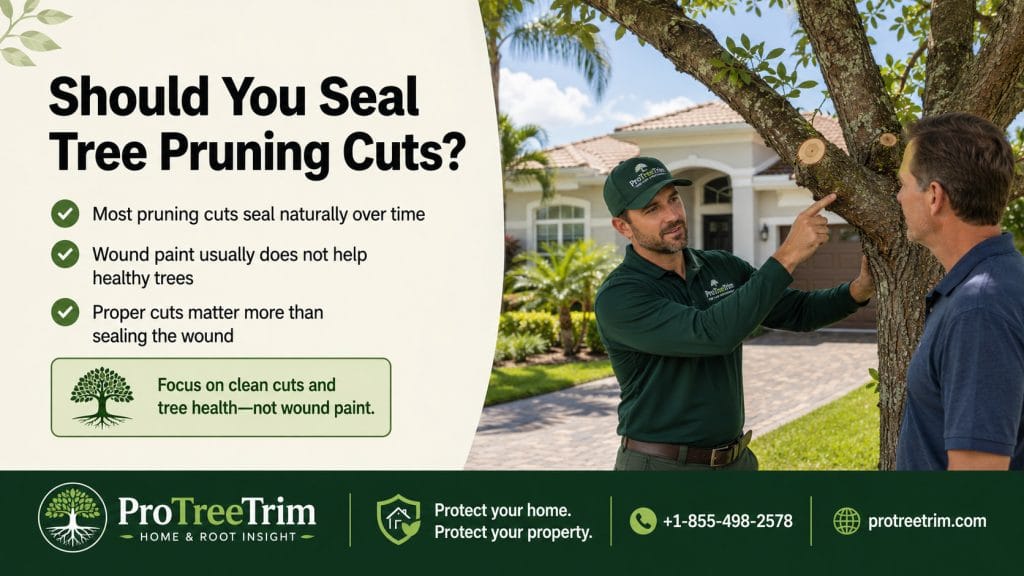
In most homeowner situations, tree pruning cuts should not be sealed with paint, tar, glue, caulk, or wound dressing. Trees do not heal like human skin. They respond to cuts by sealing off damaged tissue internally and growing new wood around the wound over time.
A clean, proper pruning cut is usually more important than anything painted over it afterward.
Why Homeowners Want to Seal Tree Cuts
Tree wounds can look exposed and vulnerable after pruning. It is easy to assume that covering the cut will protect the tree from insects, rain, disease, or decay.
That sounds logical, but it can backfire. A sealer can trap moisture, hide decay, interfere with natural closure, or create a false sense that a bad cut has been “fixed.”
| Homeowner concern | Better focus |
|---|---|
| “The cut is exposed.” | Make sure the cut was made correctly |
| “Rain will get in.” | Avoid flush cuts and large unnecessary wounds |
| “Bugs will enter.” | Keep the tree healthy and avoid poor pruning |
| “It looks ugly.” | The tree needs time to close the wound |
| “The branch was large.” | Large cuts need careful pruning decisions |
| “The cut is oozing.” | Identify why sap or fluid is present |
The best protection is good pruning, not covering bad pruning.
Trees Seal Wounds Differently Than People Heal Skin
When skin is cut, it heals by replacing damaged tissue. Trees work differently. They compartmentalize damage. That means they wall off injured tissue and grow around the wound.
A pruning cut may remain visible for years, especially on mature trees or large limbs. That does not automatically mean something is wrong.
A good wound response usually includes:
- firm wood around the cut
- gradual callus growth at the edges
- no soft or foul-smelling tissue
- no expanding cracks
- no mushrooms or obvious decay
- healthy canopy above the area
A tree does not need the cut to disappear immediately to be responding normally.
The Cut Quality Matters Most
A pruning cut should be made in the right location. It should not be flush against the trunk, and it should not leave a long stub. The branch collar should be respected because that area helps the tree close over the wound.
A good pruning cut:
- removes the branch cleanly
- avoids tearing bark
- avoids cutting into the trunk
- avoids leaving a long dead stub
- preserves the branch collar
- does not create unnecessary large wounds
- removes only what needs to be removed
A sealer cannot turn a poor cut into a good cut.
Do Not Seal Flush Cuts
A flush cut removes the branch too close to the trunk. It cuts into tissue the tree needs for wound response. Sealing that cut does not undo the damage.
Flush cuts can create:
- larger wounds
- slower closure
- greater decay potential
- trunk injury
- poor woundwood formation
- long-term structural concerns
If a branch was cut flush, the issue is the cut itself. Painting over it may only hide the problem.
Do Not Seal Long Stubs
A long stub is also a problem. The stub usually dies back and may decay before the tree can close the wound properly. A sealer on the stub does not make it living wood again.
A proper pruning cut usually removes the branch outside the branch collar without leaving an unnecessary stub.
If a tree has old pruning stubs, corrective pruning may be needed, but it should be done carefully. Cutting old stubs badly can create new wounds.
Large Cuts Need Better Decisions, Not Paint
Large pruning cuts are harder for trees to close. That is why removing large healthy limbs should not be casual.
Before making a large cut, ask:
- Is this branch dead, broken, or hazardous?
- Is it touching a roof or structure?
- Is it cracked or weak?
- Is there a smaller cut that solves the problem?
- Will removing it unbalance the tree?
- Is the tree already stressed?
- Is the branch important to the tree’s structure?
- Is removal better than repeated heavy pruning?
If the cut is unnecessary, sealer does not make it acceptable.
When Sap or Oozing Appears After Pruning
Some trees release sap after pruning. This can look dramatic, especially on certain species or during certain seasons. Sap flow does not always mean the tree is dying or that the cut needs to be sealed.
Do not rush to cover sap with paint or tar.
Instead, check:
| What you see | What to consider |
|---|---|
| Clear sap from a fresh cut | May be normal for some trees |
| Dark, foul-smelling fluid | Needs closer attention |
| Oozing from old wound | Decay or stress may be involved |
| Sap plus insects | Insects may be attracted to the wound |
| Sap plus bark cracks | Trunk or branch stress may exist |
| Oozing near mushrooms | Possible decay concern |
The question is not whether fluid is present. The question is why it is present and whether the tree has other warning signs.
Pruning Sealers Can Trap Moisture
One of the risks with sealing cuts is trapped moisture. If moisture is held against the cut surface, decay organisms may have a better environment. A dark coating can also make it harder to see whether the wound is drying, closing, softening, or spreading.
A sealed cut may look “finished,” but the tree underneath may not be better protected.
Avoid using:
- tar
- exterior paint
- glue
- caulk
- cement
- foam
- homemade paste
- random wound coatings
- thick black sealers without a specific reason
A tree wound should usually remain visible and able to dry naturally.
Are There Any Exceptions?
There are limited situations where a specific product may be recommended for a specific tree, pest, or disease concern in a particular region. But that is different from routinely sealing every pruning cut.
For general homeowner pruning, sealing is usually not needed.
If someone recommends a wound dressing, ask:
- What specific problem is it preventing?
- Is this tree species at special risk?
- Is the timing important?
- Is this product designed for that purpose?
- Is there a local disease or pest concern?
- Will it trap moisture?
- Is the pruning cut itself correct?
A routine “paint every cut” approach is usually outdated.
Do Not Seal Storm Damage Without Inspection
Storm-damaged trees may have torn bark, split limbs, broken branches, or trunk cracks. These wounds can look severe, and homeowners may want to cover them quickly.
Do not seal storm wounds without understanding the damage.
Storm damage may require:
- removal of hanging branches
- proper pruning of torn limbs
- assessment of trunk splits
- checking for root movement
- evaluation of branch unions
- documentation for insurance or property records
- removal if the tree is structurally unsafe
A sealer cannot stabilize a split trunk or repair a cracked limb.
Do Not Seal Trunk Cracks or Splits
A vertical trunk split, cavity, or deep crack should not be filled or painted as a homeowner fix. Covering it can hide decay, trap moisture, and delay a real evaluation.
A trunk split may involve structural weakness. That is not the same as a normal pruning cut.
Do not use sealer on:
- vertical trunk splits
- cavities
- hollow openings
- deep cracks
- lightning scars
- soft or wet trunk areas
- wounds with mushrooms nearby
- wounds with insects and decay
These need inspection, not cosmetic covering.
Do Not Seal Tree Cankers
A canker is an area of dead or damaged bark and underlying tissue. It may look sunken, cracked, dark, or oozing. Painting over a canker does not solve the disease, stress, or wound response behind it.
For cankers, focus on:
- monitoring spread
- checking canopy health
- reducing tree stress
- removing affected small branches when appropriate
- avoiding trunk injury
- keeping mulch off the trunk
- checking roots and soil conditions
- getting help if the canker is large or on the trunk
A sealer can hide whether the canker is expanding.
Palms Are Different, but Still Need Careful Cuts
Palm pruning cuts are different from shade-tree branch cuts because palms do not branch in the same way. Still, the same basic warning applies: do not use coatings to hide poor cutting.
For palms, avoid:
- cutting into the trunk
- shaving the trunk aggressively
- ripping off tight boots
- damaging the crown
- removing too many green fronds
- sealing wounds caused by bad cuts instead of preventing them
A palm should be trimmed carefully enough that wound dressing is not needed as a cover-up.
Fruit Trees and Special Cases
Fruit trees sometimes come with more specific pruning traditions and disease concerns. Some growers may use certain products in specific situations. But for ordinary landscape trees, routine wound dressing is still usually unnecessary.
If you have a fruit tree, the better questions are:
- Was the cut made correctly?
- Is the tree pruned at the right time?
- Is there a known disease issue?
- Is the product actually recommended for that use?
- Is the tree in a humid or high-disease environment?
- Are tools clean?
- Is the tree being over-pruned?
Do not apply random sealers just because the tree produces fruit.
Clean Tools Matter More Than Sealer
For small pruning jobs, clean, sharp tools matter. Ragged cuts, crushed branches, and torn bark create worse wounds than clean cuts.
Good tool habits include:
- using sharp pruners or saws
- making clean cuts
- avoiding bark tearing
- cleaning tools when moving between diseased material
- using proper technique for larger branches
- avoiding unsafe ladder work
- not cutting near power lines
Good pruning begins before the cut is made.
What to Do After a Proper Pruning Cut
After a proper pruning cut, the best response is usually simple:
- leave the cut uncovered
- keep the tree healthy
- water appropriately during drought if needed
- avoid mulch against the trunk
- avoid further unnecessary pruning
- monitor the wound over time
- watch for decay, cracks, or dieback
- photograph large cuts for records
The tree needs time and good conditions to respond.
When a Pruning Cut Deserves Concern
A pruning cut deserves closer attention when it is large, ragged, flush, infected-looking, soft, wet, or connected to branch dieback.
Look closer if you see:
| Warning sign | Why it matters |
|---|---|
| Bark torn below the cut | Wound is larger than needed |
| Cut flush with trunk | Branch collar may be damaged |
| Long dead stub | Stub may decay before closure |
| Soft wood | Decay may be starting |
| Mushrooms near wound | Fungal decay concern |
| Dark oozing | Stress, decay, or disease possible |
| Cracks spreading from cut | Structural concern may exist |
| Branch above cut dying | More than cut-surface issue may be present |
These signs need better evaluation, not paint.
How Homeowners Can Avoid Bad Pruning Wounds
The best way to avoid worrying about sealers is to prevent bad cuts.
Before pruning, ask:
- Is this branch truly necessary to remove?
- Is the branch dead, broken, rubbing, or hazardous?
- Is the cut small enough to be reasonable?
- Do I know where the branch collar is?
- Will this cut tear bark?
- Is the branch too large for DIY work?
- Is the branch near a roof, driveway, or utility line?
- Will removing it change the tree’s balance?
If the answer is unclear, do not cut casually.
When to Get Help
Professional help makes sense when pruning involves large limbs, rooflines, driveways, pool cages, utility areas, storm damage, trunk splits, or major deadwood.
Get help when:
- branches are large or high
- limbs hang over structures
- a trunk split is present
- the tree has decay signs
- previous cuts look bad
- the tree is leaning
- branches are near wires
- the tree has major deadwood
- you are considering large live-limb removal
Large tree wounds are easier to prevent than to fix.
Final Homeowner Takeaway
Most tree pruning cuts should not be sealed. Trees are built to seal off wounds naturally when cuts are made correctly. Pruning paint, tar, caulk, glue, or wound dressing can trap moisture, hide decay, and create a false sense of protection.
Focus on proper pruning instead: remove only what needs to be removed, make clean cuts outside the branch collar, avoid topping, avoid flush cuts, and do not remove large healthy limbs without a clear reason.
If you are unsure whether a pruning cut, trunk wound, canker, storm tear, or branch removal was handled correctly, ProTreeTrim can help connect homeowners with local tree service support. Call +1-855-498-2578 or visit protreetrim.com.
FAQs
Should I seal a tree branch after cutting it?
Usually no. A proper pruning cut is generally left uncovered so the tree can seal the wound naturally.
Does pruning sealer prevent tree disease?
Not in most routine homeowner situations. It may trap moisture or hide problems if used unnecessarily.
What matters more than tree wound sealer?
Correct pruning technique matters more: clean cuts, preserving the branch collar, avoiding stubs, and not cutting large healthy limbs unnecessarily.
Should I seal a split tree trunk?
No. A split trunk should not be filled or sealed as a DIY fix. It may be a structural issue that needs closer evaluation.
ProTreeTrim™ can help you take the next step.
If you are dealing with a damaged tree, fallen branch, stump, root issue, palm concern, or storm cleanup question in Florida, call ProTreeTrim for tree service support.