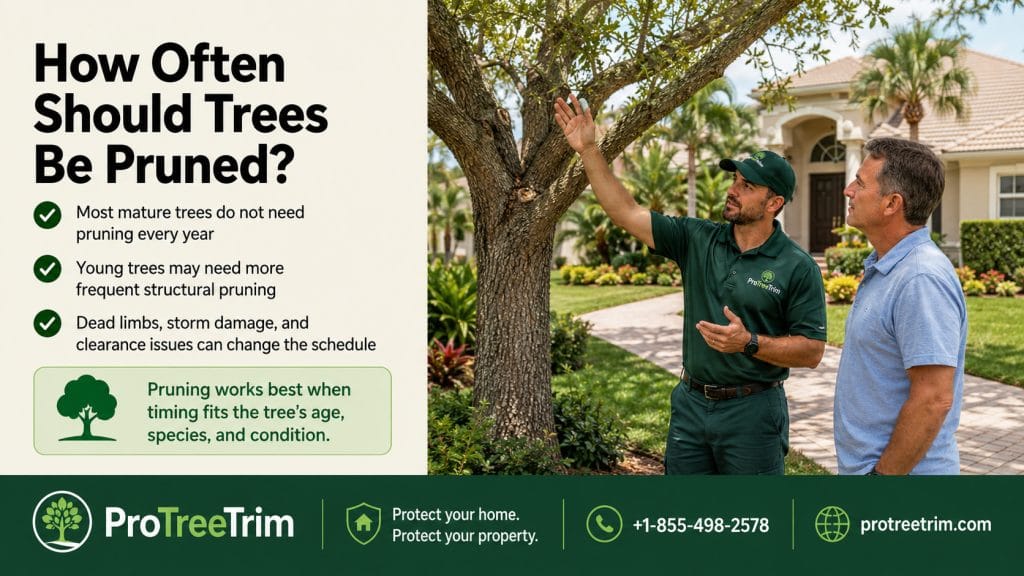
Trees do not all need pruning on the same schedule. Some young trees benefit from light structural pruning every few years. Some mature shade trees may go several years between pruning visits if they are healthy and well-placed. Palms, fruit trees, ornamentals, storm-damaged trees, and trees near roofs or driveways may need different timing.
The better question is not “Should every tree be pruned every year?”
It is “Does this tree have a clear reason to be pruned now?”
There Is No One-Year Rule for Every Tree
Many homeowners assume tree pruning should happen once a year, like mowing, fertilizing, or seasonal yard cleanup. That is not always true. Trees are living structures. Cutting them too often or too heavily can create stress, weak regrowth, large wounds, and long-term risk.
A tree may need pruning when there is deadwood, storm damage, poor branch structure, clearance conflict, roof contact, driveway obstruction, rubbing branches, or safety concern. A healthy tree in open space may not need pruning every year.
| Tree situation | Typical pruning need |
|---|---|
| Young tree | Light structural pruning every few years may help |
| Mature shade tree in open space | May not need frequent pruning |
| Tree touching roof | Pruning may be needed sooner |
| Tree over driveway or walkway | Clearance and deadwood checks matter |
| Storm-damaged tree | Needs inspection before pruning decisions |
| Palm tree | Dead fronds and seed pods guide timing |
| Over-pruned tree | May need time to recover, not more cutting |
| Tree near utility lines | Should not be handled casually by homeowners |
A pruning schedule should fit the tree, not the calendar alone.
Young Trees Often Benefit From Structural Pruning
Young trees are usually the best candidates for periodic light pruning. The goal is not to make them small. The goal is to guide good structure early, before problems become large and expensive.
Young-tree pruning may help with:
- competing leaders
- crossing branches
- weak branch angles
- low limbs that will later block access
- damaged branches
- early branch spacing
- future clearance over sidewalks or driveways
- reducing the chance of large corrective cuts later
A small cut on a young tree can prevent a large wound on a mature tree.
For many young landscape trees, a check every 2 to 3 years may be reasonable, depending on growth rate and species. The work should be light and purposeful. Young trees should not be stripped or over-shaped.
Mature Trees Usually Need Less Frequent Pruning
A healthy mature tree does not need to be cut just because time has passed. Mature trees store energy in their canopy and roots. Removing too much live growth can reduce their ability to respond to heat, drought, storms, pests, and root stress.
A mature tree may need pruning when:
- dead branches are present
- branches rub or cross badly
- limbs touch a roof, gutter, or wall
- clearance is needed over a driveway or walkway
- storm damage created broken or hanging limbs
- branch weight or structure creates concern
- the tree blocks safe access
- a large limb over a target is declining
If none of these issues exist, monitoring may be better than pruning.
Dead, Broken, or Hanging Branches Do Not Follow a Schedule
Dead or broken branches should be handled based on risk, not calendar timing. A dead limb over open lawn may be less urgent. A dead limb over a driveway, roof, pool cage, patio, or walkway deserves faster attention.
Do not wait for a seasonal pruning appointment if a branch is:
| Branch issue | Why timing matters |
|---|---|
| Hanging after a storm | May fall unpredictably |
| Dead over a driveway | Vehicles and people are exposed |
| Touching the roof | Can damage shingles or gutters |
| Cracked at the union | May fail under wind or weight |
| Over a pool cage | Screen and frame damage possible |
| Blocking a walkway | Clearance and safety issue |
| Near service lines | Utility safety concern |
Pruning frequency is flexible. Hazard timing is not.
Trees Near Structures Need More Regular Checks
A tree in the middle of a wide lawn may need less frequent pruning than a tree growing beside a house, driveway, fence, pool cage, patio, or sidewalk. Location changes the maintenance schedule.
Trees near structures should be checked more often for:
- roof contact
- gutter debris
- low driveway limbs
- branches over parking areas
- limbs touching fences
- pool cage clearance
- deadwood over patios
- branches rubbing siding
- roots affecting hardscape
This does not always mean pruning every year. It means inspection should be more consistent.
Palms Are Pruned for Dead Fronds, Not Calendar Shape
Palm pruning is different from shade-tree pruning. A palm should not be cut hard every year just to look “clean.” Removing too many green fronds can stress the palm and create a thin, unnatural crown.
Palm pruning frequency depends on:
- dead fronds
- broken fronds
- seed pods or fruit clusters
- fronds touching rooflines
- fronds resting on pool cages
- hanging material over walkways or driveways
- storm-damaged fronds
- palm health and crown condition
A palm may need cleanup once or twice a year in some landscapes, especially near pools or driveways. But the work should focus on dead, broken, messy, or hazardous material—not healthy green fronds.
Oaks Need Careful, Purposeful Pruning
Large oaks often need less frequent but more thoughtful pruning. A mature oak should not be aggressively cut every year. Poor pruning can create large wounds, weak regrowth, and long-term structure problems.
Oak pruning may make sense when there are:
- dead limbs
- large branches over roofs or driveways
- rubbing branches
- cracked limbs
- storm damage
- weak branch unions
- roofline conflict
- clearance problems
A live oak or other large oak may go several years between pruning visits if it is healthy and well structured. But if large limbs are over a house, driveway, pool cage, or walkway, regular inspection is smart.
Fast-Growing Trees May Need More Attention
Fast-growing trees can develop long limbs, weak attachments, crossing branches, or clearance issues sooner than slow-growing trees. That does not mean they should be cut hard every year. It means they should be checked more often.
Fast growth can create problems near:
- roofs
- driveways
- fences
- sidewalks
- utility areas
- pool cages
- neighbor property
- narrow side yards
The goal is to catch structural issues early, not chase the tree with constant heavy cuts.
Slow-Growing Trees May Need Less Frequent Pruning
Some slow-growing trees may not need pruning often unless they develop deadwood, storm damage, or clearance issues. Cutting them too frequently can be unnecessary and may reduce the natural form that made them valuable in the first place.
For slow-growing trees, pruning should be based on:
- structure
- deadwood
- access
- property conflicts
- health concerns
- storm damage
- branch defects
A slow-growing tree that fits its space may need observation more than cutting.
Storm Season Changes the Inspection Schedule
Before storm season, homeowners often think they should prune everything. That is not the right approach. The better move is to inspect trees and selectively address obvious problems.
A pre-storm tree check should look for:
- dead branches
- cracked limbs
- hanging branches
- branches touching roofs
- large limbs over driveways
- palms with dead fronds
- trees leaning after rain
- mushrooms near tree bases
- split trunks or weak unions
- roots lifting or soil movement
Good storm prep is not aggressive cutting. It is targeted risk reduction.
After Storms, Prune Carefully
After a storm, pruning may be needed quickly if branches are broken, hanging, blocking access, or resting on structures. But not every storm-damaged tree should be cut immediately beyond the safety work.
A careful post-storm approach:
- remove hanging broken limbs first
- keep people away from unstable branches
- avoid cutting near power lines
- document damage with photos
- do not over-prune a stressed tree
- assess whether the tree can recover
- check trunk splits and root movement
- remove only what is necessary at first
Storm pruning should stabilize the situation, not punish the tree.
Over-Pruning Can Increase Future Problems
Pruning too often or too heavily can make trees weaker over time. It may remove too much leaf area, create large wounds, trigger weak sprouts, expose bark to sun, or change weight distribution.
Over-pruning can lead to:
| Problem | Why it matters |
|---|---|
| Weak sprouts | Fast regrowth may attach poorly |
| Thin canopy | Tree loses energy-producing leaf area |
| Sunscald | Newly exposed bark may be damaged |
| Large wounds | Decay risk may increase |
| Poor structure | Future pruning becomes harder |
| Stress response | Tree may decline if already stressed |
| Storm vulnerability | Bad cuts can create weak points |
A tree should not look freshly cut all the time. It should look healthy, balanced, and structurally sound.
Some Trees Need Waiting, Not Pruning
A stressed tree may not need immediate pruning unless there is a safety issue. If a tree is recovering from drought, root damage, transplant shock, flooding, or over-pruning, more cutting can add stress.
Waiting may be better when:
- leaves are browning but branches are alive
- the tree was recently transplanted
- roots were disturbed by construction
- the tree was already over-pruned
- the canopy is thin
- the cause of decline is unclear
- no branches are hazardous
- new growth needs to be observed
Sometimes the best tree care decision is to stop cutting and improve the site.
Pruning Frequency by Purpose
Different pruning goals have different timing.
| Purpose | Frequency idea |
|---|---|
| Young structural pruning | Periodic light checks every few years |
| Deadwood removal | As needed based on risk |
| Roof clearance | When branches begin touching or rubbing |
| Driveway/walkway clearance | When access or safety is affected |
| Palm cleanup | When dead fronds, pods, or hazards appear |
| Storm damage cleanup | After damage, when safe |
| Mature shade tree maintenance | Less frequent, based on structure and condition |
| Correcting bad past pruning | Gradual, not all at once |
The right question is always: What problem are we solving?
What a Good Pruning Scope Sounds Like
A good pruning plan should be specific. It should name what is being removed and why.
Good scope examples:
- remove deadwood over the driveway
- clear branches touching the roofline
- remove broken storm limb over patio
- reduce rubbing branch near main union
- remove dead palm fronds and seed pods over pool deck
- perform light structural pruning on young tree
Poor scope examples:
- cut it way back
- make it smaller
- top it
- thin it a lot
- remove everything below a certain height without reason
- hurricane-cut the palm
- clean out the whole inside
Specific pruning is usually better than broad cutting.
How Often Should Trees Be Inspected?
Inspection can happen more often than pruning. A homeowner can look at trees several times a year without cutting anything.
Useful inspection times include:
- before storm season
- after major storms
- after heavy rain
- during drought periods
- before listing a home
- after construction or paver work
- when leaves change unexpectedly
- when branches start touching structures
Inspection tells you whether pruning is needed. It should not automatically lead to cutting.
Trees Near Utility Lines Are Different
Homeowners should not prune trees near power lines or service lines casually. Utility work has safety concerns that are different from ordinary pruning.
If branches are near utility lines:
- do not climb the tree
- do not use pole saws near wires
- do not pull branches off wires
- contact the proper utility or qualified help
- keep people away from storm-damaged wire contact
- document the situation safely from the ground
The pruning schedule does not matter if the work is unsafe.
When Annual Pruning May Make Sense
Some trees or landscapes may need annual attention, but the work should usually be light and purposeful.
Annual checks may make sense for:
- palms near pools and driveways
- ornamental trees near entries
- young trees being structurally trained
- trees near rooflines
- trees near walkways
- fast-growing trees in tight yards
- properties preparing for storm season
- trees with recurring deadwood over targets
Annual pruning does not mean annual heavy cutting. It may simply mean inspection plus selective cleanup.
When Several Years Between Pruning Is Fine
Several years between pruning visits may be fine when:
- the tree is mature and healthy
- the canopy is well structured
- no dead limbs are over targets
- branches are not touching structures
- the tree has enough space
- there are no utility conflicts
- storms have not damaged it
- roots and trunk look stable
Healthy trees do not need unnecessary cuts.
What Homeowners Should Photograph
Photos help track whether pruning is needed.
Take photos of:
- full tree from several angles
- branches near roof or driveway
- dead limbs
- broken or hanging branches
- trunk cracks or splits
- root flare and base
- branches touching pool cages or fences
- canopy density before and after pruning
- invoices and finished work
Photos are especially useful before storm season, after storms, and before selling a home.
Final Homeowner Takeaway
Trees should be pruned as often as they need it—not automatically every year. Young trees may benefit from periodic structural pruning. Mature trees may need less frequent pruning unless there is deadwood, storm damage, clearance conflict, or structural concern. Palms should be trimmed for dead fronds, seed pods, and safety issues, not stripped of green fronds.
The best pruning schedule starts with inspection. If there is a clear reason to prune, prune carefully. If the tree is healthy, well placed, and not creating risk, waiting may be the better decision.
If you are unsure whether your tree needs pruning now or should be left alone, ProTreeTrim can help connect homeowners with local tree service support. Call +1-855-498-2578 or visit protreetrim.com.
FAQs
Should trees be pruned every year?
Not always. Some trees need annual inspection, but many healthy mature trees do not need pruning every year.
How often should young trees be pruned?
Young trees may benefit from light structural pruning every few years, depending on growth rate, species, and form.
How often should palm trees be trimmed?
Palm trimming should be based on dead fronds, seed pods, roof or pool cage contact, storm damage, and safety—not a fixed yearly rule.
Can pruning too often hurt a tree?
Yes. Over-pruning can remove too much live canopy, create wounds, encourage weak sprouts, and stress the tree.
ProTreeTrim™ can help you take the next step.
If you are dealing with a damaged tree, fallen branch, stump, root issue, palm concern, or storm cleanup question in Florida, call ProTreeTrim for tree service support.