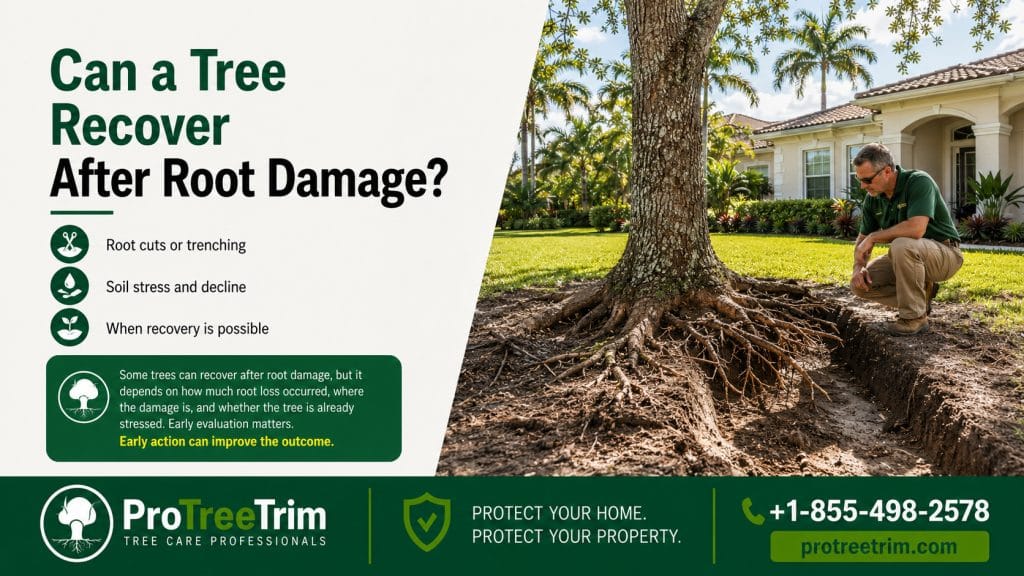
A tree can sometimes recover after root damage, but the answer depends on how much root was lost, where the damage happened, how old the tree is, and whether the roots were cut, compacted, buried, or waterlogged. The tree may look normal at first, then show stress months later.
Root Damage Is Often a Delayed Problem
Root damage does not always announce itself right away. A tree may keep its leaves after a driveway repair, trenching job, paver project, fence installation, irrigation repair, or stump grinding nearby. Later, the canopy may thin, leaves may get smaller, branch tips may die back, or one side of the tree may decline.
University of Maryland Extension notes that many plants can survive root damage if the damage does not exceed about one-quarter of the total root zone, but symptoms of decline or death may take months or even years to progress depending on the damage.
That timeline is why homeowners often miss the connection. The digging happened in spring. The leaves looked thin in late summer. By then, the root damage no longer feels like the obvious cause.
| What happened near the tree | Why it matters |
|---|---|
| Trenching or digging | Roots may have been cut |
| Paver or driveway work | Surface roots and soil structure may be disturbed |
| Heavy equipment traffic | Soil compaction can limit root function |
| Soil added around the trunk | Roots and root flare may be buried |
| Grade lowered near the tree | Roots may be exposed or cut |
| Irrigation leak or drainage change | Roots may stay too wet or too dry |
| Root cutting near trunk | Stability and water uptake may be affected |
Not All Root Damage Is Equal
A few small roots damaged far from the trunk may not cause lasting trouble. Large roots close to the tree are different. UF/IFAS warns that trenching and digging near trees can cut roots, leading to decline or even tree failure, and says cutting roots larger than about one inch in diameter can create problems. It also notes mature trees are generally more vulnerable to root pruning injury than younger, vigorous trees.
The side of the damage matters too. Root loss on one side can show up as thinning or dieback on part of the canopy. If the damaged side faces a driveway, roof, pool cage, fence, or walkway, the question becomes more than tree health. It becomes a property-risk decision.
Do not cut more roots to “clean up” the area. Do not cover exposed roots with a deep pile of soil or mulch. Do not assume fertilizer will fix the problem. Root damage is usually about structure, oxygen, water movement, and remaining root function—not simply nutrition.
What Homeowners Should Watch After Root Damage
If you know roots were disturbed, start a simple photo record. Take pictures of the full tree, trunk base, exposed roots, soil level, canopy, nearby pavers, driveway, irrigation heads, and any limbs over structures. Repeat the same angle every few weeks.
Watch for:
- smaller leaves than usual
- early leaf drop
- yellow or brown leaf edges
- dead branch tips
- one-sided canopy thinning
- mushrooms near the base
- bark cracking or oozing
- soil lifting after rain
- a new lean
- large dead limbs over high-use areas
UF/IFAS recommends protecting trees during construction with temporary fencing at the dripline to help keep equipment away from trunks, branches, and part of the root zone; it also notes younger trees often tolerate construction better than older trees.
If the damage already happened, the goal is to reduce additional stress. Keep vehicles off the root zone. Avoid heavy pruning unless a limb is dead, cracked, hanging, or threatening property. Keep mulch shallow and away from the trunk. Fix irrigation or drainage problems if the soil is staying too wet or too dry.
When Recovery Is Less Likely
Recovery becomes less certain when many large roots were cut, the tree is mature, the damage is close to the trunk, soil was compacted, drainage changed, or the tree already had decay, trunk cracks, canopy dieback, or storm damage.
A tree near open lawn can often be watched differently from a tree leaning toward a bedroom, driveway, pool cage, fence, utility area, or neighbor’s property. If root damage is paired with a new lean, lifted soil, or large dead limbs, do not treat it as a wait-and-see issue for too long.
If you are unsure whether root damage, construction stress, exposed roots, or canopy decline needs professional attention, ProTreeTrim can help connect homeowners with local tree service support. Call +1-855-498-2578 or visit protreetrim.com.
FAQs
Can a tree survive cut roots?
Sometimes. Survival depends on how many roots were cut, how large they were, how close the damage was to the trunk, and whether the tree was already stressed.
How long after root damage will a tree show symptoms?
Symptoms may appear quickly, but they can also take months or years to become obvious, especially after construction or trenching.
Should I prune the canopy after root damage?
Not automatically. Avoid heavy live pruning unless there is a clear safety reason. Removing healthy canopy can add stress while the tree is trying to recover.
When is root damage more urgent?
It is more urgent when the tree has a new lean, lifted soil, trunk cracks, dead limbs, mushrooms, or branches over a roof, driveway, pool cage, walkway, or utility area.
ProTreeTrim™ can help you take the next step.
If you are dealing with a damaged tree, fallen branch, stump, root issue, palm concern, or storm cleanup question in Florida, call ProTreeTrim for tree service support.