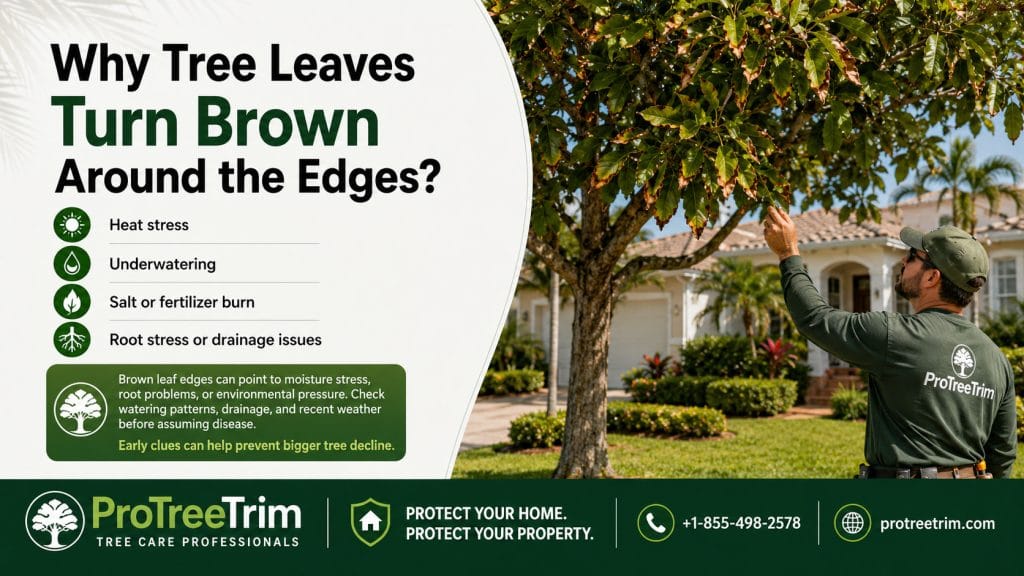
Brown edges on tree leaves usually mean the leaf is under stress, but the cause is not always disease. Heat, dry soil, waterlogged roots, fertilizer burn, reflected sun, root damage, and some pathogens can all create a scorched look. Before treating the tree, check the water pattern, the root zone, and whether the browning is spreading.
Brown Edges Often Point to Leaf Scorch
Leaf scorch commonly shows up as browning along the outside edges of leaves or as spots that look burned. Colorado State University Extension lists improper watering as a common cause and notes that too much fertilizer can also cause marginal burning or leaf spots. Scorched leaves may also drop early.
That does not mean the tree is “burned” in a simple way. Leaves brown at the edges when they cannot keep up with moisture demand or when the tissue is stressed. Hot weather, wind, bright sun, compacted soil, damaged roots, or irrigation problems can all be part of the picture.
| What you notice | What to check first |
|---|---|
| Brown edges after hot, dry weather | Soil moisture, mulch, reflected heat |
| Brown edges after heavy rain | Drainage, soggy soil, root stress |
| Browning mostly on one side | Sprinkler pattern, sun exposure, root damage |
| Brown edges plus yellow banding | Water stress, nutrients, or disease may be involved |
| Browning near driveway or wall | Heat reflection and dry soil |
| Browning after fertilizing | Fertilizer burn or salt stress |
| Browning with dead limbs | Look beyond leaves; check roots and structure |
Check the Roots Before Blaming the Leaves
The leaves are showing the symptom, but the problem may be below ground. Mississippi State Extension describes leaf scorch as yellow-brown edges beginning from the outside of the leaf, and it also notes that root system damage can lead to canopy loss starting in the upper and middle crown.
That matters in a normal yard. A tree may show brown leaf edges after driveway repair, trenching, paver work, fence installation, irrigation changes, or soil compaction. The homeowner sees leaf damage in July or August, but the original root stress may have happened months earlier.
Before doing anything dramatic, look around the base:
- Is the root flare buried under mulch or soil?
- Does water collect near the trunk after rain?
- Is irrigation spraying the same area every day?
- Are roots exposed, cut, or lifting soil?
- Did recent digging happen near the tree?
- Is the tree close to pavers, driveway edges, pool deck, or a compacted walkway?
Do not assume more water is always the answer. If the soil is already wet, adding more irrigation can make root stress worse.
Disease Is Possible, but Do Not Start There
Some diseases can create a scorched leaf-edge pattern. Mississippi State Extension explains that bacterial leaf scorch can resemble drought stress because water-conducting tissue becomes clogged, causing brown or scorched leaf edges and sometimes a yellow band between the scorched edge and green leaf tissue.
Florida 4-H/UF/IFAS forest health material also describes bacterial leaf scorch symptoms as marginal necrosis and chlorosis, and notes that it is commonly observed in Florida on trees such as oaks, sycamore, sweetgum, and elms.
Still, a homeowner should not diagnose bacterial leaf scorch from a brown edge alone. The same general look can come from drought, overwatering, fertilizer, root injury, reflected heat, or a tree planted in the wrong place. Pattern and progression matter.
A few scorched leaves on the sunniest side of the canopy are different from browning that returns every year, spreads branch by branch, or appears with dieback.
What to Do Before Treating or Pruning
Start with observation, not action. Take photos of the full tree, close-ups of the affected leaves, the trunk base, root area, irrigation heads, mulch depth, nearby hardscape, and any recent construction or digging.
Then watch the pattern:
- Is the browning stable or spreading?
- Are only older leaves affected?
- Are leaves dropping early?
- Is one side of the canopy worse?
- Are dead branches appearing?
- Does the soil stay dry, wet, or inconsistent?
Avoid heavy pruning just because leaves look scorched. If the tree is already stressed, removing live canopy may reduce its ability to recover. Dead, cracked, or hanging limbs over a roof, driveway, pool cage, fence, walkway, or utility area are a different issue and may need attention for safety reasons.
If you are unsure whether brown leaf edges are a water issue, root problem, disease concern, or part of a larger tree-risk pattern, ProTreeTrim can help connect homeowners with local tree service support. Call +1-855-498-2578 or visit protreetrim.com.
FAQs
Do brown leaf edges mean my tree is dying?
No. Brown edges can come from temporary stress, especially heat, dry soil, or watering problems. Worry more if browning spreads, limbs die back, or the tree shows trunk or root issues.
Should I water more if leaves are brown around the edges?
Check the soil first. Dry soil may need deep watering, but wet or poorly drained soil points to a different problem.
Can fertilizer cause brown leaf edges?
Yes. Extension guidance notes that too much fertilizer can cause leaf spots and marginal burning, which may look like scorch.
When should I get the tree checked?
Get help sooner if browning appears with large dead limbs, trunk cracks, mushrooms near the base, a new lean, exposed roots, or branches over a roof, driveway, pool cage, or walkway.
ProTreeTrim™ can help you take the next step.
If you are dealing with a damaged tree, fallen branch, stump, root issue, palm concern, or storm cleanup question in Florida, call ProTreeTrim for tree service support.