
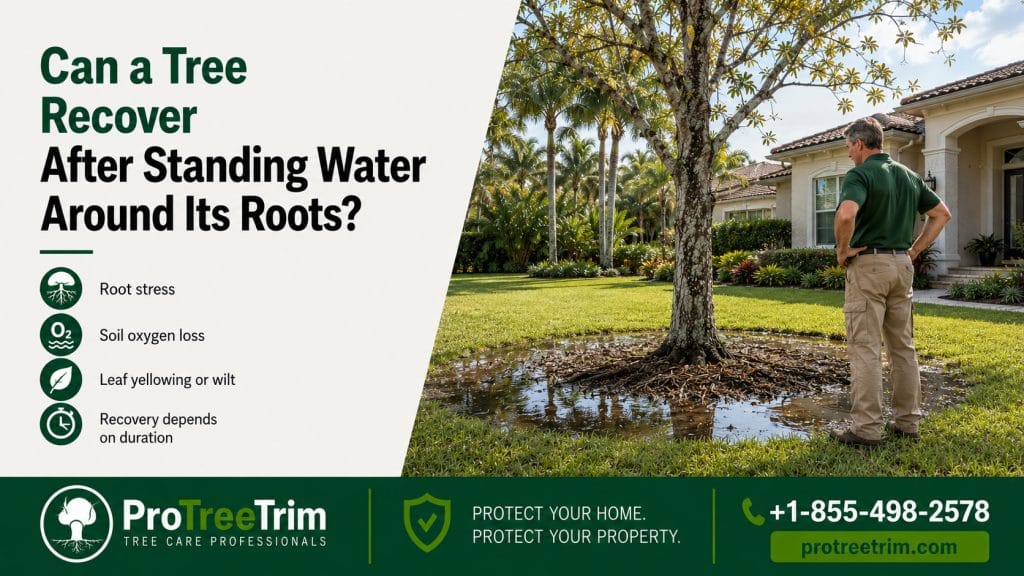
A tree can sometimes recover after standing water around its roots, but recovery depends on how long the soil stayed saturated, the tree species, root condition, drainage, and whether the tree was already stressed. The first step is not pruning or fertilizing. It is checking whether the root zone can breathe again.
Wet Roots Need Air, Not More Attention From a Hose
Standing water looks like a watering problem solved. For tree roots, it can become the opposite.
Roots need oxygen to survive and grow. University of Minnesota Extension explains that water covering the soil reduces oxygen available to tree roots, and that roots need oxygen for survival and growth. Illinois Extension makes the same point in plain homeowner terms: in flooded or waterlogged soils, roots are “robbed of oxygen,” and tree and shrub symptoms may not appear for a year or more.
That delay is why a tree may look fine the week after heavy rain and then thin out later. The damage may begin below ground while the canopy still has green leaves.
| What you notice after standing water | What it may suggest |
|---|---|
| Soil stays wet for days | Root oxygen may be limited |
| Leaves yellow or drop early | Root stress may be showing above ground |
| Tree wilts even in wet soil | Roots may not be functioning well |
| Mushrooms near the base | Moisture and organic breakdown may be present |
| New lean after rain | Soil or root support should be checked |
| Dead branch tips weeks later | Delayed root stress may be appearing |
| Water returns to the same spot | Drainage problem is still active |
Check How the Water Got There
Do not focus only on the tree. Look at the yard.
Standing water may come from heavy rain, but it can also be made worse by grading, compacted soil, irrigation leaks, roof runoff, clogged drains, paver work, pool deck drainage, or a low spot near the trunk. A tree planted too deeply or buried under mulch may also have a hidden root-flare problem that becomes worse when the bed stays wet.
Colorado State Extension notes that surface roots can indicate low soil oxygen caused by soil compaction or overly wet soil, and that compaction often shows up as low vigor and dieback symptoms. That fits many real yards: the water problem and the soil problem often overlap.
Before making changes, ask:
- Did the water drain within hours, or did it sit for days?
- Is the soil still wet a few inches below the surface?
- Does irrigation hit the same bed every day?
- Did recent paver, patio, driveway, or grading work change runoff?
- Is mulch piled against the trunk?
- Is the root flare visible?
- Is one side of the canopy declining more than the other?
What Not to Do After Waterlogging
Do not fertilize a tree just because it looks weak after standing water. Fertilizer will not fix oxygen-starved roots and may add stress if the tree is already struggling.
Do not prune healthy branches to “help the tree recover.” Leaves are part of the tree’s energy system. Dead, cracked, or hanging limbs are different; those may need attention because they create safety concerns.
Do not pile more soil or mulch over exposed roots or wet areas. That can reduce oxygen further and hide the root flare. If the water problem is caused by grade or drainage, covering it cosmetically will not solve it.
The better homeowner move is to document and watch. Photograph the full tree, standing water area, trunk base, mulch, visible roots, drainage path, irrigation heads, and nearby hardscape. Then compare the tree every couple of weeks for yellowing, leaf drop, dead tips, or new leaning.
When Recovery Is Less Likely
A tree has a better chance if the water drained quickly, the root flare is visible, the tree was healthy before the event, and the canopy remains stable. Recovery is more uncertain when water sat for a long time, the tree was already declining, soil is compacted, roots were damaged, or the tree stands in the same wet pocket after every storm.
Pay closer attention if the tree is near a roof, driveway, pool cage, fence, walkway, parked vehicle, or utility area. A stressed tree in an open yard may be monitored differently than a stressed tree with large limbs over daily-use areas.
If you are unsure whether standing water, root stress, drainage trouble, or dead limbs point to a larger tree problem, ProTreeTrim can help connect homeowners with local tree service support. Call +1-855-498-2578 or visit protreetrim.com.
FAQs
Can a tree survive standing water?
Sometimes. Short-term waterlogging may be tolerated by some trees, but longer saturation can reduce oxygen around roots and lead to delayed decline.
Why is my tree wilting if the soil is wet?
Wet soil can limit root oxygen. If roots are stressed or damaged, the tree may not take up water properly even when the ground is wet.
Should I fertilize after flooding or standing water?
No, not as a first step. Check drainage, soil moisture, root flare, mulch, and tree condition before adding fertilizer.
How long should I watch the tree after standing water?
Watch for several weeks and keep checking after the next rain. Some symptoms, including dieback or leaf drop, can appear later rather than immediately.
ProTreeTrim™ can help you take the next step.
If you are dealing with a damaged tree, fallen branch, stump, root issue, palm concern, or storm cleanup question in Florida, call ProTreeTrim for tree service support.