
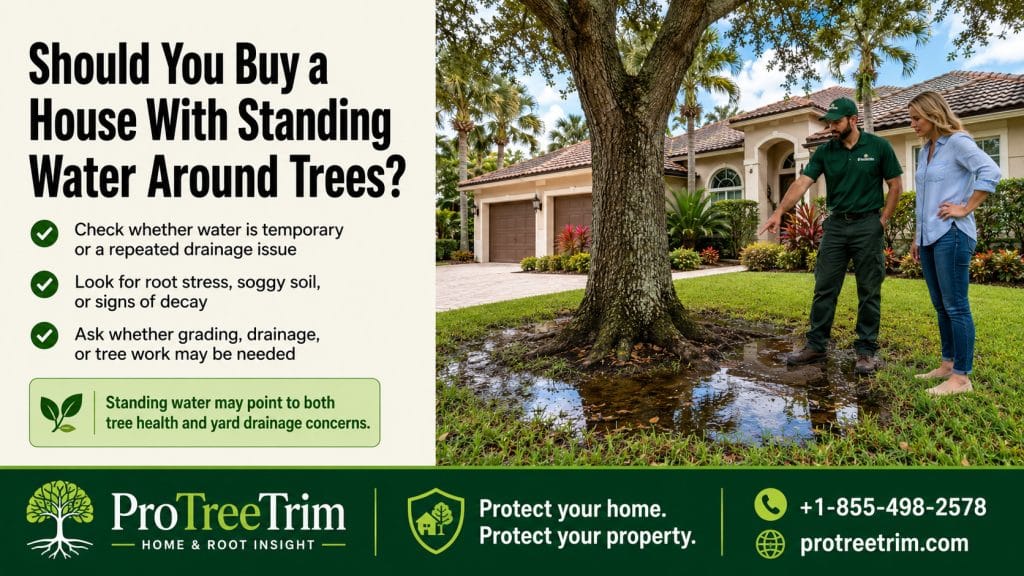
Standing water around trees does not automatically mean you should avoid buying a home. But it does mean you should slow down and understand the drainage pattern. Water sitting near trunks, roots, pavers, fences, pool decks, or septic areas can point to grading issues, compacted soil, irrigation problems, root stress, or future maintenance costs.
Start With Where the Water Collects
A puddle after heavy rain may be normal in some yards. A wet pocket that stays soggy long after the rest of the property dries is different.
As a buyer, look at where the standing water sits. Is it around one tree? Along the foundation side of the house? Near a driveway, pool cage, septic area, fence, or walkway? Does the water collect at the tree base, or is it running through the yard and stopping there?
| Where water collects | Why it matters |
|---|---|
| Around the trunk base | May stress roots and hide decay signs |
| Near exposed roots | Soil washout or root movement may be involved |
| Beside driveway or pavers | Hardscape settling or drainage trouble may follow |
| Along a fence line | Could affect posts, roots, and neighbor-facing areas |
| Near pool deck or cage | Paver movement and outdoor-use issues may appear |
| Near septic area | Needs septic-specific attention, not guesswork |
| Close to the house | Drainage and foundation-side moisture should be checked |
The tree may not be the cause of the water. It may simply be growing in the low spot where the water ends up.
Wet Soil Can Stress Tree Roots
Tree roots need moisture, but they also need oxygen. Soil that stays saturated can make it harder for roots to function normally. A tree may still look green during a showing, but long-term wet soil can contribute to yellow leaves, thinning canopy, dead branch tips, mushrooms near the base, or a new lean after storms.
Look at the tree and the ground together. A healthy-looking canopy does not cancel out soft soil around the base. A wet mulch bed does not automatically mean the tree is failing. The pattern matters.
Pay attention to:
- mushrooms near the trunk
- soft or sunken soil around roots
- bark staying wet near the base
- mulch piled against the trunk
- one-sided canopy thinning
- yellowing leaves
- exposed or lifted roots
- a lean toward the house, driveway, pool cage, or fence
If the tree is close to a structure, standing water becomes more important because root stress and property risk can overlap.
Ask Whether This Is Rain, Irrigation, or Grading
Standing water may come from a storm, but repeated wet spots often have another explanation.
During the inspection period, ask:
- Does this area flood after every heavy rain?
- Has drainage work been done?
- Were pavers, patios, or driveways recently installed?
- Does irrigation run in this zone?
- Are sprinkler heads hitting the tree trunk?
- Has the yard been regraded?
- Are downspouts sending water toward the trees?
- Is there a septic system nearby?
An irrigation leak can look like poor drainage. A downspout problem can look like a tree problem. A low spot near a tree can look minor in dry weather and become obvious after rain.
Try to visit the property after rain if possible, or ask for disclosure and repair history if the yard shows water marks, washed-out mulch, or soft ground.
Do Not Ignore Hardscape Around Wet Trees
Standing water around trees often affects nearby hardscape. Pavers may settle. Walkways may dip. Driveway edges may crack. Pool deck areas may become uneven. Fence posts may shift in soft soil.
As a buyer, look for the combination of water plus movement.
| What you notice | What it may suggest |
|---|---|
| Pavers dipping near tree roots | Soil movement, roots, or drainage may be involved |
| Cracked walkway near wet bed | Water and root pressure may be overlapping |
| Mulch washed away repeatedly | Runoff path may need correction |
| Fence post leaning near tree | Soil softness or roots may be affecting the line |
| Pool deck edge settling | Drainage and roots should be checked together |
| Driveway crack near standing water | Repair may fail if drainage is not fixed |
A surface repair may not last if the water problem remains active.
What to Ask Before Closing
A wet tree area should lead to better questions, not automatic rejection.
Ask the seller or agent:
- Has this area always held water?
- Was drainage work done recently?
- Were trees removed because of root or water issues?
- Has the tree dropped limbs or declined?
- Are there records for paver, drainage, irrigation, or tree work?
- Has the area been inspected after heavy rain?
- Is this near the septic system or drain field?
If the seller has invoices or photos, ask to see them. A drainage repair, irrigation fix, or tree service record can help you understand whether the issue was addressed or simply landscaped over.
When It May Be Manageable
Standing water may be manageable if it drains quickly, the tree looks stable, there are no dead limbs or trunk problems, and the wet area is away from structures, walkways, septic components, and daily-use spaces.
In that case, you may simply budget for drainage improvement, mulch correction, irrigation adjustment, or monitoring after closing.
When to Slow Down
Take it more seriously if the water sits for days, returns after every rain, surrounds the trunk base, appears near a leaning tree, or overlaps with mushrooms, dead limbs, exposed roots, paver movement, or septic concerns.
Also slow down if the seller recently added fresh mulch or sod over the wet area. That may be routine landscaping, or it may be covering a drainage issue that still exists.
If you are unsure whether standing water, tree roots, drainage trouble, or wet-soil tree stress should be handled before or after buying a home, ProTreeTrim can help connect homeowners with local tree service support. Call +1-855-498-2578 or visit protreetrim.com.
FAQs
Is standing water around trees a dealbreaker when buying a house?
Not always. It depends on how long the water sits, where it collects, whether the tree is stressed, and whether nearby structures or septic areas are affected.
Can standing water kill a tree?
It can stress roots over time, especially if the soil stays saturated and roots cannot get enough oxygen.
Should I ask the seller to fix drainage before closing?
If the wet area affects the house, walkway, driveway, pool deck, septic area, or a large tree near structures, it is reasonable to ask for more information or repair records.
What should I photograph during the inspection period?
Photograph the wet area, full tree, trunk base, roots, pavers, driveway, fence, drainage paths, downspouts, irrigation heads, and any mushrooms, leaning, or dead limbs.
ProTreeTrim™ can help you take the next step.
If you are dealing with a damaged tree, fallen branch, stump, root issue, palm concern, or storm cleanup question in Florida, call ProTreeTrim for tree service support.