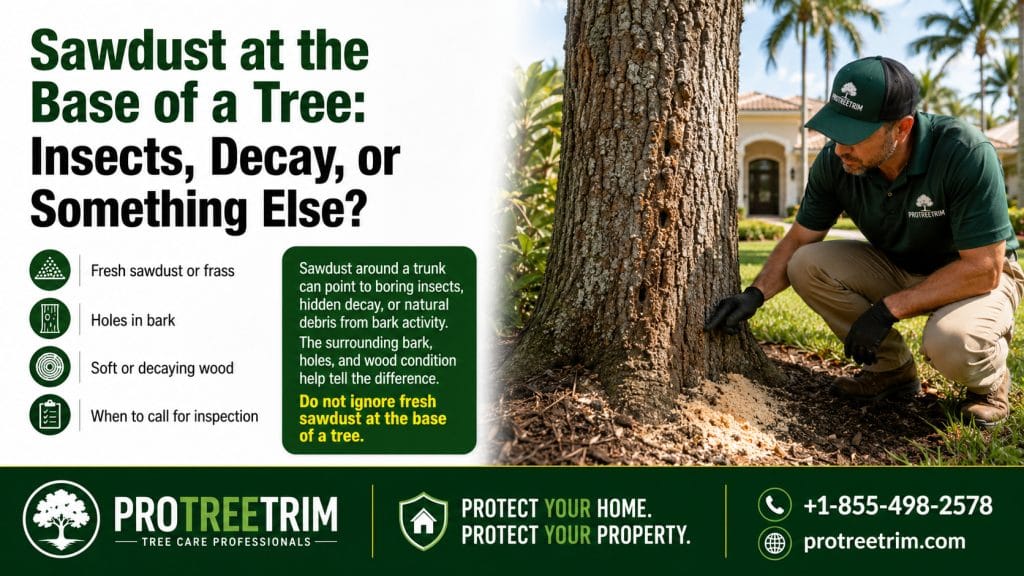
A pile of sawdust at the base of a tree is worth checking, but it does not point to one single answer. It may come from carpenter ants excavating decayed wood, wood-boring insects, old wounds, storm damage, or dead interior wood. The real concern is whether the tree also has decay, holes, dieback, cracks, or large limbs over something important.
Sawdust Is a Clue, Not the Diagnosis
Homeowners often assume sawdust means termites. Sometimes the issue is different. Iowa State Extension notes that sawdust-like material at the base of a large tree is often produced by carpenter ants; those ants do not eat wood, but they excavate soft, decaying wood to make nest cavities. The bigger concern may be the decay that allowed the cavity to develop.
Wood-boring insects can also leave sawdust-like material, often called frass. UC IPM explains that clearwing moth larvae can bore large holes and leave sawdust-like frass, while other borers and bark beetles may create holes, stains, wet areas, or tunnels. It also notes that many borers attack trees already weakened by poor care, disease, improper irrigation, or mechanical injury.
| What you notice | What it may suggest |
|---|---|
| Sawdust pile at the base only | Carpenter ants, decay, or boring activity |
| Small holes in bark | Bark beetles or other borers may be involved |
| Larger holes with frass | Clearwing moths or other wood borers are possible |
| Soft, hollow, or wet wood | Decay may be the bigger issue |
| Dead limbs above the area | Tree stress may be spreading |
| Trunk crack near sawdust | Structural concern deserves attention |
| Sawdust near a pine with resin | Pine bark beetle activity may need quicker review |
Check the Tree Above the Sawdust
The pile on the ground is only the starting point. Step back and look at the whole tree.
Is the canopy thinning? Are leaves dropping early? Are there dead branches in the upper crown? Is bark peeling near the trunk base? Are mushrooms growing nearby? Does the tree lean toward a house, driveway, pool cage, fence, or walkway?
ISA’s homeowner guidance recommends looking for patterns, checking roots, and examining trunks and branches because leaf or insect symptoms alone may not identify the real issue. It also notes that many insect problems are secondary to stress disorders or pathogens, and most insects are beneficial rather than destructive.
That distinction matters. The insect may not be the original problem. A tree weakened by drought, overwatering, mower damage, root cutting, storm wounds, bad pruning, or construction may become more attractive to insects later. Treating the insect without understanding the tree’s condition can miss the larger risk.
For pines, be especially careful. UF/IFAS says bark beetles are commonly seen on dead pines in Florida and are associated with signs such as abundant sawdust or resin oozing. But it also cautions that bark beetles are most often a symptom of previous stress or injury, not always the original cause of death.
What Homeowners Should Do Next
Do not kick the trunk, dig into the bark, spray randomly, or seal the area with paint or filler. Those actions may hide evidence or enlarge the wound.
Instead:
- Photograph the sawdust pile before sweeping it away.
- Take close-ups of holes, resin, cracks, mushrooms, bark loss, or wet wood.
- Photograph the full tree and nearby targets: roof, driveway, pool cage, fence, walkway, or service line.
- Note recent stress: drought, heavy rain, irrigation changes, construction, pruning, lightning, or storm damage.
- Check whether sawdust returns after it is gently cleared.
- Avoid standing under large dead limbs while inspecting.
The decision changes if the tree is near a structure. A hollow tree in an open corner may be a monitoring issue. A hollow tree with sawdust, trunk cracks, and heavy limbs over a roof or driveway deserves faster attention.
If you are unsure whether sawdust, carpenter ants, borers, decay, or a declining tree needs professional attention, ProTreeTrim can help connect homeowners with local tree service support. Call +1-855-498-2578 or visit protreetrim.com.
FAQs
Does sawdust at the base of a tree mean termites?
Not necessarily. Sawdust-like material may come from carpenter ants, boring insects, decay, or old damaged wood.
Are carpenter ants killing my tree?
Often, carpenter ants are using already softened or decaying wood. The decay or hollow area may be more important than the ants themselves.
Should I spray the tree if I see sawdust?
Not before identifying the source. Spraying may not help if the issue is decay, stress, or insects already inside the wood.
When is sawdust near a tree more urgent?
It is more urgent if the tree also has trunk cracks, hollow wood, mushrooms, dead limbs, a new lean, or branches over a roof, driveway, pool cage, or walkway.
ProTreeTrim™ can help you take the next step.
If you are dealing with a damaged tree, fallen branch, stump, root issue, palm concern, or storm cleanup question in Florida, call ProTreeTrim for tree service support.