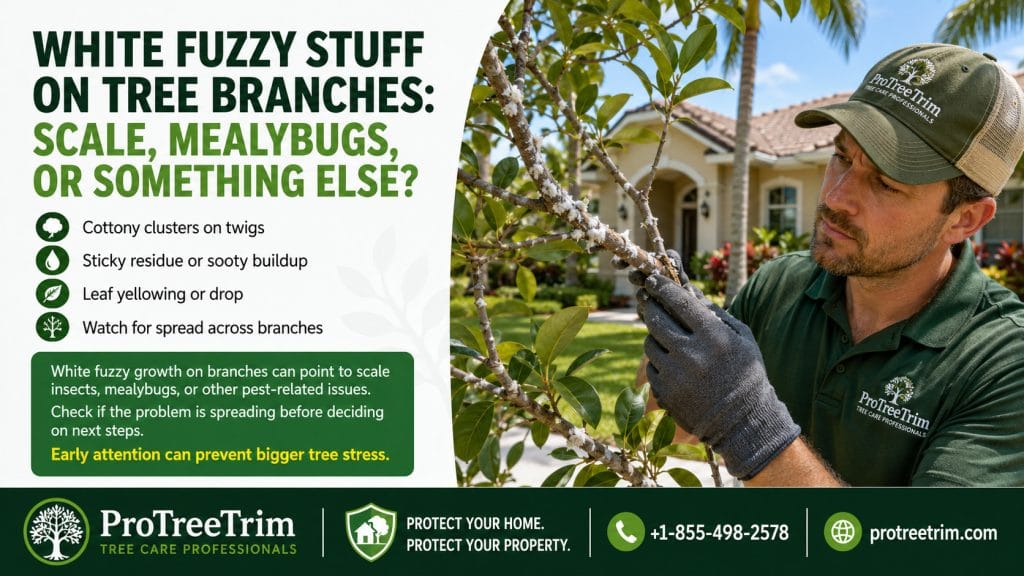
White fuzzy material on tree branches is worth a closer look, but it is not a reason to panic. It may be mealybugs, cottony scale, waxy insect covering, egg sacs, old debris, or fungal-looking growth on stressed wood. The real question is whether the tree also shows sticky residue, ants, leaf yellowing, branch dieback, or spreading decline.
Do Not Scrape Everything Off Right Away
The first instinct is usually to wipe, scrape, or spray. Hold off for a moment. What looks like “white fuzz” can come from different causes, and the next step depends on the pattern.
Mealybugs can leave white, cottony egg masses or wax-covered areas, and UC IPM notes that signs can include sticky honeydew, black sooty mold growing on honeydew, and ants feeding on that honeydew. High populations can weaken plants and may contribute to slowed growth or leaf drop.
Cottony cushion scale can also look like white cottony material. UC IPM describes the adult female as having a distinctive elongated, fluted white cottony egg sac. Some scale insects produce sticky honeydew, while others do not, which is why proper identification matters before deciding whether treatment is warranted.
| What you notice | What it may suggest |
|---|---|
| White cottony clusters on twigs or branch joints | Mealybugs, scale, or egg masses may be present |
| Sticky residue on leaves, cars, pavers, or patio furniture | Honeydew-producing insects may be active |
| Black coating on leaves or branches | Sooty mold may be growing on honeydew |
| Ants traveling up and down the trunk | Ants may be attracted to honeydew |
| Yellowing leaves or early leaf drop | Tree stress or insect pressure may be involved |
| White material only on dead wood | Could be decay, old debris, or secondary growth |
Look for the Tree’s Response
The white material matters less by itself than what the tree is doing around it.
If the tree looks full, growth is steady, and the fuzzy material is limited to a few small spots, the situation may be something to monitor and identify before taking action. If the affected area is spreading, leaves are yellowing, branches are dying back, or sticky residue keeps coating surfaces below, it deserves more attention.
Check where the issue is located. White fuzzy material on a small ornamental branch is one thing. The same symptom on a tree with dead limbs over a driveway, roof, pool cage, fence, or walkway becomes a different homeowner decision. The pest issue may not make the tree dangerous by itself, but it can be part of a larger decline pattern.
Also check the site. Insects often show up more noticeably on trees that are already stressed. Recent drought, overwatering, root damage, construction, heavy pruning, storm wounds, or compacted soil can all make a tree less resilient. A pest may be the visible problem, while the tree’s real weakness started at the roots or trunk.
What Homeowners Should Check Before Treating
Before spraying or pruning, take ten minutes to document the pattern.
Look at:
- Whether the white material is on leaves, twigs, bark, branch joints, or the trunk
- Whether it wipes off, looks waxy, or appears attached like an egg sac
- Whether ants are present
- Whether sticky residue is dripping onto hardscape or cars
- Whether leaves are yellowing, curling, spotting, or dropping
- Whether dead branches are appearing above the affected area
- Whether the tree has recent wounds, cracks, or pruning cuts
Avoid broad spraying before you know what is present. UC IPM notes that correctly distinguishing scale families and species matters because control methods and timing can vary.
Do not cut large limbs simply because insects are visible. Pruning may be useful if a branch is dead, hazardous, or structurally compromised, but pest presence alone does not justify random cutting. If the affected branch hangs over a roof, driveway, pool screen, or service area, the pruning decision should consider both tree condition and property risk.
When It Deserves Professional Attention
White fuzzy material becomes more concerning when it appears with decline signs: thinning canopy, branch dieback, sticky honeydew, black sooty mold, bark damage, trunk wounds, or repeated pest buildup despite homeowner cleanup.
It also deserves a closer look when the tree is in a high-consequence location. A declining tree over open lawn can be monitored differently than one over a driveway, fence, pool cage, roofline, or walkway. If the tree is already stressed, leaning, cracked, or dropping limbs, do not treat the problem as only an insect issue.
If you are unsure whether white fuzzy material, pest activity, branch dieback, or tree stress needs professional attention, ProTreeTrim can help connect homeowners with local tree service support. Call +1-855-498-2578 or visit protreetrim.com.
FAQs
Is white fuzzy stuff on tree branches always mealybugs?
No. It may be mealybugs, cottony scale, waxy insect covering, egg sacs, old debris, or growth on dead or stressed wood. The pattern matters.
Should I spray the tree right away?
Not before identifying the cause. Different pests require different timing and methods, and unnecessary spraying can disrupt beneficial insects.
Why are ants on the same branches?
Ants may be attracted to honeydew from sap-feeding insects such as mealybugs or certain scale insects.
When should I worry more?
Worry more if the white material spreads, leaves yellow or drop, branches die back, sticky residue appears, or the tree is near a roof, driveway, pool cage, or walkway.
ProTreeTrim™ can help you take the next step.
If you are dealing with a damaged tree, fallen branch, stump, root issue, palm concern, or storm cleanup question in Florida, call ProTreeTrim for tree service support.