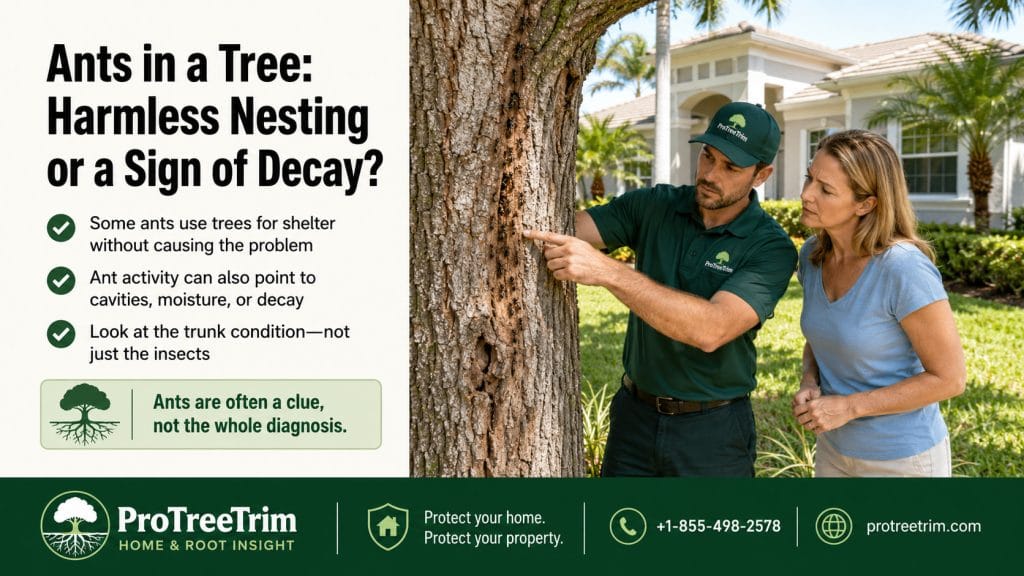
Ants in a tree do not always mean the tree is dying. Some ants simply travel over bark, feed on sap, or use small openings without seriously harming the tree. But ants can also be a clue that part of the tree is hollow, decaying, wet, wounded, or already weakened.
The key question is not just “Are there ants?”
It is “Where are the ants going, and what condition is the wood around them in?”
Ants Usually Do Not Start the Problem
Many homeowners assume ants are eating and killing the tree. Sometimes insects can damage trees, but ants are often secondary visitors. They may move into wood that is already soft, hollow, cracked, moist, or decaying.
Ants may be attracted to:
- trunk cavities
- old pruning wounds
- bark cracks
- sap flow
- aphid honeydew
- dead branches
- hollow limbs
- decaying wood
- moisture pockets
- storm wounds
- root flare decay
So the ant activity may be a symptom, not the original cause.
Ants on the Bark Are Different From Ants Inside the Tree
Ants walking up and down the outside of the trunk may be less concerning than ants entering a crack, hole, cavity, or soft area.
| Ant location | What it may mean |
|---|---|
| Traveling on bark | May be feeding, nesting nearby, or following sap |
| Around leaves or twigs | May be associated with aphids or honeydew |
| Entering a trunk hole | Cavity or decay may exist |
| Coming from the base | Root flare or lower trunk issue possible |
| Inside a dead branch | Deadwood or decay likely |
| Around dark ooze or sap | Wound, insect, or disease stress possible |
| Around mushrooms | Decay concern increases |
Location matters more than ant presence alone.
Carpenter Ants Are Often Found in Decaying Wood
Carpenter ants are commonly associated with moist, softened, or decaying wood. They do not usually eat wood the same way termites do. They excavate galleries to nest, often in wood that is already compromised.
That distinction matters.
If carpenter ants are present, the bigger question may be: Why was the wood suitable for nesting in the first place?
Look for:
- soft wood
- hollow areas
- trunk cavities
- sawdust-like debris
- bark loss
- old pruning wounds
- mushrooms
- dark staining
- cracks
- large dead limbs
Killing the ants does not restore decayed wood.
Ants Plus Sawdust or Wood Shavings
If you see ants and sawdust-like material, pay closer attention. Fine debris may come from insect activity, decaying wood, or galleries inside a cavity.
Check whether the debris is:
- fresh or old
- fine powder or coarse shavings
- collecting at the base
- coming from a hole
- mixed with sap
- near dead wood
- near a soft area
- appearing after rain or wind
Fresh debris from a trunk or large limb deserves more attention than old dry dust in a dead twig.
Ants Near Sap or Oozing
Ants are attracted to sugary or moist material. If sap is leaking from the tree, ants may gather there even if they did not cause the wound.
Ants near sap may be connected to:
- pruning wounds
- bark injury
- sapsucker holes
- aphid honeydew
- cankers
- trunk cracks
- insect feeding
- bacterial wetwood
- decay pockets
Clear sap from a small wound may be minor. Dark, foul-smelling ooze with ants is more concerning.
Ants and Aphids
Sometimes ants are not interested in the trunk at all. They may be feeding on honeydew produced by aphids or scale insects on leaves and small branches. In that case, the issue may be more about leaf pests than trunk decay.
Signs include:
- sticky leaves
- shiny residue on cars, patios, or outdoor furniture
- ants moving up to the canopy
- aphids or scale on leaves or twigs
- black sooty mold on leaves or surfaces
- otherwise solid trunk and healthy canopy
This can be annoying, but it is different from ants entering a hollow trunk.
Ants in a Hollow Tree
Ants entering a hollow tree should not be ignored. The ants may not have caused the hollow area, but their presence can reveal that decay or an internal cavity exists.
A hollow tree may still live for many years, but stability depends on:
- how much sound wood remains
- where the hollow area is located
- tree species
- trunk size
- lean
- canopy weight
- nearby targets
- root condition
- storm exposure
A hollow tree near a house, driveway, walkway, patio, or pool cage deserves careful evaluation.
Ants at the Base of the Tree
Ant activity at the lower trunk or root flare can be more concerning than ants on small branches. The base of the tree is important for structure and stability.
Check for:
- buried root flare
- mulch piled against trunk
- soft bark
- mushrooms or conks
- dark oozing
- trunk cracks
- cavities
- soil staying wet
- new lean
- exposed roots with decay
Ants at the base plus soft wood, mushrooms, or lean should be taken seriously.
Mulch Can Attract Ants and Hide Problems
Mulch is helpful when used correctly, but thick mulch against the trunk can hold moisture, hide decay, and create habitat for insects.
Poor mulch habits include:
- mulch touching the trunk
- mulch piled like a volcano
- root flare completely buried
- wet mulch packed against bark
- old mulch layered year after year
- soil added over roots
- raised beds around the tree base
Pull mulch away from the trunk so the root flare and lower bark can be seen.
Termites in a Tree Are a Different Concern
Termites in a tree can be more alarming for homeowners because of concerns about the house. Termites may use dead or decaying wood in a tree, stump, or root system. Like ants, they may be attracted to wood that is already compromised.
Termites near a tree should prompt two separate questions:
- What does this mean for the tree’s structure?
- What does this mean for the home or nearby wooden structures?
A tree service can help with tree condition. A pest-control professional may be needed for home termite risk.
Ants in Old Stumps
Ants in an old stump are common. A stump is dead wood, so insects, fungi, and decay organisms naturally move in over time.
Ants in a stump may be expected when:
- the stump is old
- wood is soft
- mushrooms appear nearby
- soil stays moist
- roots are decaying underground
- wood chips remain after grinding
- the stump is close to mulch beds
If the stump is near the house, patio, walkway, or driveway, stump grinding or removal may be worth considering for appearance, safety, and pest-habitat reduction.
Ants After Stump Grinding
After stump grinding, old roots and wood chips continue to decay below the surface. Ants, fungi, and other insects may appear in that area as the wood breaks down.
This does not always mean something is wrong.
After stump grinding, homeowners may notice:
- settling soil
- mushrooms
- ants in the old stump area
- soft spots
- wood chips surfacing
- uneven grass growth
- roots decomposing underground
If the area is close to the house, a walkway, or a patio, cleanup and regrading may be helpful.
Ants in Dead Branches
Ants entering dead branches may indicate that the branch is decaying or hollow. The question then becomes whether the branch could fall and hit something important.
Dead branches matter most when they are over:
- rooflines
- driveways
- patios
- pool cages
- fences
- sidewalks
- parked vehicles
- outdoor seating areas
- neighbor property
Ants in a small dead branch over open lawn may be low priority. Ants in a large dead limb over a driveway are different.
Ants and Tree Cavities
Tree cavities can form from old wounds, storm damage, poor pruning cuts, branch tear-outs, decay, lightning injury, or trunk cracks. Ants may use the cavity once it exists.
Do not fill cavities with concrete, foam, soil, or sealant. Filling cavities can trap moisture, hide decay, and make inspection harder.
Instead, check:
- cavity size
- location
- whether wood is soft
- whether water collects inside
- whether the tree leans
- whether large limbs are above targets
- whether mushrooms are present
- whether the canopy is declining
A cavity is a structural clue, not a hole to patch.
Do Not Spray Blindly
Spraying ants without understanding why they are there can miss the real problem. If ants are nesting in decayed wood, killing visible ants does not restore tree strength. If ants are feeding on honeydew, the issue may be aphids or scale. If termites are involved, a pest-control plan may be needed.
Before spraying, ask:
- Are ants entering the tree or just walking on it?
- Is the wood soft or hollow?
- Is there sawdust or frass?
- Are there mushrooms?
- Is sap or dark ooze present?
- Is the canopy declining?
- Is the tree near the house?
- Are termites possible?
The right response depends on the cause.
Ants and Tree Removal Decisions
Ants alone usually do not mean a tree must be removed. But ants can reveal decay, cavities, or deadwood that may affect safety.
Removal may need discussion when ants appear with:
| Sign | Why removal may be considered |
|---|---|
| Large trunk cavity | Structural wood may be reduced |
| Soft lower trunk | Decay concern |
| Mushrooms near base | Root or trunk decay possible |
| New lean | Stability concern |
| Large dead limbs | Falling branch risk |
| Hollow major limb | Limb failure concern |
| Tree near house | Consequences are higher |
| Repeated storm damage | Tree may be weakened |
| Severe canopy decline | Tree health may be poor |
The ants are not the whole decision. The tree’s structure and location drive the risk.
When Ants Are Less Urgent
Ant activity may be less urgent when:
- ants are only walking on the bark
- the canopy is healthy
- no holes or cavities are visible
- no sawdust is present
- no mushrooms are present
- wood is firm
- no dark ooze is present
- no large dead limbs are over targets
- the root flare is visible and dry
In that case, monitoring may be enough.
When Ants Are More Serious
Act sooner when ants are:
- entering a trunk cavity
- coming from the base
- mixed with sawdust or frass
- around soft wood
- around mushrooms or conks
- near dark oozing
- inside a large dead limb
- associated with a leaning tree
- in a tree close to the house
- connected to termites or home pest concerns
Ants plus structural warning signs should not be ignored.
What Homeowners Should Photograph
Take photos of:
- ants entering the tree
- close-up of holes or cavities
- sawdust or debris
- full trunk
- base and root flare
- mushrooms or soft wood
- sap or dark ooze
- full canopy
- dead branches
- nearby house, driveway, patio, or walkway
Photos help determine whether the issue is simple insect activity or a tree-structure concern.
What to Do First
A practical first response:
- Watch where the ants go.
- Check whether they enter a hole, crack, cavity, or soft area.
- Look for sawdust, sap, mushrooms, or dark ooze.
- Inspect the canopy for decline.
- Check the base and root flare.
- Pull mulch away from the trunk if needed.
- Do not fill cavities.
- Do not spray blindly.
- Get help if ants are connected to decay, hollow wood, lean, or large dead limbs.
The goal is to find out whether the ants are harmless visitors or a clue to a bigger tree problem.
Final Homeowner Takeaway
Ants in a tree do not always mean the tree is dying. They may be feeding on sap, following honeydew, traveling over bark, or nesting in nearby mulch. But ants entering holes, cavities, soft wood, dead limbs, or the base of the tree can point to decay or structural weakness.
Do not focus only on killing the ants. Look at the wood, canopy, trunk base, root flare, and nearby targets. If ants are paired with mushrooms, hollow areas, dark oozing, large dead limbs, or lean, the tree should be taken more seriously.
If you are unsure whether ants in your tree are harmless activity, a decay warning, or a removal-level concern, ProTreeTrim can help connect homeowners with local tree service support. Call +1-855-498-2578 or visit protreetrim.com.
FAQs
Do ants mean a tree is dying?
Not always. Ants may simply travel over bark or feed on sap. They are more concerning when they enter cavities, soft wood, dead limbs, or the base of the tree.
Are carpenter ants bad for trees?
Carpenter ants often nest in moist or decaying wood. Their presence may indicate the tree already has soft or hollow areas.
Should I spray ants on my tree?
Do not spray blindly. First check whether the ants are connected to sap, aphids, cavities, decay, or termites.
Do termites in a tree mean my house is at risk?
Not automatically, but termites near a home should be taken seriously. A tree professional can assess the tree, while pest-control support may be needed for the house.
ProTreeTrim™ can help you take the next step.
If you are dealing with a damaged tree, fallen branch, stump, root issue, palm concern, or storm cleanup question in Florida, call ProTreeTrim for tree service support.