You can cut off fully brown, dead palm leaves when they are hanging, unattractive, or creating a cleanup or safety issue. But you should be careful about cutting palm leaves that are only partly brown, yellowing, or still green. Brown palm leaves can be normal aging, but they can also point to water stress, poor drainage, nutrient problems, pests, over-pruning, weather damage, or a deeper palm-health issue.
The first question is not only “Can I cut this frond?”
It is “Why did it turn brown, and is the rest of the palm healthy?”
Fully Brown Fronds Are Usually Safe to Remove
A palm naturally retires older fronds. These are usually the lower fronds, not the newest center growth. As they age, they may turn yellow, then brown, then dry out and hang down.
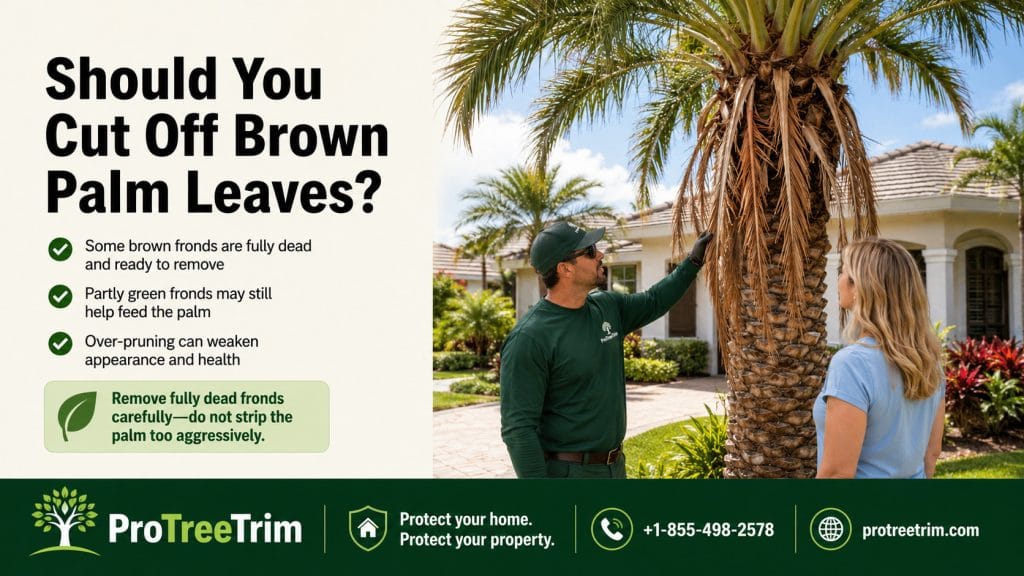
Once a palm frond is fully brown and dead, removing it is usually a normal maintenance step.
| Frond condition | Better response |
|---|---|
| Fully brown and dry | Usually safe to remove |
| Broken and hanging | Remove if it could fall or hit property |
| Touching roof or pool cage | Remove or clear carefully |
| Partly yellow or partly green | Do not rush; check cause first |
| New center spear turning brown | More serious; not routine trimming |
| Many fronds browning quickly | Look for water, root, pest, or crown issues |
| Brown after heavy pruning | Avoid cutting more green fronds |
A dead frond is cleanup. A browning crown is a warning sign.
Do Not Remove Too Many Partly Green Fronds
The biggest mistake is cutting every frond that looks imperfect. Palms need green fronds to produce energy. A frond with brown tips or some yellowing may still be contributing to the palm.
Removing too many partly green fronds can leave the palm thin, stressed, and unnatural-looking. This is especially true when palms are trimmed into a severe “hurricane cut,” with only a small tuft of leaves left at the top.
A better rule is simple:
- remove fully dead fronds
- remove broken or dangerous fronds
- remove fronds touching structures when needed
- preserve healthy green fronds
- be cautious with partly green fronds
- do not strip the palm just for appearance
A clean palm should still look full and natural.
Brown Tips Are Not the Same as Dead Fronds
Brown tips are common on palms. They may come from dry periods, wind, salt exposure, irrigation issues, nutrient stress, old frond aging, or root stress. A frond with brown tips is not necessarily dead.
If only the tips are brown and the rest of the frond is green, cutting off the whole frond may remove useful leaf area unnecessarily.
Brown tips deserve a closer look when they appear on many fronds at once or spread quickly.
Ask:
- Is the soil too dry?
- Is the soil staying too wet?
- Is irrigation hitting the trunk?
- Is the palm near hot pavement?
- Was it recently pruned?
- Did a cold, wind, or storm event happen?
- Are pests visible on the fronds?
- Is the newest center growth affected?
The tip damage may be a symptom, not the problem itself.
Lower Brown Fronds Are Less Concerning
If only the lowest fronds are turning brown gradually, the palm may simply be shedding older growth. That is usually less concerning when the crown is full and the new central growth looks healthy.
Normal aging is more likely when:
- browning starts on lower fronds
- the newest spear leaf looks healthy
- only one or two fronds are affected
- the trunk feels firm
- the palm is not leaning
- there is no soft crown area
- the browning is gradual
- watering and drainage have been stable
In that situation, trimming dead lower fronds can be routine maintenance.
New Brown Growth Is More Serious
The newest growth in the center of the palm matters most. If the central spear leaf or newest fronds turn brown, collapse, or pull loose, that is not the same as old lower fronds dying.
That may point to a crown problem, disease concern, severe stress, or internal decline. Cutting off outer brown leaves will not solve that.
Be more cautious if you see:
| Warning sign | Why it matters |
|---|---|
| Center spear turns brown | Crown health may be compromised |
| New growth collapses | More serious than normal aging |
| Spear leaf pulls loose | Urgent palm-health concern |
| Crown feels soft or wet | Decay or disease may be possible |
| Foul smell near crown | Not routine frond aging |
| Many fronds brown quickly | Severe stress may be involved |
| Sudden lean | Root or trunk stability concern |
If the center is affected, treat it as a palm-health issue, not a trimming question.
Brown Fronds After Over-Pruning
Sometimes palm fronds turn brown after the palm was trimmed too aggressively. If too many green fronds were removed, the remaining fronds may show stress. The palm may also look thin, exposed, or unnatural.
In that case, the answer is usually not more trimming.
A better recovery approach is:
- stop removing green fronds unnecessarily
- remove only fully dead or hazardous fronds
- protect the crown from damage
- check watering and drainage
- avoid heavy fertilizer as a panic fix
- watch new growth over time
- schedule gentler maintenance in the future
A palm that has been over-pruned needs time and better care, not another harsh cut.
Brown Leaves Can Point to Water Stress
Both underwatering and overwatering can lead to browning. This is why homeowners should check the soil before changing irrigation.
A palm in dry soil may brown at the tips or edges. A palm in soggy soil may also brown because roots are stressed and oxygen is limited.
Look at the planting area:
- Does soil stay dry even after watering?
- Does water run off instead of soaking in?
- Does soil stay wet for days after rain?
- Is the palm in a low spot?
- Is mulch piled against the trunk?
- Is a downspout draining nearby?
- Is irrigation spraying the trunk every day?
- Are pavers or concrete limiting root space?
Do not assume brown leaves always mean the palm needs more water.
Nutrient Stress Can Also Cause Browning
Some palms develop yellowing, orange tones, brown tips, or weak growth when nutrient availability is poor. This can happen in sandy soil, compacted beds, or areas where irrigation and drainage are not balanced.
But fertilizer should not be the first blind response. A palm with root rot, poor drainage, pests, or crown damage may not improve from fertilizer alone.
Nutrient stress is more likely when:
- browning develops gradually
- older fronds show discoloration first
- several fronds have uneven color
- soil is sandy or poor
- watering and drainage seem reasonable
- the crown is otherwise firm and healthy
Use palm-appropriate fertilizer only when the site conditions make sense and the palm is healthy enough to respond.
Pests May Be Involved
Brown palm leaves can also appear with pest activity. Scale insects, mites, mealybugs, or other pests may weaken fronds, create spotting, yellowing, stickiness, or sooty-looking buildup.
Inspect fronds before cutting them off.
Look for:
- sticky residue
- tiny bumps on fronds
- white fuzzy material
- speckling
- black sooty coating
- webbing
- insects near leaf bases
- uneven browning or yellowing
If pests are present, trimming dead leaves may improve appearance, but the pest issue may remain.
Weather and Storms Can Brown Palm Leaves
Palms can show browning after cold snaps, wind exposure, salt spray, heavy rain, drought, or storm damage. The timing matters.
If browning appeared after a specific weather event, monitor the palm before making aggressive cuts. Some damaged fronds may continue to decline, while new growth may reveal whether the palm is recovering.
Weather-related browning is more concerning if it comes with:
- broken fronds
- torn crown area
- leaning
- trunk wounds
- soft tissue
- many fronds collapsing
- center spear damage
- roots exposed after heavy rain
Fully dead storm-damaged fronds can be removed. But do not strip the palm while it is still showing recovery signs.
Brown Fronds Over Property Should Be Handled Sooner
Even if brown fronds are normal, their location matters. A dead palm frond hanging over open lawn may be less urgent. A dead frond over a driveway, roof, pool cage, walkway, or patio is more important.
Remove or address brown fronds sooner when they hang over:
- parked vehicles
- pool cages
- rooflines
- gutters
- patios
- sidewalks
- front entries
- fences
- outdoor seating
- neighbor-facing areas
A dead frond can be both normal and worth removing.
Do Not Cut Into the Palm Trunk or Crown
Palm trimming should remove fronds cleanly without cutting into the trunk or damaging the crown. The trunk should not be gouged for a cleaner look. Old frond bases should not be ripped off if they are tightly attached. The crown should not be injured.
Poor cutting can leave wounds, weaken appearance, and create long-term problems.
Avoid:
- shaving the trunk aggressively
- cutting into living trunk tissue
- yanking tight boots off
- damaging the central crown
- cutting too close to the trunk
- leaving jagged stubs
- using unsafe ladders or pole saws near wires
A palm should be trimmed carefully, not carved.
When to Wait Before Cutting
Waiting may be better when the frond is only partly yellow or partly brown, the palm is stressed, or the cause is unclear.
Wait and observe when:
- the frond is still mostly green
- browning is limited to tips
- the palm was recently transplanted
- the palm was recently over-pruned
- weather damage just happened
- the newest growth looks okay
- you are trying to diagnose water or nutrient stress
- removing more fronds would leave the crown too thin
A palm can look imperfect while still needing its remaining leaf area.
When to Cut Brown Palm Leaves
Cutting makes sense when the frond is fully dead, broken, hanging, rubbing a structure, or creating a property concern.
Cut or schedule removal when:
| Situation | Why cutting makes sense |
|---|---|
| Fully brown lower frond | Normal maintenance |
| Broken storm-damaged frond | Prevents hanging debris |
| Dead frond over driveway | Reduces falling-debris concern |
| Frond touching roof or gutter | Protects roofline and drainage |
| Frond resting on pool cage | Reduces screen damage and debris |
| Dead frond over walkway | Improves safety and appearance |
| Brown frond with seed pods | Cleanup may be combined |
The best trimming is specific. It does not remove healthy fronds without reason.
What Homeowners Should Check First
Before cutting, work through a simple check:
- Are the brown fronds lower and older?
- Is the center spear healthy?
- Is the browning gradual or sudden?
- Is the soil too dry or too wet?
- Was the palm recently pruned?
- Are pests visible?
- Did weather damage happen recently?
- Are fronds over a roof, pool cage, driveway, or walkway?
- Would removing them leave the crown too thin?
This helps separate routine trimming from a larger palm-health concern.
When to Get Help
Professional help makes sense when the palm is tall, near structures, near power lines, or showing signs beyond normal frond aging.
Get help if:
- newest fronds are browning
- the center spear looks damaged
- crown feels soft or wet
- palm is leaning
- many fronds brown quickly
- pests are heavy
- roots or trunk look damaged
- fronds hang over a roof, driveway, pool cage, or walkway
- trimming requires climbing or ladder work
Tall palm work is not a casual DIY project.
Final Homeowner Takeaway
You can usually cut off fully brown, dead palm leaves, especially when they hang over high-use areas. But do not remove every partly brown or yellowing frond just to make the palm look cleaner.
Lower brown fronds are often normal aging. Brown new growth, rapid crown decline, soft tissue, leaning, pests, or drainage problems deserve a closer look. A healthy palm should be maintained carefully, not stripped.
If you are unsure whether brown palm leaves are normal aging, storm damage, water stress, or a sign of a larger palm problem, ProTreeTrim can help connect homeowners with local tree service support. Call +1-855-498-2578 or visit protreetrim.com.
FAQs
Should I cut off brown palm leaves?
Fully brown, dead fronds can usually be removed. Partly green or partly yellow fronds should not be cut automatically.
Are brown palm leaves normal?
Sometimes. Older lower fronds naturally turn brown as they age. Brown new center growth is more concerning.
Can cutting too many palm fronds hurt the palm?
Yes. Removing too many green or partly green fronds can stress the palm and leave the crown too thin.
Why are the tips of my palm leaves brown?
Brown tips may come from water stress, wind, salt, nutrient stress, old frond aging, pests, or root problems.
ProTreeTrim™ can help you take the next step.
If you are dealing with a damaged tree, fallen branch, stump, root issue, palm concern, or storm cleanup question in Florida, call ProTreeTrim for tree service support.