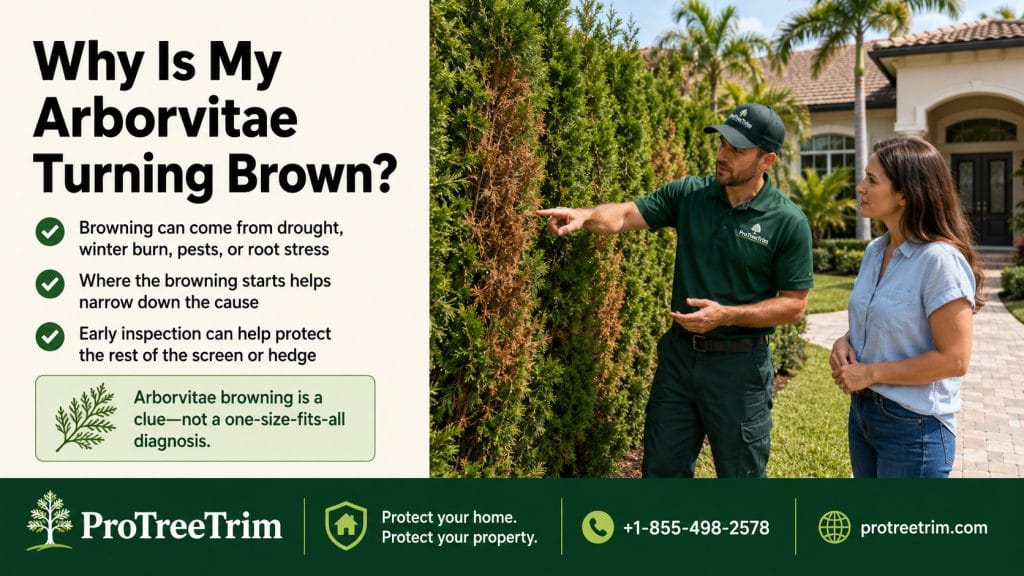
Arborvitae turning brown can worry homeowners because these evergreens are often planted for privacy, screening, and curb appeal. When one tree in a row starts browning, the whole landscape can look damaged. Sometimes the browning is normal interior shedding. Other times it may point to drought stress, overwatering, poor drainage, pests, winter injury, root damage, crowding, or a planting problem.
The first step is to look at where the browning appears. Interior browning is different from brown tips, brown tops, brown sides, or an entire plant fading.
Start With the Browning Pattern
The pattern tells you what to check next.
| Browning pattern | What it may suggest |
|---|---|
| Interior foliage browning | Often normal seasonal shedding |
| Outer tips turning brown | Water stress, pests, winter injury, or root stress may be involved |
| One side browning | Sun, wind, irrigation, salt, or neighbor-side exposure may matter |
| Top turning brown | More serious stress or damage may be possible |
| Bottom browning | Shade, crowding, pet urine, irrigation, or soil issues may contribute |
| One arborvitae in a row declining | Local root, water, pest, or planting issue may exist |
| Whole row browning | Irrigation, drought, soil, spacing, or weather stress may be broader |
A few brown inner sprays are not the same as an entire privacy screen failing.
Interior Browning Can Be Normal
Arborvitae are evergreen, but they still shed older interior foliage. This can look alarming because the inside may turn brown while the outside remains green.
Normal shedding is more likely when:
- browning is mostly inside the plant
- outer tips remain green
- the tree still looks full from the outside
- nearby arborvitae show similar seasonal browning
- the browning does not spread outward
- there are no dead branches or trunk problems
- the soil and watering have been stable
If the outside growth is healthy, the plant may simply be renewing older foliage.
Brown Outer Tips Are More Concerning
If the outer tips are turning brown, the arborvitae may be under active stress. Unlike interior shedding, tip browning affects the visible growing area and may not fill back in quickly.
Tip browning may be linked to:
- drought
- inconsistent watering
- overwatering
- poor drainage
- root damage
- winter burn in colder regions
- pests
- fertilizer burn
- reflected heat
- transplant shock
- crowding in a privacy row
Look closely before pruning or replacing the plant.
Water Stress Is a Common Cause
Arborvitae often struggle when watering is wrong. Too little water can brown tips and thin the plant. Too much water can stress roots and create similar symptoms.
Before watering more, check the soil.
Ask:
- Is the soil dry several inches down?
- Does water run off instead of soaking in?
- Is irrigation reaching the root zone?
- Is one tree in the row getting less water?
- Does the soil stay soggy after rain?
- Is the plant in a low spot?
- Is mulch piled against the trunk?
- Did a downspout or grading change water flow?
A brown arborvitae does not always need more water. It may need better drainage or more consistent watering.
Newly Planted Arborvitae Need Careful Monitoring
Newly planted arborvitae can brown from transplant stress, root ball drying, poor planting depth, or inconsistent watering. The surrounding soil may feel moist while the original root ball is still dry.
Check newly planted arborvitae for:
| Planting issue | Why it matters |
|---|---|
| Root ball planted too deep | Can stress roots and trunk base |
| Root ball drying out | Plant browns even if nearby soil is damp |
| Poor drainage in planting hole | Roots may stay too wet |
| Mulch against trunk | Moisture and decay may be hidden |
| Tight burlap, wire, or ties | Root establishment may be restricted |
| Reflected heat from pavement | Foliage and roots may stress faster |
| Wind exposure | New roots may not support water demand yet |
A new arborvitae turning brown should be treated as an establishment issue first.
Privacy Rows Often Brown From Spacing Problems
Arborvitae are commonly planted close together for fast privacy. That can create problems later. The row may become crowded, shaded, and difficult to water evenly. Lower branches may thin. Interior foliage may brown. One plant may decline faster than the others.
In a row, check:
- Are the trees planted too close together?
- Is one plant shaded by a fence or building?
- Does irrigation reach every tree equally?
- Is the soil compacted along the fence?
- Are roots competing in a narrow strip?
- Are some trees closer to pavement or reflected heat?
- Is the row trapping moisture and reducing airflow?
A privacy screen problem is often a site and spacing problem, not just a plant disease.
Winter Burn Can Cause Browning
In colder regions, arborvitae can brown from winter burn. Wind, frozen soil, sun exposure, and dry conditions can damage foliage. Browning may show up on the side facing wind or sun.
Winter injury is more likely when:
- browning appears after winter
- one exposed side is worse
- tips are dry and tan or brown
- plants are near open windy areas
- soil was dry before freezing weather
- the plant is newly installed
- salt exposure from roads or sidewalks is possible
Not all winter-browned foliage recovers. Watch for new growth before deciding how much is dead.
Salt, Heat, and Pavement Can Stress Arborvitae
Arborvitae planted near driveways, sidewalks, streets, walls, or pavers may face extra stress. Reflected heat, road salt in colder regions, compacted soil, and limited root space can all contribute to browning.
This matters when browning appears mostly on the side facing:
- a driveway
- sidewalk
- road
- wall
- patio
- fence
- hot reflected surface
- drainage runoff path
The plant may be reacting to its location.
Pests Can Be Involved
Some arborvitae browning can involve pests such as spider mites, bagworms, scale-type insects, or other small pests. The symptoms may include webbing, speckled foliage, hanging bags, sticky residue, or branch dieback.
Check for:
- fine webbing
- small hanging bags
- tiny moving insects
- white or gray bumps
- sticky residue
- browning starting at tips
- foliage thinning unevenly
- dead branch sections
Do not spray randomly. Identify what is present first.
Bagworms Are Worth Checking
Bagworms can be a serious issue on arborvitae because they can strip foliage and make privacy trees look brown and patchy. Their cases may look like small hanging cones or brown bags attached to the branches.
If you see bag-like structures, inspect nearby arborvitae too. Bagworms can spread through a row.
Small reachable infestations may sometimes be removed by hand, but heavy infestations or tall plants may need professional help.
Do Not Shear a Stressed Arborvitae Hard
When arborvitae turn brown, some homeowners try to cut them back hard. That can make things worse. Arborvitae may not regrow well from old bare wood. If you cut past green growth into dead-looking interior wood, the area may stay bare.
Avoid:
- cutting deeply into brown interior wood
- topping the plant to fix browning
- shearing during heat or drought stress
- removing too much green foliage
- pruning before identifying water or pest issues
- cutting a privacy row into permanent gaps
Light shaping may be fine on healthy plants, but stressed arborvitae need careful decisions.
Will Brown Arborvitae Turn Green Again?
Sometimes, but not always.
If the browning is interior seasonal shedding, the plant may continue looking healthy from the outside. If the outer tips are brown but branches are still alive, some recovery may occur. If a branch is fully dead and bare, it may not refill.
Before removing the plant, check:
- Are branch tips still flexible?
- Is there green growth beyond the brown area?
- Is browning spreading?
- Is the trunk or stem still healthy?
- Is new growth appearing?
- Is the root zone stable?
- Are pests present?
A fully brown arborvitae with no green growth may not recover. A partly brown one may still have a chance if the cause is corrected.
One Brown Arborvitae in a Row
If only one arborvitae in a row is browning, look at that specific location.
Possible reasons include:
- root ball dried out after planting
- irrigation misses that spot
- soil is compacted there
- water collects there
- pests started on that plant
- the plant was damaged during installation
- roots were restricted
- nearby pavement or wall creates extra heat
- pet urine or chemical exposure occurred
Do not assume the whole row has the same issue if only one plant is declining.
When Removal May Be Better Than Waiting
Removal may be realistic when the arborvitae is fully brown, brittle, bare, badly placed, or no longer serving its purpose as screening.
Removal may make sense when:
- the plant is completely brown
- no green growth remains
- the trunk or stems are dead
- the row has permanent gaps
- roots are failing in soggy soil
- pests caused severe damage
- the plant was installed too close to hardscape
- it blocks access, windows, or walkways
- replacement with better spacing would solve the problem
Sometimes saving one badly placed arborvitae costs more effort than replacing it correctly.
What Homeowners Should Photograph
Take photos before cutting or replacing.
Photograph:
- the full plant or row
- close-up brown foliage
- branch tips
- interior versus outer browning
- trunk base and mulch level
- irrigation pattern if visible
- nearby driveway, sidewalk, fence, or wall
- any webbing, bags, insects, or residue
- soil condition after watering or rain
Photos help reveal patterns over time.
What to Do First
A practical first check:
- Decide whether browning is interior or outer-tip browning.
- Check soil moisture.
- Inspect drainage.
- Look for pests, bags, or webbing.
- Check whether the plant was recently installed.
- Look at spacing in the row.
- Avoid hard pruning into bare wood.
- Monitor new growth.
- Get help if the plant is heavily browned or near important property areas.
This prevents overwatering, over-pruning, or replacing too quickly.
Final Homeowner Takeaway
Arborvitae turning brown is not always a disaster. Interior browning can be normal. Brown tips, one-sided browning, top browning, or a whole plant fading should be checked more carefully.
Start with water, drainage, planting depth, spacing, pests, and recent weather. Avoid cutting into old bare wood or spraying without knowing the cause. If the plant is fully brown and brittle, replacement may be more realistic than recovery.
If you are unsure whether your arborvitae is shedding normally, stressed, pest-damaged, or unlikely to recover, ProTreeTrim can help connect homeowners with local tree service support. Call +1-855-498-2578 or visit protreetrim.com.
FAQs
Is it normal for arborvitae to turn brown inside?
Yes. Interior foliage can brown and shed naturally while the outside remains green.
Why are the tips of my arborvitae turning brown?
Brown tips may come from drought, overwatering, poor drainage, winter injury, pests, root stress, or planting problems.
Can a brown arborvitae recover?
Sometimes, if some green growth remains and the cause is corrected. Fully brown, brittle plants often do not recover well.
Should I cut brown parts off arborvitae?
Remove clearly dead or broken material carefully, but avoid cutting deeply into old bare wood because it may not regrow.
ProTreeTrim™ can help you take the next step.
If you are dealing with a damaged tree, fallen branch, stump, root issue, palm concern, or storm cleanup question in Florida, call ProTreeTrim for tree service support.