
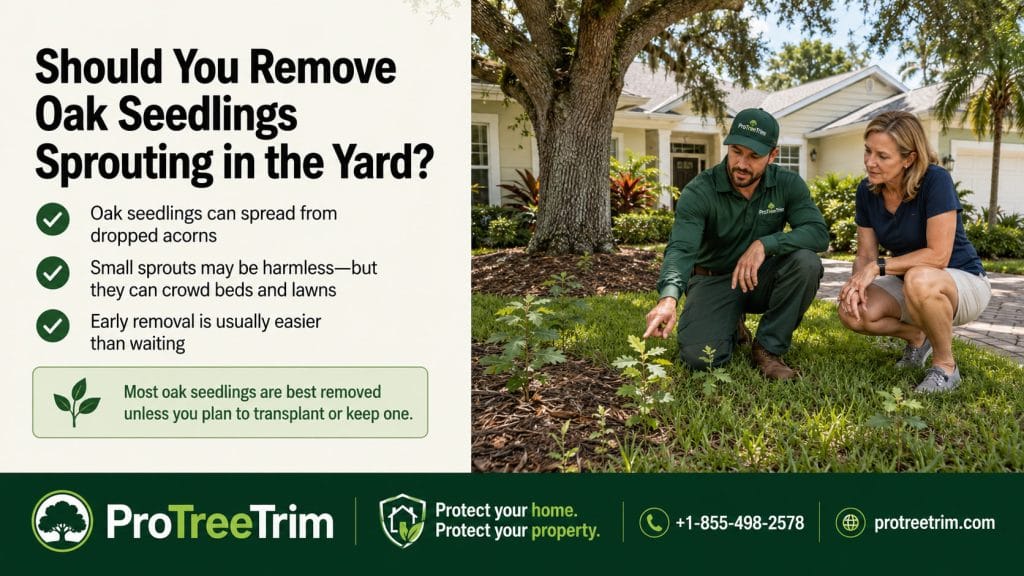
Oak seedlings in the yard are usually not a crisis. They often appear after acorns drop, especially under mature oaks, near fence lines, in mulch beds, along driveways, or around patios. The real question is whether the seedling is growing in a place where a future oak tree would actually make sense.
Oak Seedlings Are Usually Normal
If you have a mature oak nearby, small seedlings may appear after acorns germinate. They can show up in lawn, mulch, paver joints, garden beds, drainage edges, or under shrubs.
A few seedlings do not mean the yard is being “taken over.” But ignoring them can create work later. A tiny oak is easy to pull. A young sapling with a stronger root system is harder. A small volunteer tree in the wrong place can eventually become a roof, driveway, fence, or sidewalk problem.
| Where the seedling appears | What to consider |
|---|---|
| Open lawn | Easy to remove early |
| Near driveway edge | Future root and clearance problem |
| Beside sidewalk | Could become a hardscape issue |
| Against fence | Boundary and pruning concerns later |
| Near house foundation bed | Usually a poor place for an oak |
| In mulch under parent tree | May simply be acorn germination |
| Near pool deck or patio | Future debris and root conflicts likely |
| In drainage swale | May interfere with water flow later |
The seedling itself is not the problem. The future mature tree may be.
Do Not Let a Volunteer Oak Choose the Planting Spot
A volunteer seedling did not choose the best location. It grew where an acorn landed and conditions allowed it to sprout.
That spot may be terrible for a mature oak. It may be too close to the house, under power lines, beside a driveway, against a fence, near a pool cage, or in a narrow side yard.
Before keeping an oak seedling, ask:
- Would I intentionally plant an oak in this exact spot?
- Is there enough room for a mature canopy?
- Will roots have enough space?
- Will branches eventually touch the roof or gutters?
- Will it grow into a fence or neighbor’s yard?
- Is it near a sidewalk, driveway, patio, or pool deck?
- Are overhead or underground utilities nearby?
- Will future pruning or removal be difficult?
If the answer is no, remove it while it is small.
Small Seedlings Are Easier to Remove
The best time to remove unwanted oak seedlings is when they are young and the soil is moist enough to loosen the root. Pulling early reduces disturbance and prevents the seedling from developing a stronger taproot or woody stem.
For small seedlings:
- pull gently from the base
- remove as much root as practical
- work after rain or watering if soil is hard
- avoid tearing up nearby desirable plants
- check mulch beds again after acorn season
- do not mow over them repeatedly and assume they are gone
Mowing may keep seedlings short in lawn, but it may not remove them fully. Some may resprout or become woody at the base if ignored.
Do Not Keep Seedlings Near Structures
Oak trees can become large, valuable shade trees, but they need space. A seedling beside a home may look harmless for several years before the real conflict begins.
Avoid keeping oak seedlings near:
| Location | Why it is a poor long-term spot |
|---|---|
| House wall | Future canopy, roofline, and root concerns |
| Driveway | Roots, low limbs, and vehicle clearance |
| Sidewalk | Trip hazards and lifted panels |
| Pool cage | Debris, screen contact, and pruning difficulty |
| Fence line | Neighbor and repair issues |
| Septic area | Root and access concerns |
| AC unit | Debris, airflow, and service access problems |
| Power lines | Future utility clearance issue |
A strong oak in the wrong place can become an expensive decision later.
Can You Transplant an Oak Seedling?
Sometimes, but it is not always simple. Oak seedlings can develop deeper roots early, and transplanting becomes harder as they grow. If the seedling is very small, you may be able to move it carefully to a better location.
Before transplanting, make sure the new spot is truly suitable. Do not move a volunteer oak from one bad location to another.
A better oak planting spot should have:
- enough room for mature canopy spread
- distance from the house and roofline
- distance from driveway, sidewalk, and patio edges
- no overhead power-line conflict
- enough open soil for roots
- good drainage
- future pruning access
- no septic or utility conflict
If you do not have that kind of space, it may be better not to keep the seedling.
Seedlings in Mulch Beds Need Attention
Oak seedlings often appear in mulch beds because acorns settle there and moisture stays more consistent. These seedlings may be hidden under shrubs, along edging, or near the trunk of a larger tree.
Do not let them grow unnoticed. A seedling in a mulch bed near the house can become woody before you realize it. If it grows close to other plants, pulling it later may disturb roots.
Check mulch beds during routine cleanup, especially after heavy acorn years.
Seedlings in Pavers or Cracks Should Be Removed Early
Oak seedlings growing between pavers, driveway cracks, patio joints, or walkway edges should usually be removed quickly. They are not in a realistic planting location, and their roots can make small hardscape gaps worse over time.
Do not wait until the stem becomes woody. At that point, removal may disturb pavers or leave root material behind.
If seedlings keep appearing in paver joints, the issue may be regular acorn collection and debris buildup. Cleaning the area more often during acorn drop can reduce sprouting.
What If the Seedling Is From a Neighbor’s Oak?
Acorns do not respect property lines. If a neighbor’s oak drops acorns into your yard and seedlings appear, you can usually manage the seedlings on your side as routine yard maintenance.
The bigger issue is not blame. It is timing. Remove unwanted seedlings early so they do not become woody volunteers along the fence, driveway, or side yard.
If larger branches, roots, or debris from a neighbor’s oak are also causing issues, treat that as a separate property-line tree concern.
Seedlings Under a Mature Oak May Struggle Anyway
A seedling growing under the parent oak may not become a strong tree. It may compete for light, water, and root space. It may grow thin, lean toward light, or stay weak under the larger canopy.
If you want another oak, it is usually better to plant intentionally in a suitable location rather than letting a random seedling compete under an established tree.
Do Not Confuse Seedlings With Root Suckers
An oak seedling usually comes from an acorn. A sucker grows from roots, the base, or stump material. The difference matters because repeated shoots from an old stump or root system may need a different approach.
Seedlings often appear scattered where acorns landed. Suckers may appear clustered around a root, stump, or previously cut tree.
If you see repeated woody shoots in the same area after a tree was removed, you may be dealing with root regrowth rather than acorn seedlings.
When Oak Seedlings Are Worth Keeping
Keeping an oak seedling may make sense if it is in a good location, the yard has enough space, and you want a long-term shade tree.
It may be worth considering if:
- the seedling is far from structures
- it is not near hardscape
- it has room to mature
- it is not under utility lines
- it is not in a drainage path
- it is not crowding another tree
- you are willing to manage it as it grows
- it fits the long-term landscape plan
Even then, the seedling should be monitored and trained as it grows. A volunteer tree still needs intentional care.
When Removal Is the Better Choice
Removal is usually better when the seedling is close to anything that would make a mature oak a problem.
Remove it if it is near:
- rooflines
- gutters
- driveways
- sidewalks
- patios
- pavers
- pool cages
- fences
- septic areas
- power lines
- narrow side yards
- AC units
- drainage swales
The smaller the seedling, the easier the decision.
Final Homeowner Takeaway
Oak seedlings are normal after acorns drop, but they should not be allowed to grow wherever they appear. A mature oak can be a major asset in the right place and a costly problem in the wrong one.
Remove unwanted seedlings early, especially near structures, hardscape, fences, pools, utilities, and drainage areas. Keep or transplant only when the location makes sense for a full-sized oak tree.
If you are unsure whether a volunteer oak seedling should stay, be moved, or be removed before it becomes a future yard problem, ProTreeTrim can help connect homeowners with local tree service support. Call +1-855-498-2578 or visit protreetrim.com.
FAQs
Should I pull oak seedlings from my yard?
Usually yes, if they are growing in lawn, mulch beds, paver joints, near structures, or anywhere a mature oak would not fit.
Can I transplant an oak seedling?
Sometimes, especially when it is very small. But only move it to a location with enough room for a mature oak.
Will mowing kill oak seedlings?
Mowing may keep them short, but it may not fully remove them. Pulling young seedlings is usually more effective.
Are oak seedlings a sign the main oak tree is unhealthy?
No. Seedlings usually come from acorns and are a normal part of the oak’s reproduction cycle.
ProTreeTrim™ can help you take the next step.
If you are dealing with a damaged tree, fallen branch, stump, root issue, palm concern, or storm cleanup question in Florida, call ProTreeTrim for tree service support.