
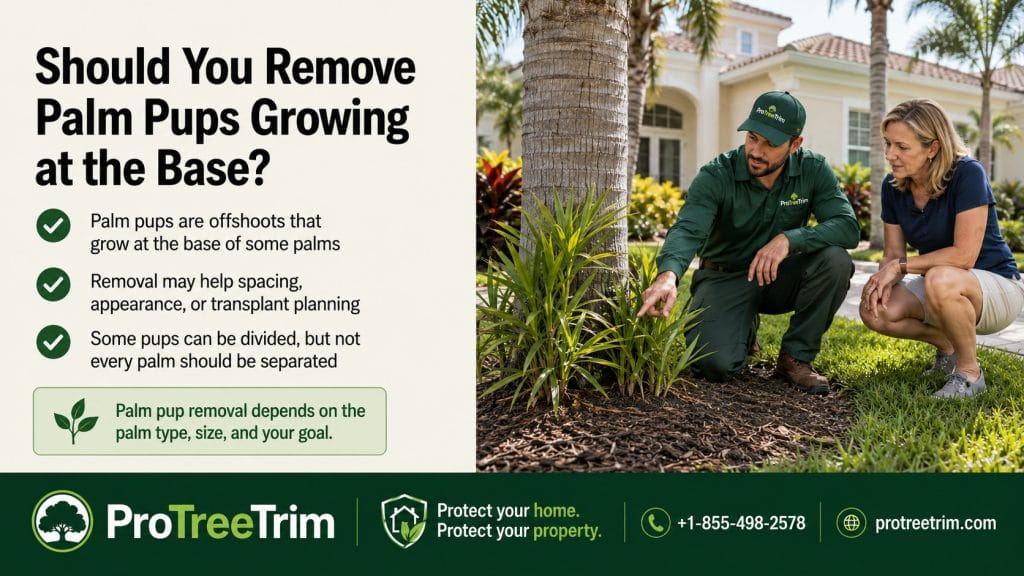
Palm pups, also called offshoots or suckers, are small new palm shoots that grow from the base of certain palms. They can be normal for some palm types, but they are not always something homeowners should keep. A palm pup in the right place may become part of a fuller landscape. A pup growing against a trunk, walkway, pool deck, driveway, or house wall can become crowded, messy, or difficult to remove later.
First, Know Whether Your Palm Naturally Produces Pups
Not every palm grows the same way. Some palms naturally form clusters or send up offshoots around the base. Others are meant to grow as a single trunk. Seeing a new shoot at the base does not automatically mean something is wrong, but it does mean you should look at the palm’s growth habit and the location.
| What you see | What it may mean |
|---|---|
| One small shoot near the base | May be a normal offshoot on some palms |
| Several shoots forming a cluster | Palm may naturally grow in a clumping habit |
| Pups crowding a walkway | Future access and cleanup problem |
| Pups growing against the house | Poor long-term placement |
| Pups near pool pavers | Future root, debris, and access concern |
| Pups after trunk damage or stress | Palm condition may deserve closer attention |
| Pups around an old palm stump | Remaining roots or growth may be involved |
The pup itself may be healthy. The question is whether it belongs where it is growing.
Do Not Keep Every Palm Pup Automatically
A small palm pup can look attractive at first. It may make the base look fuller and tropical. But over time, it can crowd the main palm, hide the trunk base, block airflow, trap debris, or grow into a space that was already tight.
This matters especially around:
- pool decks
- patios
- walkways
- driveways
- front entries
- AC units
- fences
- narrow side yards
- house walls
- irrigation heads
A pup growing in open landscape bed may be fine. A pup growing where people walk, park, or maintain equipment may become a problem.
Palm Pups Can Hide the Base of the Main Palm
The base of a palm should be visible enough to notice changes. If pups, mulch, weeds, or dense plants cover the trunk base, homeowners may miss early signs of trouble.
A crowded base can hide:
- trunk wounds
- soft or wet areas
- insect activity
- old frond bases
- irrigation spray hitting the trunk
- mulch piled too high
- soil covering the root area
- leaning or movement near the base
Keeping the base visible is especially useful near homes, pool cages, patios, and high-value outdoor spaces.
When Removing Palm Pups Makes Sense
Removal usually makes sense when the pup is in a poor location, crowding the main palm, or likely to become a future maintenance issue.
Consider removal when pups are:
| Pup location | Why removal may help |
|---|---|
| Beside a walkway | Prevents future crowding and tripping concerns |
| Near a driveway | Avoids access and debris issues |
| Against a house wall | Prevents tight growth and maintenance problems |
| Near pool pavers | Reduces future hardscape and cleanup concerns |
| Around AC equipment | Keeps airflow and service access open |
| At a front entry | Improves curb appeal and visibility |
| Along a fence | Avoids boundary and pruning issues |
| Under a main palm trunk | Prevents crowding and hidden base problems |
Small pups are usually easier to remove than larger ones. Waiting until they become woody, rooted, and crowded makes the work harder.
When You Might Keep Palm Pups
Keeping pups may make sense if the palm is naturally clumping, the pups have enough space, and the cluster improves the landscape without blocking access.
A pup may be worth keeping when:
- it grows in an open bed
- it does not crowd the main trunk
- it is not near hardscape
- it does not block walking or service access
- the palm species naturally forms clusters
- the homeowner wants a fuller tropical look
- future trimming access remains realistic
Even then, the cluster should be monitored. A natural clump can still become too dense if it traps debris, blocks irrigation, or grows into nearby structures.
Removing a Palm Pup Is Not Always Like Pulling a Weed
A very small pup may be easy to cut or remove. A larger pup may be attached firmly to the base or root system. Pulling, chopping, or digging carelessly can damage the main palm, nearby roots, irrigation lines, pavers, or surrounding plants.
Be careful if the pup is:
- large and woody
- tightly attached to the main palm
- growing between roots
- next to pavers or concrete
- near irrigation lines
- close to the house
- beside pool equipment
- part of a dense palm cluster
In those cases, removal should be planned rather than hacked out quickly.
Can Palm Pups Be Transplanted?
Sometimes, but not always successfully. Transplanting depends on the palm type, the pup’s size, whether it has its own roots, how it is attached, and whether it can be removed without damaging the parent palm.
Before trying to transplant a palm pup, ask:
- Does the pup have its own root system?
- Is it large enough to survive but small enough to move?
- Will removal injure the parent palm?
- Is the new planting spot suitable?
- Will the new location have enough space?
- Is this palm type commonly propagated from offshoots?
Do not transplant a pup just because it is free. If the new location is too close to a house, pool deck, driveway, fence, or utility area, you are simply moving the future problem.
Watch Irrigation Around Palm Pups
Palm pups often appear in watered beds, and irrigation can make the base area dense and wet. That may encourage weeds, fungal-looking growth, or debris buildup around the palm.
Check whether irrigation heads are spraying directly into the palm base or pup cluster. Constant moisture near the trunk area is rarely ideal, especially if mulch and old leaf bases are also holding damp material.
A cleaner base with visible soil, controlled mulch, and proper irrigation is usually easier to manage than a crowded wet clump.
Pool and Patio Areas Need Cleaner Decisions
Palm pups near pool areas deserve extra attention because pool landscapes are high-use spaces. A dense palm base can collect leaves, seeds, fronds, insects, and debris near pavers or screens. It can also make the area harder to clean.
If pups grow near a pool cage or deck, ask:
- Will they crowd the paver edge?
- Will they block walking space?
- Will they drop debris into the pool area?
- Will they hide irrigation leaks?
- Will they make future palm trimming harder?
- Will they grow into the screen enclosure?
A small pup may look tropical today and annoying later.
Do Not Confuse Pups With Volunteer Seedlings
Not every small palm-looking plant at the base is a true pup. Some may be volunteer seedlings from dropped palm fruit or seeds. Others may be unrelated weeds or landscape plants growing in the same bed.
A true pup is usually attached to or emerging from the parent palm’s base or root area. A seedling may be separate and easier to pull.
This matters because seedlings are usually easier to remove early. If you let them grow, they can become small palms in places you never intended to plant.
What to Do Before Removing Pups
Before cutting or digging, clear the area visually. Move loose mulch away from the trunk base, identify irrigation lines if possible, and look at how the pup is attached.
A careful approach includes:
- removing loose debris first
- checking whether the pup is attached to the parent palm
- avoiding cuts into the main trunk
- protecting nearby roots and irrigation
- cutting small unwanted shoots early
- avoiding deep digging near hardscape
- cleaning up debris after removal
- watching whether new shoots return
If the palm is valuable, large, or close to structures, get help before removing large attached pups.
When Pups May Signal a Bigger Issue
Palm pups are often normal, but pay closer attention if they appear along with palm stress.
Look closer if you see:
- crown thinning
- sudden leaning
- trunk wounds
- many fronds browning quickly
- soft or wet trunk areas
- pests or sawdust-like material
- heavy seed drop and volunteer seedlings
- old stump regrowth nearby
- irrigation soaking the base constantly
In that situation, removing the pups may improve appearance, but it may not address the main palm-health question.
Final Homeowner Takeaway
Palm pups are not automatically bad. On some palms, they are normal and may even add a fuller look. But homeowners should not keep them blindly.
Remove pups that crowd walkways, driveways, pool decks, AC units, fences, house walls, or the base of the main palm. Keep them only when they have room, fit the palm’s natural habit, and will not create future maintenance or access problems.
If you are unsure whether palm pups should be removed, transplanted, or left as part of the landscape, ProTreeTrim can help connect homeowners with local tree service support. Call +1-855-498-2578 or visit protreetrim.com.
FAQs
Are palm pups normal?
Yes, on some palm types. Certain palms naturally form offshoots or clusters, while others are usually single-trunk palms.
Should palm pups be removed?
Remove them if they crowd the main palm, block access, grow near hardscape, or appear in a place where a future palm would not fit.
Can you transplant palm pups?
Sometimes, if the pup has enough roots and can be separated without damaging the parent palm. Not every palm pup transplants well.
Can palm pups damage pavers or pool decks?
A small pup may not cause immediate damage, but if it grows in a tight hardscape area, future roots, trunk expansion, and debris can become problems.
ProTreeTrim™ can help you take the next step.
If you are dealing with a damaged tree, fallen branch, stump, root issue, palm concern, or storm cleanup question in Florida, call ProTreeTrim for tree service support.