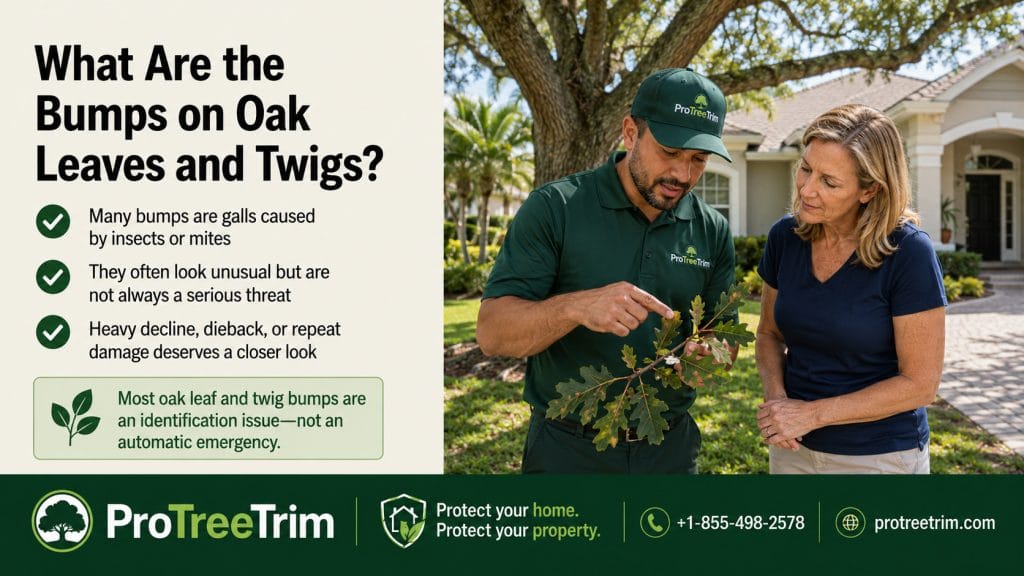
Bumps on oak leaves, twigs, or small branches are often called galls. They can look strange, ugly, or alarming, especially when they appear suddenly. In many cases, oak galls are more of a cosmetic issue than a serious tree problem. But homeowners should still look at the whole tree before deciding everything is harmless.
Oak Galls Can Look Worse Than They Are
Oak galls may appear as round balls, fuzzy patches, hard lumps, raised spots, or odd growths on leaves and twigs. They are often caused by insects or mites interacting with the tree’s tissue. The tree grows around the irritation, forming the gall.
That can look dramatic, but a few galls do not usually mean the oak is dying.
| What you see | What it may mean |
|---|---|
| Small bumps on leaves | Often leaf galls and usually cosmetic |
| Round balls on twigs | May be twig galls |
| Fuzzy or woolly-looking patches | Could be a type of leaf gall |
| Many galls on a few branches | Worth monitoring, not immediate panic |
| Galls plus dead twigs | Look closer at branch health |
| Galls plus canopy thinning | More than gall activity may be involved |
| Galls near roof or driveway limbs | Tree structure matters more than the bumps |
The galls themselves may look unusual, but the tree’s overall condition matters more.
Look at the Whole Oak, Not Just the Bumps
A homeowner can easily focus on the strange growth and miss bigger clues. Step back and look at the full oak.
Is the canopy mostly full? Are new leaves growing normally? Are there large dead limbs? Is one side thinning badly? Are branches over the roof, driveway, pool cage, or walkway? Are there trunk cracks, mushrooms near the base, or roots lifting hardscape?
A few bumps on leaves are one issue. A declining oak with galls, dead limbs, and root problems is a different situation.
Pay closer attention if you see:
- large dead branches
- twig dieback across the canopy
- thinning that does not recover
- bark peeling or cracking
- mushrooms near the trunk base
- sawdust-like material
- new leaning after heavy rain
- branches touching the roof or gutters
- repeated large limb drop
If those signs are present, the galls may not be the main problem.
Leaf Galls Are Usually Less Concerning
Galls on leaves often look strange but may not seriously affect a mature oak. Leaves can still function unless the infestation is heavy enough to distort large portions of the canopy.
If the oak is otherwise healthy, leaf galls may simply be something to notice and monitor. They may come and go seasonally. Some years may be worse than others.
Homeowners should avoid overreacting with random sprays, heavy pruning, or unnecessary branch removal just because leaves look bumpy.
A better response is:
- photograph the affected leaves
- monitor whether new growth looks normal
- rake heavy fallen leaf debris if needed
- avoid stressing the tree with unnecessary pruning
- check whether other symptoms are present
- focus on tree health and site conditions
Twig Galls Deserve More Attention
Galls on twigs or small branches may matter more than leaf galls, especially if they are numerous or associated with dieback. A few twig galls may still be manageable, but heavy galling can make small branches look swollen, distorted, or weak.
Look for whether the twig beyond the gall is still alive. If branch tips are dying, breaking, or thinning across larger areas, the oak may need a closer look.
Twig galls become more important when they appear on branches over:
- driveways
- walkways
- roofs
- patios
- pool cages
- fences
- outdoor seating areas
- parked vehicle areas
The location does not make the gall more dangerous by itself, but it changes how much branch dieback matters.
Do Not Prune an Oak Aggressively Just Because of Galls
Pruning is rarely the first answer for simple leaf galls. Cutting branches just because they have bumps can remove healthy canopy and create unnecessary wounds.
Pruning may be reasonable when branches are dead, cracked, broken, rubbing, or clearly declining. It may also make sense if twig galls are concentrated on small dead branches that can be removed cleanly.
But avoid:
- topping the oak
- stripping the canopy
- removing large healthy limbs
- cutting every branch with visible galls
- pruning just to make leaves look cleaner
- making large cuts during a stress period
A mature oak should not be punished for a cosmetic leaf issue.
Tree Stress Can Make Symptoms Look Worse
An oak that is already stressed may show multiple symptoms at once: galls, leaf spots, early leaf drop, small leaves, twig dieback, dead branches, or thinning canopy. In that case, the problem may not be only insects or galls.
Stress can come from:
- drought
- standing water
- root damage
- soil compaction
- driveway or paver work
- grade changes
- too much mulch
- construction traffic
- storm damage
- poor drainage
- heavy pruning
If the oak started looking worse after yard work, trenching, paver installation, or flooding, look at the root zone too.
Should You Treat Oak Galls?
For many homeowner situations, treatment is not practical or necessary, especially once galls are already visible. By the time you see the bump, the gall has already formed.
The better approach is usually monitoring and tree health support:
- avoid unnecessary pruning
- keep mulch reasonable and off the trunk
- avoid soil compaction under the canopy
- protect roots during construction
- water appropriately during dry periods if needed
- avoid piling soil over roots
- keep mowers and string trimmers away from trunk flare
- watch for dead limbs or canopy decline
If the gall problem is severe, recurring, or paired with branch dieback, it may be worth getting a tree-specific opinion before trying chemical treatment.
What Homeowners Should Photograph
Photos can help you track whether the issue is mostly cosmetic or getting worse.
Take pictures of:
- close-up galls on leaves or twigs
- full canopy from several angles
- branch tips with dieback if present
- trunk base and root flare
- branches over roof, driveway, pool cage, or walkway
- fallen leaves or twigs
- any cracks, mushrooms, wounds, or bark loss
- recent construction, pavers, or soil changes nearby
Good photos make it easier to compare the tree in a few weeks or months.
When Galls Are Mostly a Cosmetic Issue
Galls are usually less concerning when:
- the oak canopy remains full
- new leaves look healthy
- there are no large dead limbs
- only some leaves are affected
- twig dieback is limited or absent
- the trunk and root area look stable
- the tree is not near high-risk targets
- the issue appears seasonal
In that case, the homeowner response may be simple observation and cleanup.
When to Look Closer
Look closer when galls appear along with signs of decline or when affected branches are over important areas.
Get more cautious if you see:
| Sign | Why it matters |
|---|---|
| Widespread twig dieback | May indicate more than cosmetic galls |
| Large dead limbs | Limb risk matters near structures |
| Canopy thinning | Tree stress may be broader |
| Root damage or exposed roots | Stability and health concerns may overlap |
| Mushrooms near trunk base | Possible decay concern |
| Cracks or cavities | Structural questions may exist |
| Branches over roof or driveway | Failure consequences are higher |
| Recent heavy pruning | Tree may already be stressed |
The galls may be the visible thing that gets your attention, but they may not be the main issue.
Final Homeowner Takeaway
Bumps on oak leaves and twigs are often galls, and many gall problems are mostly cosmetic. A healthy mature oak can usually tolerate some galls without needing major action.
The smart move is to look at the whole tree. If the canopy is full, new growth is present, and there are no dead limbs, cracks, mushrooms, or root concerns, monitoring may be enough. If galls appear with dieback, thinning, dead branches, or property-risk areas, the oak deserves a closer look.
If you are unsure whether bumps on your oak are harmless galls or part of a larger tree-health problem, ProTreeTrim can help connect homeowners with local tree service support. Call +1-855-498-2578 or visit protreetrim.com.
FAQs
Are bumps on oak leaves dangerous?
Often no. Many bumps on oak leaves are galls and are mostly cosmetic on otherwise healthy trees.
Do oak galls mean the tree is dying?
Not by themselves. Worry more if galls appear with canopy thinning, dead branches, twig dieback, cracks, mushrooms, or root problems.
Should I prune branches with oak galls?
Not usually for leaf galls alone. Pruning may make sense if branches are dead, cracked, broken, or clearly declining.
Can oak galls be treated after they appear?
Often, treatment is not useful once galls are visible. Monitoring, reducing stress, and checking overall tree health are usually better first steps.
ProTreeTrim™ can help you take the next step.
If you are dealing with a damaged tree, fallen branch, stump, root issue, palm concern, or storm cleanup question in Florida, call ProTreeTrim for tree service support.