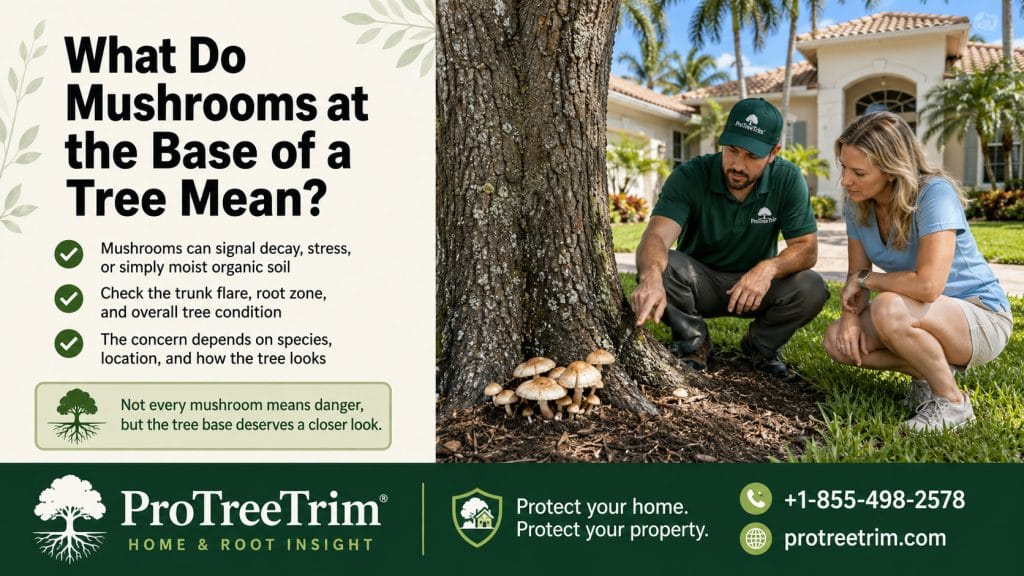
Mushrooms at the base of a tree can mean several different things. Sometimes they are growing from old buried wood, mulch, stump roots, or decaying organic matter in the soil. Other times, they may be connected to root decay, trunk decay, or a fungal problem affecting the tree itself.
The important question is not only “What kind of mushroom is this?”
It is “Is the mushroom growing from harmless debris, or is it growing from the tree’s roots, trunk base, or root flare?”
Mushrooms Are a Clue, Not a Diagnosis by Themselves
A mushroom near a tree does not automatically mean the tree is dangerous. Fungi naturally break down dead wood and organic matter. If an old stump, buried root, wood chip layer, or decaying mulch is present, mushrooms may appear after rain or humid weather.
But mushrooms growing directly from the trunk, root flare, exposed roots, or soil right against the tree base deserve more attention.
| Where mushrooms appear | What it may suggest |
|---|---|
| In mulch away from trunk | Often decaying organic matter |
| From old stump area | Old stump or roots are breaking down |
| On exposed roots | Root decay may be possible |
| At trunk base | More concerning; root or trunk decay may be involved |
| On the trunk itself | Serious decay concern |
| Around a declining tree | Tree health issue may be present |
| After heavy rain only | Moisture may be triggering visible fruiting bodies |
The location matters more than the mushroom alone.
Why Mushrooms Show Up After Rain
Mushrooms often appear after wet weather because moisture helps fungi produce visible fruiting bodies. The fungus itself may have been present before the mushroom appeared. Rain simply makes it visible.
This is common after:
- heavy rain
- humid weather
- irrigation changes
- mulch staying wet
- soil staying soggy
- drainage problems
- storm damage
- stump grinding
- tree removal
- decaying root activity underground
A mushroom can appear suddenly, but the decay process may have been developing for a long time.
Mushrooms in Mulch Are Usually Less Concerning
If mushrooms are growing in mulch several inches or feet away from the trunk, they may simply be breaking down organic material. Mulch is made of wood and bark, so fungi are naturally part of decomposition.
Mulch mushrooms are less concerning when:
- the tree canopy looks healthy
- mushrooms are not attached to the trunk
- the root flare is visible
- there are no trunk cracks
- no large dead limbs are present
- the tree is not leaning
- soil does not stay soggy
- mulch is not piled against the bark
The fix may be as simple as correcting mulch depth and keeping it away from the trunk.
Mushrooms at the Trunk Base Are More Serious
Mushrooms growing directly at the base of the tree are more concerning. This is where the trunk transitions into the major roots. Decay in this area can affect health and stability.
Be more cautious when mushrooms are:
- touching the trunk
- growing from the root flare
- growing from large exposed roots
- recurring in the same spot
- forming shelf-like growths on the trunk
- appearing with soft or hollow wood
- paired with canopy decline
- near a leaning tree
A tree can have green leaves and still have decay at the base.
Mushrooms on the Trunk Should Not Be Ignored
If fungal growth is attached to the trunk, especially near the lower trunk or root flare, it deserves attention. Mushrooms or shelf-like conks on the trunk may indicate decay inside the wood.
Warning signs include:
| Sign | Why it matters |
|---|---|
| Shelf fungus on trunk | Internal decay may be present |
| Soft wood near fungus | Structural strength may be reduced |
| Bark falling around fungus | Tissue may be dead or damaged |
| Hollow sound near base | Decay may be advanced |
| Crack near fungal growth | Structural concern increases |
| Oozing or dark staining | Tree stress or decay possible |
| Canopy thinning above | Root/trunk function may be affected |
Do not scrape off the fungus and assume the problem is solved. The visible growth may be only the outside sign.
Old Stumps and Buried Roots Can Produce Mushrooms
If a tree was removed nearby, mushrooms may grow where old roots and stump material are decomposing. This can happen even after stump grinding because many roots remain underground and decay over time.
This is common when:
- a stump was recently ground
- wood chips were left in the soil
- old roots remain under the lawn
- soil stays damp
- the stump hole was filled unevenly
- mushrooms appear in a circle or line where roots were
- the original tree was large
In this case, mushrooms may be part of normal wood decay. But if a living tree nearby also shows decline, the situation deserves a closer look.
Mushrooms Plus Canopy Decline Is a Bigger Warning
Mushrooms alone may be harmless. Mushrooms plus canopy decline are more concerning. The tree may be losing root function, trunk strength, or overall health.
Look for:
- thinning canopy
- smaller leaves
- early leaf drop
- dead branches
- dead top
- one-sided dieback
- branch tips dying back
- reduced growth
- bark peeling
- increased deadwood
If the tree is declining above ground and mushrooms are appearing at the base, the issue may be more than mulch decomposition.
Mushrooms Plus Leaning Is Serious
A leaning tree with mushrooms at the base should be treated seriously. A lean can come from many causes, including natural growth habit, wind exposure, soil conditions, or root movement. But mushrooms near the base can raise concern about root or trunk decay.
Be more cautious when the lean is:
- new
- getting worse
- toward a house
- toward a driveway
- toward a walkway
- paired with soil lifting
- paired with exposed broken roots
- paired with trunk cracks
- paired with canopy dieback
If a tree is leaning toward a target and mushrooms are near the base, do not wait too long to get it evaluated.
Mushrooms Plus Soil Lifting Can Indicate Root Movement
Soil lifting on one side of a tree can be a warning sign that roots or the root plate are moving. If mushrooms are also present, the concern increases.
Check for:
- raised soil near the base
- cracks in the ground
- exposed roots that look broken
- new gaps around roots
- leaning after rain or wind
- soft soil around the trunk
- wet ground that stays saturated
Root decay and soil instability can be a dangerous combination.
Wet Soil Can Encourage Fungal Activity
Poor drainage does not automatically mean decay, but constantly wet soil can stress roots and encourage fungal activity. Roots need oxygen. When soil stays saturated, root health can decline.
Check drainage around the tree:
- Does water pool near the trunk?
- Do downspouts empty near the root zone?
- Is irrigation soaking the base?
- Is mulch holding moisture against bark?
- Is the tree in a low spot?
- Did grading change recently?
- Does the area stay soggy after rain?
Correcting water problems may be part of protecting the tree.
Mulch Volcanoes Can Hide Decay
Mulch piled high against the trunk can trap moisture, hide root flare problems, and make it harder to see mushrooms, soft wood, girdling roots, or decay.
Bad mulch habits include:
- mulch touching the trunk
- mulch piled several inches deep
- old mulch stacked year after year
- root flare completely hidden
- mulch forming a cone around the tree
- wet mulch packed against bark
A good mulch bed should be wide and shallow, with mulch pulled away from the trunk.
Do Not Just Kick or Remove the Mushrooms
Removing mushrooms may make the yard look cleaner, but it does not remove the underlying fungus or decay source. The mushroom is the visible fruiting body. The real fungal activity may be in wood, roots, or soil.
You can remove mushrooms for appearance or pet/child safety, but do not assume the tree is now fine.
Instead, check:
- where the mushrooms were attached
- whether wood is soft
- whether mushrooms return
- whether the canopy is healthy
- whether the tree leans
- whether the root flare is visible
- whether large limbs are dead
The mushroom is a signal to inspect, not the whole problem.
Do Not Spray Random Fungicide on the Tree
Spraying mushrooms or soil with a random fungicide is usually not the right first response. If decay is already inside roots or trunk wood, surface spraying will not rebuild structural strength.
Before using any product, ask:
- What fungus is actually present?
- Is it growing from mulch or the tree?
- Is the tree structurally affected?
- Is the canopy declining?
- Is drainage the underlying issue?
- Would treatment change the risk?
- Is removal or monitoring more realistic?
For many decay-related situations, the key decision is structural safety, not surface treatment.
Mushrooms Near Oaks
Large oaks may carry internal decay while still looking leafy. Mushrooms near the base of an oak deserve attention, especially if the tree is mature and near a house, driveway, patio, or walkway.
With oaks, watch for:
- large dead limbs
- canopy thinning
- trunk cavities
- mushrooms near root flare
- cracks at major unions
- hollow areas
- branches over targets
- history of storm damage
A mature oak with base mushrooms near a home should not be dismissed casually.
Mushrooms Near Pines
Pines can decline from root stress, pests, disease, storm damage, or site conditions. Mushrooms near a pine base may indicate buried wood decay or more serious root concerns depending on location.
Be more cautious if the pine has:
- brown top
- thinning crown
- bark peeling
- large dead branches
- pitch or oozing
- holes or sawdust-like material
- lean toward a structure
- mushrooms at the root flare
A pine with a dead top and mushrooms at the base deserves prompt attention.
Mushrooms Near Palms
Palms are different from branching trees, but mushrooms or fungal growth near the base can still be a warning. The concern depends on whether the fungus is in mulch, old buried wood, or connected to palm trunk/base decay.
Check for:
- soft trunk areas
- leaning palm
- crown decline
- loose or damaged trunk tissue
- fruiting bodies at base
- wet soil around the palm
- fronds declining unusually
- root-zone disturbance
A palm that is leaning or soft at the base should be evaluated quickly.
Mushrooms After Stump Grinding
Mushrooms after stump grinding are common because underground roots and leftover wood chips are decomposing. This is usually expected, especially after rain.
You may see:
- mushrooms in the old stump area
- soft spots as roots decay
- soil settling
- wood chips mixed with soil
- mushrooms in a line where roots remain
- temporary fungal activity in mulch
This is different from mushrooms at the base of a living tree, but if nearby living trees are also declining, the area should be checked.
Mushrooms and Tree Removal Decisions
Mushrooms do not always mean a tree must be removed. But they can become part of the removal discussion when they appear with decay, instability, or decline.
Removal may need discussion when:
| Situation | Why removal may be considered |
|---|---|
| Mushrooms at trunk base | Root or trunk decay possible |
| Tree is leaning | Stability concern |
| Large dead limbs present | Falling branch risk |
| Trunk is hollow or soft | Structural strength may be reduced |
| Canopy is thinning | Tree health may be declining |
| Tree is near house or driveway | Consequences are higher |
| Soil is lifting around roots | Root movement concern |
| Decay signs recur yearly | Problem may be ongoing |
The closer the tree is to people or property, the less room there is for guessing.
When Monitoring May Be Reasonable
Monitoring may be reasonable when mushrooms are clearly in mulch or old stump material and the living tree appears healthy.
Monitoring may fit when:
- mushrooms are away from the trunk
- canopy is full and normal
- no dead limbs are present over targets
- no lean is developing
- root flare is visible
- wood at the base feels firm
- drainage is not excessive
- mushrooms appear only seasonally in mulch
Even then, take photos so you can compare changes later.
When to Act Quickly
Do not wait if mushrooms appear with obvious risk signs.
Act sooner when:
- the tree leans toward a house
- soil is lifting near roots
- large limbs are dead or hanging
- the trunk is cracked
- wood at the base is soft
- mushrooms grow directly from the trunk
- canopy is rapidly thinning
- the tree is near a driveway, roof, patio, or walkway
This is especially important after storms or heavy rain.
What Homeowners Should Photograph
Photos help track whether the issue is changing.
Take photos of:
- mushrooms close up
- where they attach
- full tree from several angles
- trunk base and root flare
- any lean
- canopy condition
- dead branches
- cracks or cavities
- soil lifting or wet areas
- nearby house, driveway, patio, or sidewalk
Repeat photos if mushrooms return after rain.
What to Do First
A practical first response:
- Do not panic.
- Note exactly where the mushrooms are growing.
- Check whether they are in mulch, stump remains, roots, or trunk tissue.
- Pull mulch away from the trunk if it is piled high.
- Check canopy health.
- Look for lean, soil lifting, cracks, or soft wood.
- Photograph the tree and mushrooms.
- Get help if mushrooms are attached to the tree or paired with decline.
The goal is to understand the source before deciding what to do.
Final Homeowner Takeaway
Mushrooms at the base of a tree can be harmless decay in mulch or old buried roots, but they can also signal root or trunk decay. The difference depends on location, tree condition, drainage, root flare visibility, lean, canopy health, and nearby targets.
Mushrooms growing directly from the trunk, root flare, or large roots should be taken seriously. If they appear with leaning, dead limbs, canopy thinning, trunk cracks, soft wood, or soil lifting, the tree may need prompt evaluation.
If you are unsure whether mushrooms near your tree are normal decay, a root problem, or a removal-level warning sign, ProTreeTrim can help connect homeowners with local tree service support. Call +1-855-498-2578 or visit protreetrim.com.
FAQs
Are mushrooms at the base of a tree bad?
Sometimes. Mushrooms in mulch or old stump material may be normal decay. Mushrooms growing from the trunk, root flare, or roots are more concerning.
Should I remove mushrooms growing near my tree?
You can remove them for appearance, but that does not remove the underlying fungus or decay source. Check where they are growing from.
Do mushrooms mean a tree is dying?
Not always. But mushrooms paired with canopy decline, lean, trunk cracks, soft wood, or dead limbs can indicate a serious problem.
Can a tree with mushrooms at the base fall?
It depends on whether decay affects roots or trunk structure. If the tree is leaning or near a house, driveway, or walkway, get it checked.
ProTreeTrim™ can help you take the next step.
If you are dealing with a damaged tree, fallen branch, stump, root issue, palm concern, or storm cleanup question in Florida, call ProTreeTrim for tree service support.